Choosing a Heavy-Duty Vehicle Lift for Your Shop
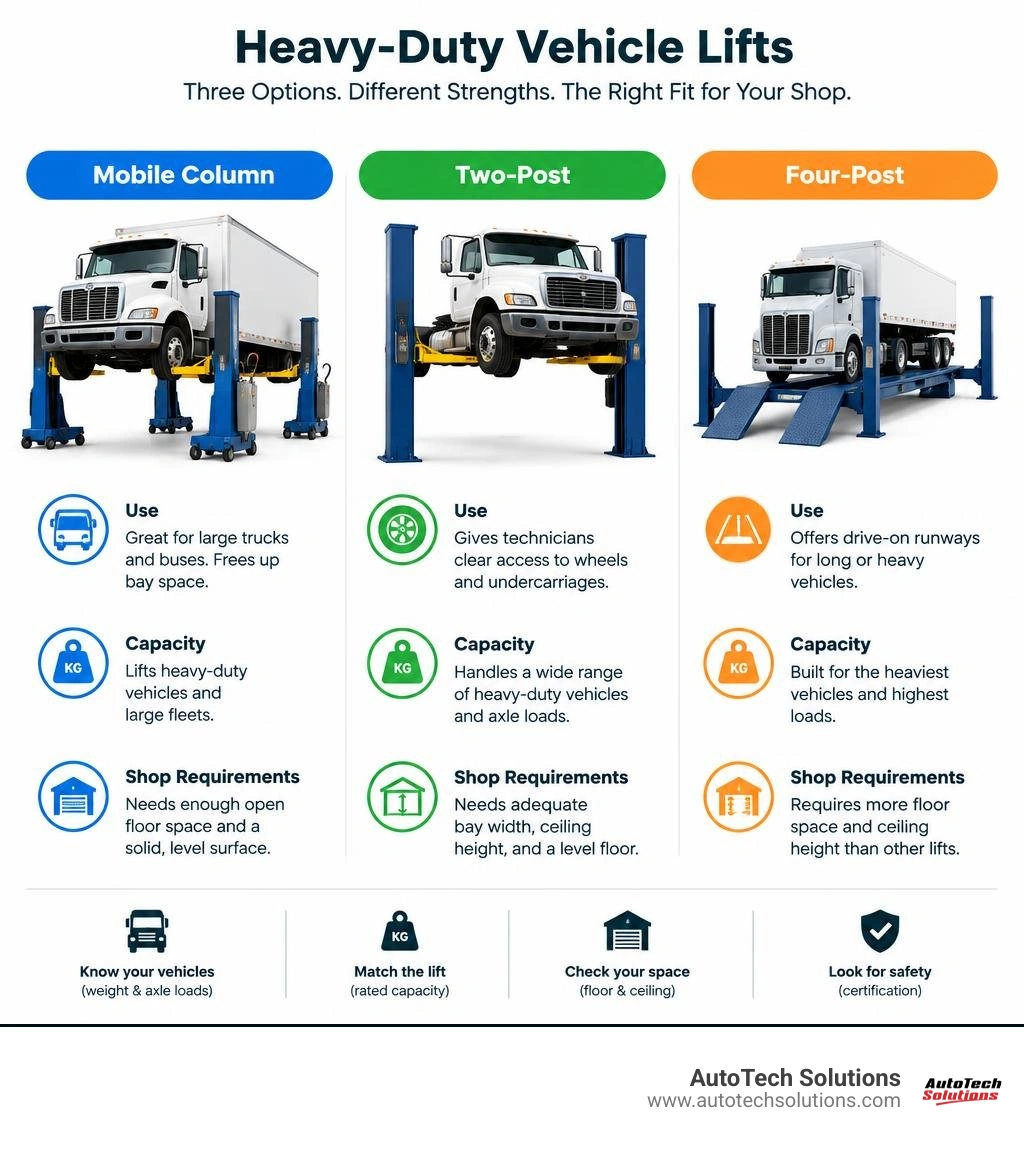
Start with the vehicles you service and the work your technicians do. Mobile column lifts free up bay space and can lift large trucks or buses. Heavy-duty two-post lifts give technicians clear access to wheels and undercarriages. Four-post lifts offer drive-on runways for long or heavy vehicles. Before comparing models, check each vehicle's weight and axle loads, the lift's rated capacity, your floor and ceiling space, and the model's safety certification.
The right choice should keep vehicles moving through the shop without adding avoidable downtime. We're AutoTech Solutions Staff, and we'll compare the options with that goal in mind.
Explore more about heavy duty vehicle lift:
Core Types of Heavy Duty Vehicle Lift Systems for Commercial Shops
Choosing the right commercial hoisting architecture is the most important equipment decision a fleet maintenance facility, municipal garage, or commercial truck center will make. The right hoisting setup boosts bay efficiency, keeps technicians safe, and accommodates changing fleet weights. Selecting the wrong platform leads to chronic bay bottlenecks, underutilized footprint, and costly equipment downtime.

Commercial lifting systems fall into three primary categories: mobile column lifts, fixed heavy-duty two-post hoists, and heavy-duty four-post runway platforms. Selecting among them depends on your shop layout, vehicle wheelbase diversity, and undercarriage service demands. Exploring our specialized heavy duty auto lift configurations helps clarify how each format meets different commercial bay demands.
| Lift Architecture | Rated System Capacities | Bay Footprint & Mobility | Primary Commercial Applications |
|---|---|---|---|
| Mobile Column Sets | 20,000 lbs. to 114,000+ lbs. (2 to 8 columns) | Fully portable, minimal storage footprint, flexible bay allocation | Municipal transit buses, motorcoaches, multi-axle fire apparatus, utility trucks |
| Heavy-Duty 2-Post Hoists | 10,000 lbs. to 20,000 lbs. | Fixed footprint, open floor design, overhead crossbeam | Class 1–5 commercial vans, utility service trucks, ambulances, complete wheel-free service |
| Heavy-Duty 4-Post Hoists | 18,000 lbs. to 60,000+ lbs. | Large dedicated bay footprint, fixed continuous runways | Class 6–8 highway tractors, straight trucks, school buses, quick drive-on PM inspections |
Mobile Column Lift Configurations (Wired vs. Wireless)
Mobile column lifts are the most adaptable hoisting solution for commercial facilities servicing diverse heavy fleets. Because these systems engage the vehicle by its tires rather than frame lifting points, setup is fast across varying axle widths and vehicle profiles.

Commercial column setups are configured in paired sets of 2, 4, 6, or 8 units depending on vehicle axle counts and gross weight:
- Two-Column Pairing: Delivers lifting capacities between 10,000 lbs. and 38,000 lbs., ideal for axle-specific servicing or light commercial apparatus.
- Four-Column Systems: Provide comprehensive lifting capabilities from 20,000 lbs. up to 76,000 lbs., making them the standard choice for tandem-axle delivery fleets, box trucks, and city buses.
- Six-to-Eight Column Systems: Expand capacity from 78,000 lbs. to over 114,000 lbs., providing synchronized lifting for articulated transit buses, heavy fire engines, and multi-axle vocational trucks.
Modern mobile systems are available in wired or wireless network configurations. Wired setups link each column through heavy-duty interconnect cables that provide power and communication data. Wireless units operate on onboard deep-cycle AGM 12-volt battery systems and communicate via secure industrial wireless frequencies.
Wireless columns eliminate cables across shop floors, removing tripping hazards and speeding up bay staging. When work is finished, technicians can roll the columns into a dedicated storage corner with hydraulic pallet-jack handles, turning a heavy lifting bay back into open floor space.
Fixed 2-Post and 4-Post Heavy Duty Hoists
Fixed hoisting infrastructure is the backbone of high-volume fleet turnaround. For fast drive-on preventative maintenance, fleet facilities rely heavily on a rugged 4 post vehicle lift. These platforms feature continuous structural steel runways, diamond-plate anti-skid surfaces, and single-point air-actuated lock releases. Extended-length models, featuring capacities of 27,000 lbs. or more with extended 300-plus-inch runways, easily support long wheelbases on Class 7 semi-trucks, city transit buses, and extended commercial chassis.
For technicians needing wheel-free access for brake, suspension, and steering work, heavy-duty frame-engaging two-post lifts provide an open floor. Premium heavy-duty two-post lifts offer capacities starting at 12,000 lbs. with three-stage front and rear arms, adjustable height ranges from 13' 2" to 13' 8", and width extensions that accommodate broad delivery chassis.
For high-demand mixed-vehicle commercial shops, high-capacity models deliver heavy-duty structural steel designs capable of lifting commercial service vehicles day after day. Fixed heavy-duty four-post models range from 18,000 lbs. up to 60,000 lbs. for commercial facilities servicing heavy municipal transport.
Critical Engineering and Facility Specifications
Installing a commercial lifting system requires evaluating your building's structural and electrical infrastructure. Commercial lifts handle immense static and dynamic loads; proper facility engineering ensures safety, code compliance, and reliable operation.

Sizing Your Heavy Duty Vehicle Lift by Fleet Class and Weight Capacity
Proper lift sizing requires matching hoist capacity to your fleet's actual axle weight distribution rather than average curb weight. Commercial trucks carry uneven loads across front steer axles and rear tandem drive axles. A Class 8 tractor-trailer or loaded refuse vehicle may place 70% of its total weight over the rear drive bogies.
When sizing equipment:
- Determine Maximum GVWR: Identify the heaviest vehicle class entering the service bay, factoring in auxiliary bodies, cranes, and payload margins.
- Account for Wheelbase Length: Ensure 4-post runways fully support the vehicle's outer tire track without overhang, or that mobile column lift forks align safely with tire diameters ranging from 19.5 to 24.5 inches.
- Include a Safety Operating Buffer: We recommend sizing equipment capacity at least 15% to 20% above your heaviest planned fleet unit to account for dynamic loading and heavy equipment accessories.
Concrete Slab Thickness, Ceiling Heights, and Bay Dimensions
Concrete slab strength is critical for safe lift anchoring. While light-duty automotive hoists often require only 4 inches of standard concrete, heavy-duty commercial hoists require substantial structural support:
- Slab Thickness: Fixed heavy-duty 2-post and 4-post installations require a minimum concrete thickness of 6 to 8 inches of reinforced, uncracked slab rated at 3,000 to 4,000 PSI.
- Anchor Embedment: Structural anchor bolts must meet strict embedment depth and edge distance specifications. Anchoring too close to expansion joints or slab seams weakens load-holding capability.
- Surface Levelness: Mobile column lifts require flat, level concrete across the operational envelope to prevent side-loading on column guide tracks.
- Overhead Clearances: Bay height must account for maximum lift travel plus the overall vehicle height. For tall commercial step vans and municipal buses, bays require clear ceiling heights of 16 to 22 feet, keeping lighting, overhead radiant heat, and shop-level exhaust extraction ducting out of the vehicle envelope.
Facility design requires comprehensive layout planning. Reviewing our commercial garage equipment planning guide will help your team optimize traffic patterns, service aisles, and utility supply lines before equipment arrives.
Electrical Power Units and Hydraulic Synchronization
Commercial lifts use powerful electro-hydraulic pump assemblies engineered for consistent duty cycles. Heavy-duty 2-post and 4-post systems generally run on dedicated 208–230V single-phase or 230–460V 3-phase circuits. Modern hydraulic power units feature optimized electric motors that reduce amp draw (often lowering breaker requirements from 30A to 20A), reducing infrastructure installation costs.
Hydraulic valving and column synchronization are critical safety elements when lifting multi-axle commercial vehicles:
- Variable-Synchro Systems: Advanced 4-post systems use variable-synchro hydraulic valving that balances fluid delivery between front and rear cylinders. This prevents platform tilting when hoisting trucks with uneven axle weights.
- Electronic Column Synchronization: Mobile column networks use microprocessor-controlled leveling systems. If one column deviates by more than a fraction of an inch due to load differences, the central control system immediately adjusts hydraulic flow to re-level all columns.
- Controlled Descent Valving: Flow-control velocity fuses prevent unmanaged descent in the unlikely event of sudden hydraulic pressure loss.
Evaluating Safety Compliance, Accessories, and Shop Efficiency
Safety and productivity go hand in hand in a professional fleet maintenance shop. Equipping your bays with certified equipment and the right operational accessories speeds up repairs while protecting technicians under suspended vehicles.
Key Safety Certifications for Every Commercial Heavy Duty Vehicle Lift
Never compromise on lifting equipment certification. In commercial settings, third-party validation proves the hoist meets rigorous engineering and safety standards.
The Automotive Lift Institute (ALI) Gold Label is the industry standard for lift safety. ALI certification confirms that the lift model has undergone independent structural and functional testing by accredited laboratories (such as ETL/Intertek) to meet ANSI/ALI ALCTV standards. This testing verifies:
- Structural safety factors under full load testing
- Proper operation of primary mechanical safety locks
- Secondary anti-drop safety mechanisms
- Electrical system compliance with UL and CSA standards
For portable hydraulic shop equipment, verify compliance with ASME-PASE (Portable Automotive Service Equipment) standards. Installing certified equipment ensures shop compliance with OSHA regulations and protects your facility against liability risks.
Essential Accessories: Rolling Jacks, Adapters, and Ramp Extensions
A heavy-duty drive-on lift can handle diverse commercial service needs when paired with the right auxiliary equipment. Equipping four-post runways with air-hydraulic rolling jacks (rated from 9,000 to 25,000 lbs. capacity) enables complete wheel-free service for brake jobs, hub seal replacements, and suspension inspections.
Key productivity accessories include:
- Stack Adapter Extension Kits: Provide multi-height frame extensions for two-post lifts, ensuring secure pad contact around steps, fuel tanks, and side-mounted utility toolboxes.
- Drive-Through Pivoting Ramps: Extended approach ramps (36 to 72 inches) with diamond-plate traction ease approach angles for low-floor transit buses and loaded delivery vans.
- Integrated Oil Drain Pan Kits: Runway-mounted rolling drain pans slide under axles and transmissions, catching fluids directly without requiring technicians to balance standalone drain caddies.
- Heavy-Duty Wheel Balancers and Tire Changers: Pair your lifting infrastructure with dedicated heavy duty truck wheel balancer units to turn preventive maintenance bays into full-service tire and hub inspection stations.
To explore supplementary lifting equipment, view our guide on heavy duty jacks for professional shops.
Installation, Preventative Maintenance, and Total Cost of Ownership
Purchasing a heavy-duty lift is a long-term capital investment. Maximizing equipment lifespan, protecting technicians, and securing a fast return on investment requires professional installation and strict preventative maintenance.
Professional Installation Requirements and Turnkey Facility Buildouts
Installing multi-ton commercial vehicle lifts requires specialized rigging equipment, laser leveling, and certified anchor installation. Improperly torqued anchor bolts or uneven column shimming can cause guide block binding, premature cable wear, and hydraulic seal failure.
Working with an experienced installation partner guarantees that your equipment is safely aligned, plumbed, wired, and verified to factory torque specifications. Review our comprehensive car lift installation ultimate guide for details on site preparation, slab testing, and commissioning workflows.
Mitigating Equipment Downtime with Routine Maintenance Protocols
In fleet maintenance, equipment downtime directly affects operational revenue. When a primary service bay goes down, preventative maintenance schedules slip and vehicle turnaround times increase. Implementing structured preventative maintenance lift guide protocols prevents surprise breakdowns.
Effective maintenance routines should follow a structured schedule:
- Daily Operator Checks: Inspect hydraulic hoses for leaks, check mechanical lock engagement during lifting cycles, verify emergency stop buttons, and confirm wireless column battery charge levels.
- Monthly Lubrication & Tensioning: Lubricate column slide tracks, inspect equalizer cables and heavy-tensile leaf chains for elongation or wear, and clear debris from floor latch mechanisms.
- Annual ALI Certified Safety Inspections: Schedule annual structural, mechanical, and electrical safety inspections by certified lift technicians to ensure ongoing OSHA compliance and detect component wear early.
Applying proven strategies for how to reduce equipment downtime in an automotive shop protects your capital investment and keeps fleet vehicles running on schedule.
Frequently Asked Questions About Heavy Duty Vehicle Lifts
How thick must shop concrete be to support a mobile column or four-post lift?
Commercial heavy-duty four-post and fixed two-post lifts generally require a reinforced, cured concrete slab with a minimum thickness of 6 to 8 inches, rated at 3,000 to 4,000 PSI. For mobile column lifts, a level 6-inch solid concrete slab is required across the operating area to prevent floor deflection and side-loading on the columns. Always perform core drilling to verify slab thickness and structural integrity before anchoring fixed equipment.
What are the main operational advantages of wireless mobile columns over wired systems?
Wireless mobile columns communicate via secure industrial wireless networks and run on onboard 12V deep-cycle batteries, eliminating interconnect cables across the shop floor. This removes tripping hazards, prevents cable damage from heavy truck roll-overs, and allows fast positioning in any bay or outdoor concrete yard.
Why is ALI certification essential for commercial fleet lifts?
ALI (Automotive Lift Institute) certification provides third-party validation that a lift model meets strict ANSI/ALI ALCTV engineering standards. ALI certification tests structural integrity at 150% of rated capacity, validates automatic mechanical safety locks, and ensures electrical system safety. Utilizing ALI-certified lifts protects technicians, lowers shop liability, and satisfies OSHA inspection requirements.
Conclusion: Maximizing Fleet Bay Throughput and Safety
Investing in the right heavy-duty lifting equipment transforms commercial shop performance. Matching weight capacity, runway length, and column configurations to your fleet's needs helps reduce service bottlenecks, enhance technician safety, and lower your total cost of ownership.
At AutoTech Solutions, we are dedicated to maximizing shop productivity and minimizing equipment downtime. From facility layout design and certified equipment installation to preventative maintenance programs and rapid service across Michigan and the Carolinas (with regional support hubs in Novi, MI, Charlotte, NC, Raleigh, NC, and Wade, NC), our certified technicians keep your bays running at peak performance.
Explore our collision center solutions and fleet equipment services to equip your commercial service facility with dependable heavy-duty lifting systems.