Choose Wheel Alignment Equipment That Fits Your Shop Workflow
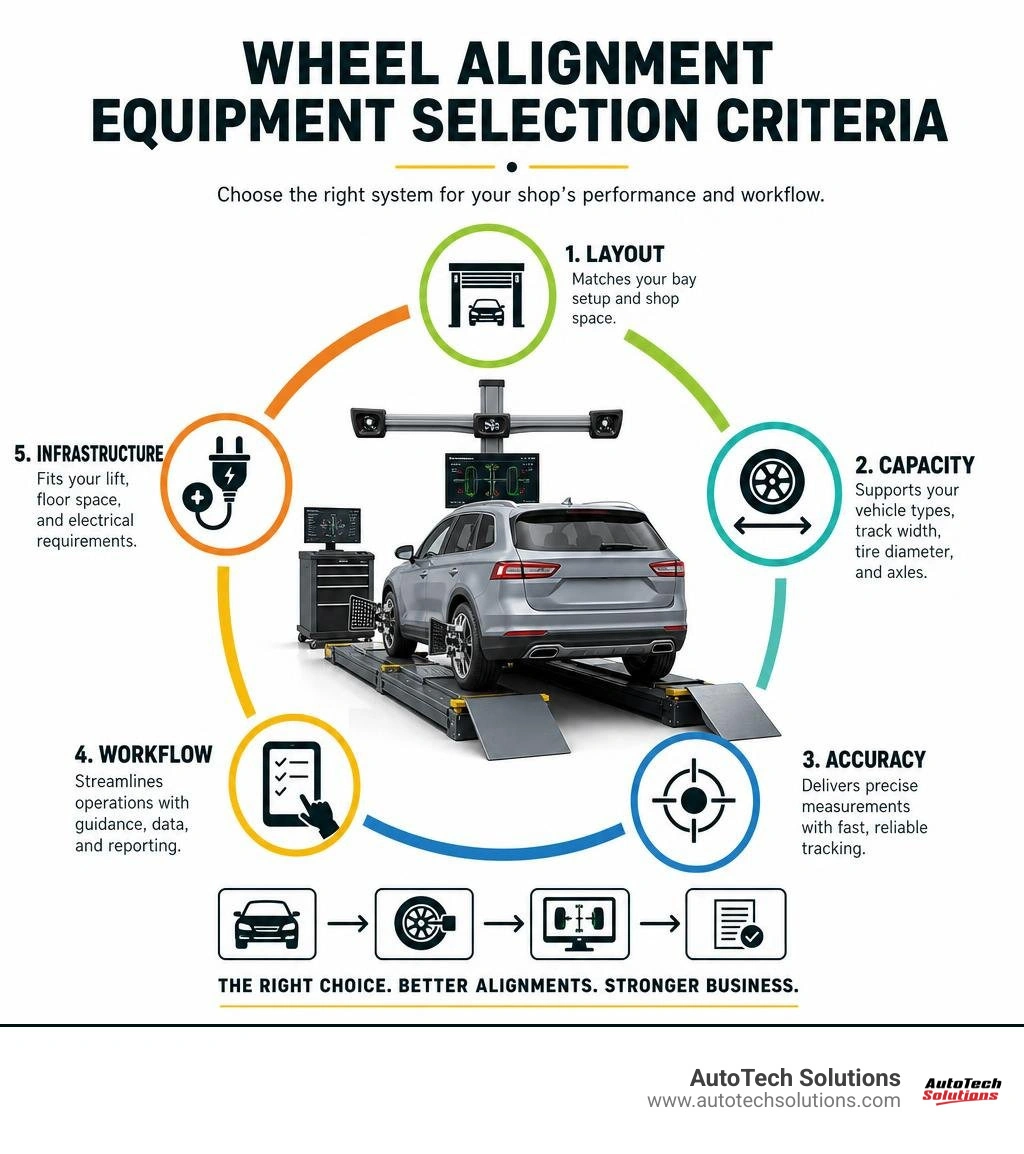
The best wheel alignment equipment matches your shop's bay layout, service mix, and required measurement range. Tower-based camera systems suit high-volume, dedicated alignment bays, while towerless systems offer more flexibility for multi-bay and commercial work. Before buying, compare:
- Configuration: fixed camera towers versus portable, towerless sensors
- Capacity: track width, tire diameter, and number of axles supported
- Accuracy and speed: automatic camera tracking, continuous calibration, and no-run-out clamps
- Workflow tools: tablet control, OEM adjustment data, guided procedures, and audit functions
- Infrastructure: lift compatibility, available floor space, and electrical requirements
Modern systems do more than display toe and camber readings. Camera tracking can follow lift height automatically, so technicians do not need to reset cameras after raising a vehicle. Mobile sensor systems can support long multi-axle combinations, while advanced software can guide adjustments and flag potential structural issues before work begins.
The right choice protects technician time, keeps alignment bays productive, and helps a commercial shop turn reliable measurements into profitable repair recommendations. AutoTech Solutions Staff will walk through the key comparisons that matter before selecting a system.
Architecture Comparison: Tower-Based vs. Towerless Wheel Alignment Equipment
Evaluating the architectural design of alignment machinery is the primary step in configuring a profitable service bay. Commercial facilities must balance physical shop footprints against daily vehicle throughput and structural adaptability.
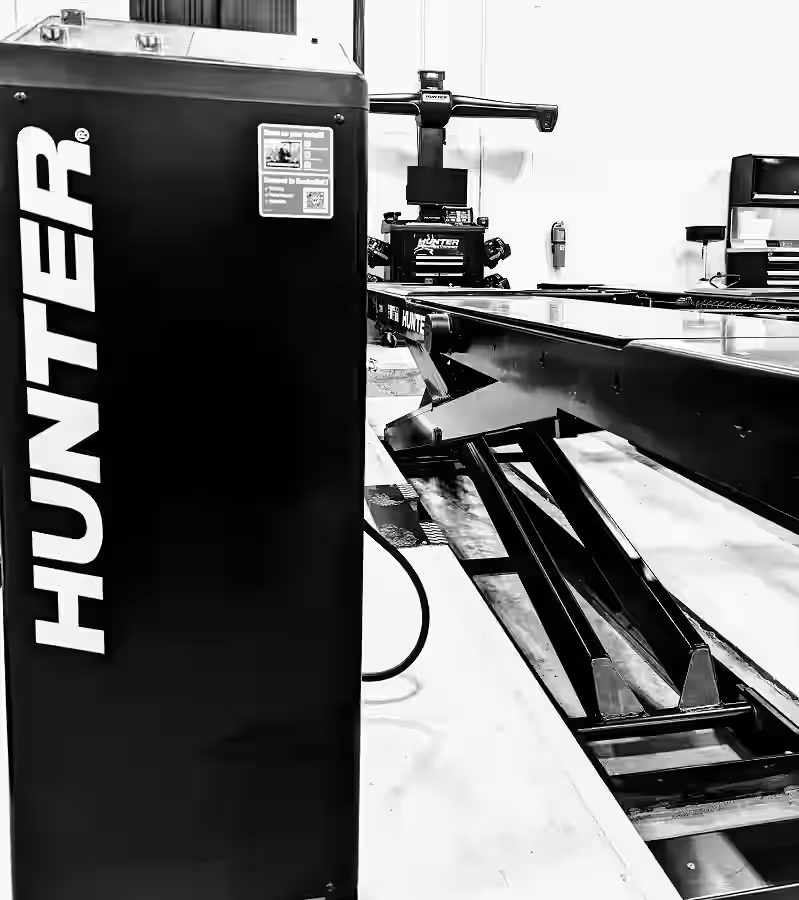
Fixed, tower-based architectures place high-resolution cameras on stationary vertical posts or crossbeams positioned ahead of the service lift. These configurations create dedicated alignment stalls where vehicles pull onto turnplates and slip plates in an optimized linear path. Conversely, towerless setups eliminate physical forward posts entirely by housing sensor electronics directly on wheel-mounted heads or mobile uprights that communicate wirelessly with a central console or tablet interface.
Deciding between stationary posts and mobile equipment directly impacts service flexibility, floor layout planning, and routine maintenance requirements for wheel alignment machine parts.
| Architectural Feature | Tower-Based Alignment Systems | Towerless / Mobile Alignment Systems |
|---|---|---|
| Bay Footprint Requirement | Fixed structural stall (dedicated 20–30 ft bay length) | Flexible stall usage (stores against walls or between bays) |
| Mobility & Bay Sharing | Stationary, or relocatable via optional mobility kits | 100% portable across multiple lift bays or pit floors |
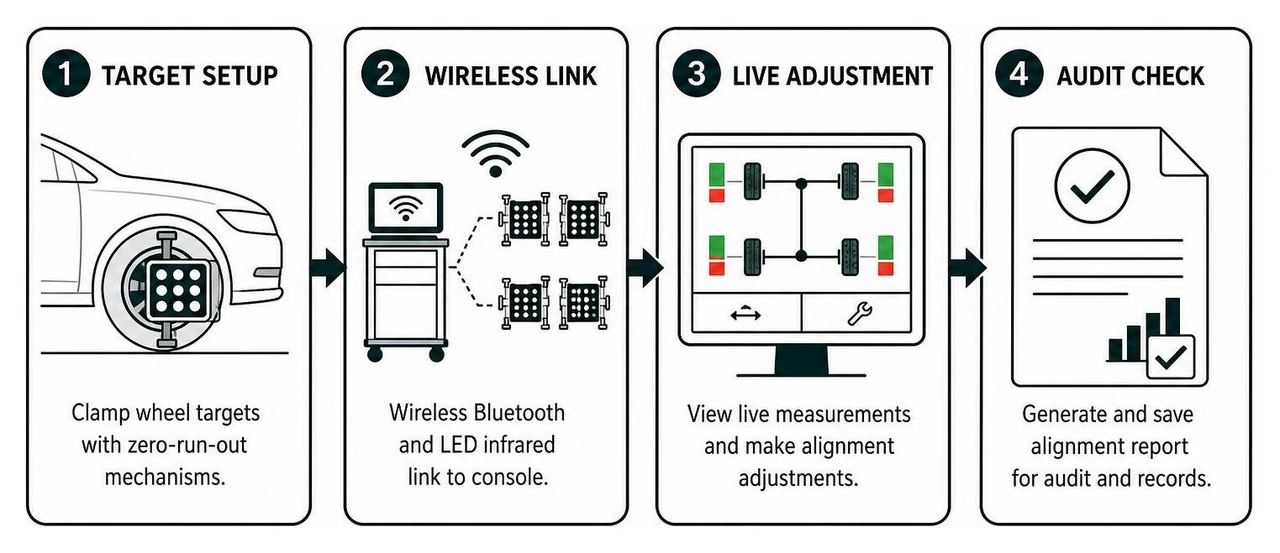
| Sensor Communication | Optical/digital line-of-sight from post to wheel targets | Wireless Bluetooth and LED infrared transmission between heads |
| Multi-Axle Reach | Standard passenger/light-duty wheelbase limits | Capable of long wheelbases and up to 8 commercial axles |
| Run-Out Compensation | Target rolling/pushing or clamp-level calculation | Often zero-run-out rapid clamping mechanisms |
| Best-Fit Application | High-volume light-duty and passenger service centers | Mixed commercial fleets, heavy trailers, and flexible multi-bay shops |
Tower-Based Systems with Automatic Camera Tracking
Tower-based architectures deliver extreme speed in high-volume settings. Top-tier camera systems utilize digital camera tracking that automatically follows the elevation of the vehicle as the lift rises from floor level to full working height. In standard alignment bays without tracking cameras, technicians must pause vehicle servicing to manually adjust camera angles whenever the lift height changes.
Automatic camera tracking links continuous digital calibration with real-time target elevation. High-definition XD cameras track target movement synchronously with lift positioning, keeping optical targets locked in the visual sweet spot from zero to full working height. Paired with drive-through bay layouts, systems like the geoliner series allow technicians to drive a vehicle onto the rack, roll it for compensation, raise the platform, and execute corrections without losing optical reference or recalibrating physical posts.
Towerless and Mobile Wheel Alignment Equipment Configurations
For commercial service facilities balancing mixed vehicle classes across multiple stalls, towerless configurations offer exceptional spatial versatility. When alignment racks are occupied by ongoing suspension repairs, rigid stationary towers can trap workflow. Towerless platforms eliminate fixed footprint barriers, allowing technicians to turn any level bay or service pit into an active alignment stall.
Facilities running multiple repair stalls benefit heavily from mobility kit hardware. An optional mobility kit allows alignment towers and mobile cart consoles to be rolled between bays or stored out of the way to facilitate collision repair framing or ADAS calibrations. For shop managers looking to maximize bay profitability across diverse service lines, combining flexible alignment carts with modern rotary wheel service complete guide standards ensures lifts remain versatile and productive.
Multi-Axle and Commercial Vehicle Alignment Capabilities
Aligning commercial trucks, municipal transit fleets, and heavy multi-axle trailers demands industrial-grade measurement hardware engineered for long wheelbases and extreme structural loads.
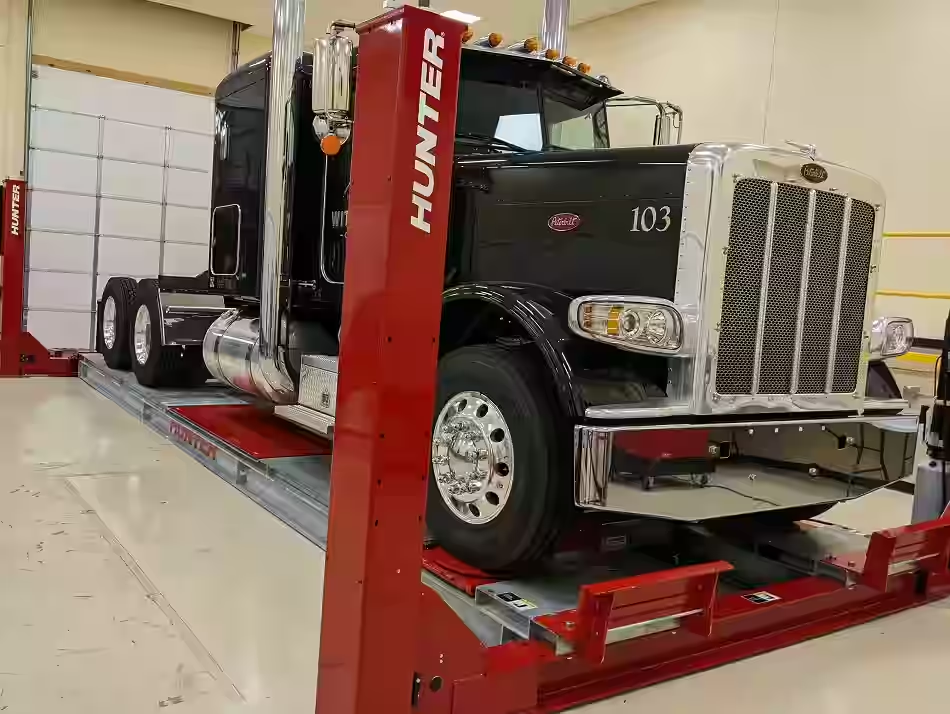
Commercial systems such as the R5100HD PRO are engineered specifically to overcome the physical limitations of fixed optical setups. Commercial alignment operations encounter variable vehicle geometries—from dual-steer vocational chassis to four-axle flatbeds and long tractor-trailer combinations. Heavy-duty aligners must capture real-time thrust angles, scrub lines, and axle parallelisms across expansive distances while maintaining industrial precision.
Sensor Technology and Long-Range Wireless Transmission
Commercial fleet alignment relies on optical sensor lines and infrared signal transmission rather than short-range reflection targets. Advanced heavy-duty aligners utilize precision LED sensors paired with wireless Bluetooth transmission between front measuring heads and the main processing unit.
These high-output LED arrays generate precise measurement beams capable of bridging distances up to 59 feet. This extended transmission reach enables complete alignment readings across complex multi-axle combinations—up to 8 full axles simultaneously—without signal degradation. Wireless Bluetooth protocols maintain zero-interruption data streams at any lift height, allowing technicians to make live adjustments underneath loaded trailers or tandem tractors while referencing stable specifications.
Furthermore, double inclinometer hardware on heavy-duty sensor heads allows direct caster measurement and adjustments without requiring repeated manual steering sweeps. Integrating long-range alignment tools into your shop operations forms the backbone of comprehensive fleet tire service solutions.
Rapid Clamping and Tablet-Based Workflow
Technician workflow and setup velocity determine how quickly a commercial bay generates revenue. Traditional truck alignments often require lifting each heavy axle off the rack with rolling pit jacks to perform individual wheel run-out compensation—a cumbersome process that adds substantial setup time per truck.
Patented no-run-out fast tire clamps eliminate this bottleneck entirely. These clamps attach directly to commercial tire sidewalls and wheels, referencing the true geometric wheel center immediately without requiring technicians to raise heavy commercial axles off the lift. This direct-reference clamping mechanism saves 15 to 20 minutes of setup time on every heavy commercial vehicle that enters the bay.

Setup speed is further amplified by mobile PC tablet integration. Instead of forcing technicians to walk back and forth between the chassis underbody and a distant stationary monitor, live adjustments appear directly on a handheld tablet. Technicians retain full system control, viewing dynamic toe, camber, and thrust angle readings directly at the steering tie-rod sleeves and tandem torque rods.
Software Intelligence and Revenue-Generating Diagnostic Tools
Modern alignment platforms are powered by software engines that combine OEM vehicle specifications, dynamic 3D modeling, and real-time suspension geometry diagnostics. Alignment software acts as a productivity engine that pairs alongside wheel balancer equipment to deliver complete, premium tire service.
Advanced Software Features in Modern Wheel Alignment Equipment
Software suites like Pro42 PLATINUM elevate routine alignments into accurate diagnostic procedures. Proprietary features optimize complex adjustment steps:
- Automated Caster Sweep: Eliminates manual multi-step sensor leveling by prompting smooth, real-time caster calculations upon steering input.
- EZ-Toe Adjustments: Allows technicians to set front toe accurately with the steering wheel turned at full lock angle, eliminating difficult reach issues around tight wheel wells and engine components.
- A-Arm and Cradle Adjustment: Calculates exact cross-member shim and bolt movement necessary to correct caster and camber simultaneously on complex subframes.
- Advanced Geometry Diagnostics: Generates live metrics for ProAckerman angles, graphical caster trail, scrub radius, and Steering Axis Inclination (SAI) to diagnose bent spindles, shifted subframes, and damaged suspension links.
Rapid Inspection and Vehicle Auditing Modes
Equipment investment must generate measurable return on investment (ROI), and software-driven auditing tools are among the most effective revenue drivers in a modern shop. Integrated audit routines, such as Audit Mode, allow technicians to perform a complete diagnostic vehicle geometry check in under two minutes during routine preventative maintenance check-ins.
Audit procedures verify front and rear toe, track width, camber, individual wheelbase length, tire diameter, and diagonal cross-dimensions. If a vehicle has suffered structural collision damage or shifted subframes, the system highlights the fault immediately on a printable graphical audit sheet. Service advisors can present clear, OEM-backed alignment and structural data to fleet managers and commercial clients, instantly converting routine service bay visits into profitable alignment adjustments and suspension repair orders.
Key Technical Specifications to Evaluate Before Purchasing
Selecting the right commercial alignment platform requires a careful review of operational capacity, dimensional clearance, and infrastructure power compatibility.
- Track Width Range: Commercial and light-service bays require wide measurement latitude. Look for systems accommodating track widths between 48 and 96 inches (122 to 244 cm) to service compact utility vehicles up to wide heavy-duty commercial chassis.
- Tire Diameter Clamping Capacity: Ensure wheel clamps cover your full client profile. Light-to-medium platforms with high-grade clamps (such as AC400 series) handle 19 to 39 inches (48 to 99 cm), while heavy-duty commercial truck aligners require a measuring range of 30 to 50 inches.
- Measurement Accuracy Tolerances: Commercial fleet alignment demands stringent tolerance bands. Ensure your chosen equipment achieves accuracy within ±2 minutes (±0.03°) for camber and ±3 minutes (±0.05°) for total front-axle toe.
- Power Supply & Facility Infrastructure: Verify whether the platform requires dedicated 115V or 230V single-phase electrical drops, clean ground connections for sensitive microprocessors, and sufficient physical stall clearance for lift runways and digital target lines of sight.
Frequently Asked Questions About Commercial Alignment Systems
How do patented no-run-out wheel clamps save shop setup time?
Patented no-run-out clamps grip the tire directly and establish immediate center-of-rotation alignment geometry without requiring the technician to lift the vehicle's axles off the rack to perform manual mechanical run-out compensation. This direct-referencing design eliminates wheel lifting procedures, protects expensive alloy and heavy-duty rims from claw damage, and saves 15 to 20 minutes of initial setup time on every vehicle.
What technical specifications are critical for mixed-fleet servicing?
For shops servicing passenger cars, delivery vans, vocational trucks, and heavy tractor-trailers, three specifications are vital: a track width range spanning at least 48 to 96 inches, a clamp tire diameter capacity covering 19 to 50 inches, and heavy-duty sensor accuracy maintaining tolerances within ±2 minutes for camber and ±3 minutes for front total toe across multi-axle configurations.
How does alignment audit mode increase commercial shop revenue?
Audit mode performs a rapid, comprehensive geometry and dimensional screening in under two minutes. By quickly measuring front and rear toe, camber, wheelbase symmetry, track width, and structural cross-dimensions during standard inspections, the system generates clear visual verification reports. This objective documentation exposes unaligned axles, abnormal tire scrub conditions, and bent structural components, enabling service advisors to show documented proof and capture high-margin alignment and suspension repair work.
Conclusion
Selecting the right alignment platform requires matching equipment capability to your facility's physical layout, volume demands, and vehicle service mix. Tower-based optical systems equipped with automatic camera tracking streamline workflow in dedicated, high-speed alignment stalls. Meanwhile, versatile towerless platforms with long-range LED sensors and rapid clamping mechanisms give multi-bay and commercial fleet facilities the mobility to perform multi-axle alignments anywhere on the shop floor.
AutoTech Solutions provides end-to-end support for commercial shops, automotive dealerships, and municipal service centers throughout Charlotte, NC, Raleigh, NC, Wade, NC, and Novi, MI. We deliver complete shop solutions—from equipment sales and expert layout planning to professional car lift installation and ongoing preventative maintenance. To explore full equipment configurations and choose the ideal alignment solution for your commercial facility, consult our wheel service equipment guide 2026 or connect with our technical specialists to schedule an on-site equipment demonstration.