Why Choosing the Right Wheel Balancer Equipment Matters for Your Shop
Wheel balancer equipment is one of the most critical investments a commercial automotive shop can make. The right machine directly affects technician throughput, customer satisfaction, and your shop's bottom line.
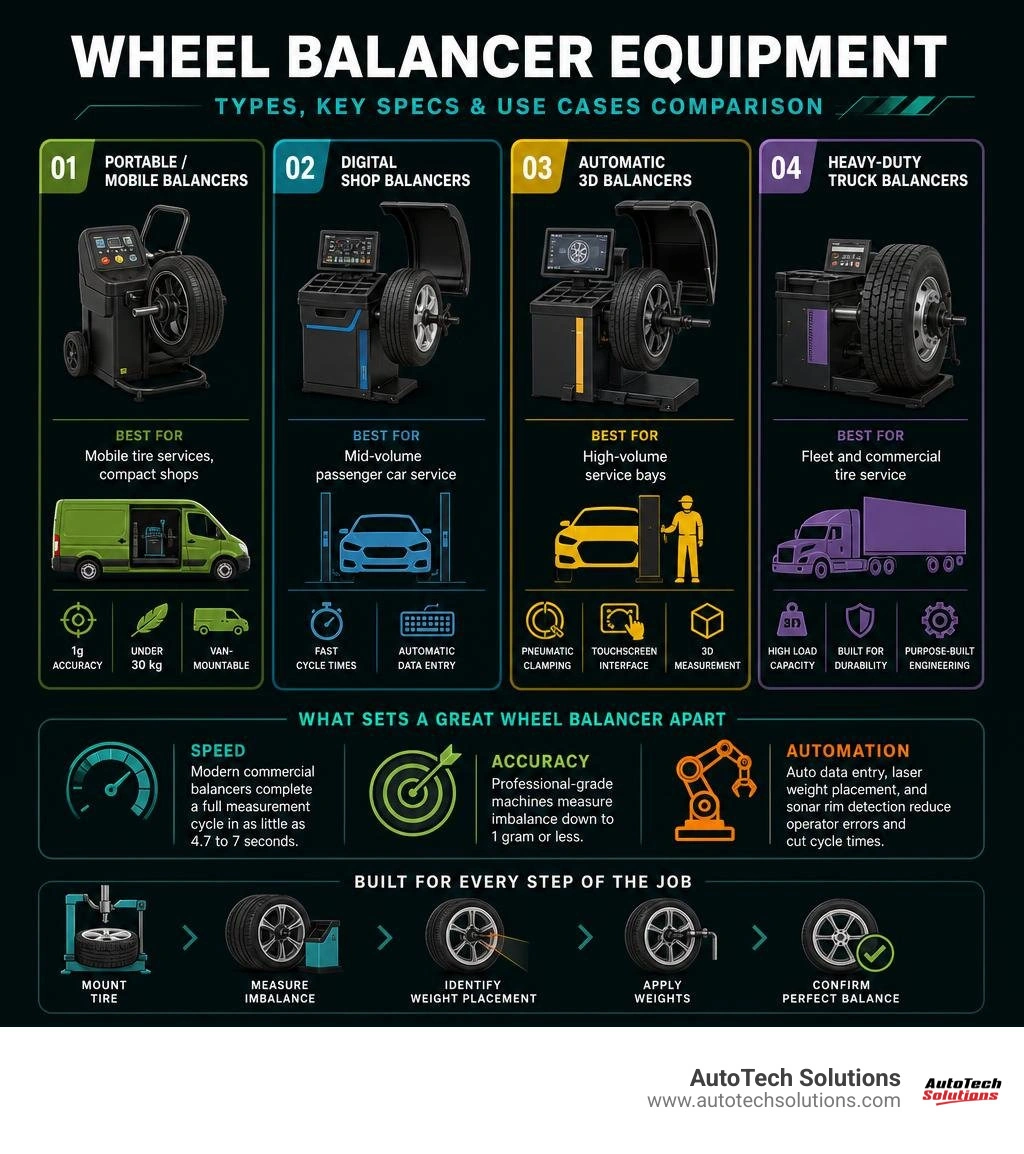
Here is a quick breakdown of the main types available and who they are best suited for:
| Equipment Type | Best For | Key Capability |
|---|---|---|
| Portable/Mobile Balancers | Mobile tire services, compact shops | 1g accuracy, under 30 kg, van-mountable |
| Digital Shop Balancers | Mid-volume passenger car service | Fast cycle times, automatic data entry |
| Automatic 3D Balancers | High-volume service bays | Pneumatic clamping, touchscreen, 3D measurement |
| Heavy-Duty Truck Balancers | Fleet and commercial tire service | High load capacity, purpose-built engineering |
A few things that separate a good wheel balancer from a great one:
- Speed — Modern commercial balancers complete a full measurement cycle in as little as 4.7 to 7 seconds
- Accuracy — Professional-grade machines measure imbalance down to 1 gram or less
- Automation — Features like auto data entry, laser weight placement, and sonar rim detection reduce operator errors and cut cycle times
It is worth noting that a vibration-free tire balance heavily influences how customers perceive your entire service quality — including brake and suspension work. The wheel balancer may actually be the most sophisticated piece of equipment in a modern auto repair shop.
Here at AutoTech Solutions, our team of commercial shop equipment specialists has put together this complete comparison guide to help facility managers make a confident, informed decision.
Types of Commercial Wheel Balancer Equipment and Primary Use Cases
Selecting commercial wheel balancer equipment requires aligning machine specs with your facility's daily service volume, physical shop space, and target customer vehicle fleet. Commercial balancers are engineered across distinct categories to serve specific operational demands.
Portable and Mobile Wheel Balancer Equipment
For roadside fleet management, emergency service vans, or brick-and-mortar bays with severe spatial constraints, compact portable balancing units offer incredible agility. Lightweight models like the Move! - Garage demonstrate that compact machinery can deliver true commercial-grade precision. Weighing under 30 kg, these modular machines can be mounted directly on workbenches, service van floors, or mobile baseplates.
Key benefits of mobile units include:
- High Precision in Small Footprints: Measurement uncertainty down to 1 g, matching full-sized floor machines.
- Rapid Cycle Speeds: Spin cycles as fast as 4.7 seconds for standard 15 kg wheel assemblies.
- Low Power Consumption: Efficient motors (e.g., 0.65 kW power draw) designed to run off mobile power systems or standard single-phase circuits.
Mobile tire service models are popular across service facilities in Michigan and North Carolina, enabling commercial teams to perform precision Computerized Wheel Balancing Brighton, MI Novi, MI Ann ... on-site without hauling assemblies back to a central facility.
High-Volume Digital and Automatic 3D Balancers
For high-volume retail tire bays, fleet service centers, and dealerships, speed and operational automation dictate total bay profitability. Automatic 3D wheel balancers eliminate physical manual measurements entirely using advanced sensor arrays.
High-end units like the P45 Plus | Automatic 3D Wheel Balancer with Pneumatic Clamping feature 3D automatic data acquisition, pedal-controlled pneumatic wheel clamping, and dual LED displays. Pneumatic clamping locks wheels in seconds with uniform force, preventing manual threaded nut alignment errors and reducing physical technician strain. Meanwhile, space-saving designs like the Compact high-performance 3D wheel balancer | ER15 offer laser-guided accuracy, automatic distance and diameter gauges, and rapid 4.7-second detection cycles without taking up valuable floor space.
Heavy-Duty Fleet Wheel Balancer Equipment
Commercial truck fleets, buses, off-the-road (OTR) equipment, and heavy service vehicles demand heavy-duty balancing systems engineered from the ground up. Attempting to balance heavy commercial assemblies on adapted passenger car machines leads to rapid equipment failure and inaccurate readings.
Dedicated heavy-duty truck balancers accommodate massive wheel diameters (up to 43 inches or more) and heavy assembly weights exceeding 150 kg to 200 kg. These systems utilize heavy-gauge chassis construction, integrated pneumatic wheel lifts, and direct-axis drive motors to deliver smooth rotation under high loads. Investing in specialized heavy-duty balancing technology directly lowers tire wear and extends chassis component life across municipal and commercial vehicle operations. Learn more about optimizing commercial bay workflows with our Fleet Tire Service Solutions.
Key Technical Specifications: Accuracy, Speed, and Cycle Times
When comparing wheel balancer equipment, technical specs determine how quickly and reliably technicians can complete jobs.

Here are the vital specifications every facility manager must review:
- Measurement Accuracy & Precision: Commercial machines deliver unbalance measurement accuracy within ±1 g (0.035 oz), with top-tier high-precision units achieving accuracy down to hundredths of an ounce (0.5 g).
- Cycle Speed & Spin Time: Average spin times on digital units range from 4.7 to 7 seconds. A fast spin cycle allows technicians to process full sets of four wheels in record time.
- Encoder Resolution: Hybrid and high-precision drive designs use high-count magnetic transducer encoders (such as 64-tooth encoders, doubling traditional 32-tooth configurations). This doubles available weight placement points along the rim plane, eliminating rounding errors.
- Dimension & Capacity Limits: Standard commercial units handle wheel diameters up to 28–30 inches, rim widths up to 20 inches, and max wheel weights between 75 kg and 85 kg (such as the B 335 C - B 335 semi-automatic balancer).
For a deeper look into selecting complementary tire changers and shop lifts, review our comprehensive Wheel Service Equipment Guide 2026.
Advanced Technologies and Diagnostic Features
Modern commercial wheel balancer equipment leverages sophisticated software and hardware solutions to diagnose tire problems and optimize weight placement:
- Diagnostic Load Rollers: High-end diagnostic balancers apply simulated road pressure (often up to 1,200 lbs or more) against the tread using a motorized load roller. This measures radial and lateral force variation, identifying internal tire ply defects, belt shifts, or wheel runout that dynamic spin balancers miss.
- Virtual Sonar & Contact-Free Measuring: Touchless sonar systems acquire rim width automatically. Software like Virtual Sonar uses vast profile databases to calculate secondary correction planes on standard rims with 95% accuracy, skipping physical measurement arm deployment.
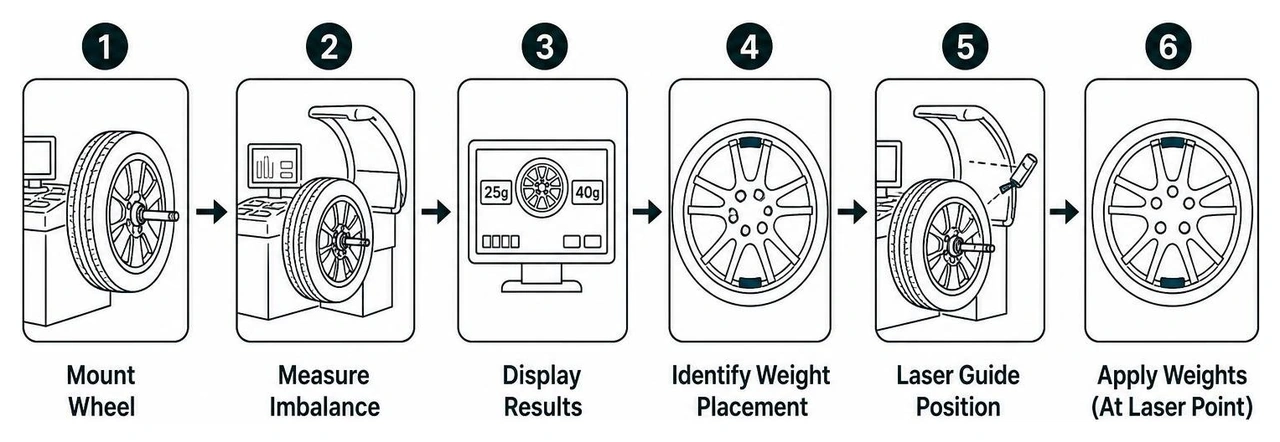
- Laser-Spot & Laser Blade Placement: Pinpoint laser pointers project an exact line or spot at the 6 o'clock or 12 o'clock position, showing technicians precisely where to apply adhesive counterweights.
- AutoAdaptive Mode & Intelligent Weight Software: AutoAdaptive software recalculates weight tolerances based on real-time tire mass and dimension data. Combined with single-plane balancing (OPB) or eco-weight algorithms (like Control Weight EVO), shops reduce adhesive weight consumption by up to 30% while reducing working times by up to 20%.
Maintaining high diagnostic accuracy requires quality replacement parts and accessories. Keep your machines running smoothly with our guide to Wheel Alignment Machine Parts.
Choosing Between Semi-Automatic, Touchscreen, and Fully Automatic Units
Understanding machine control types helps match equipment to operator skill levels and throughput demands.
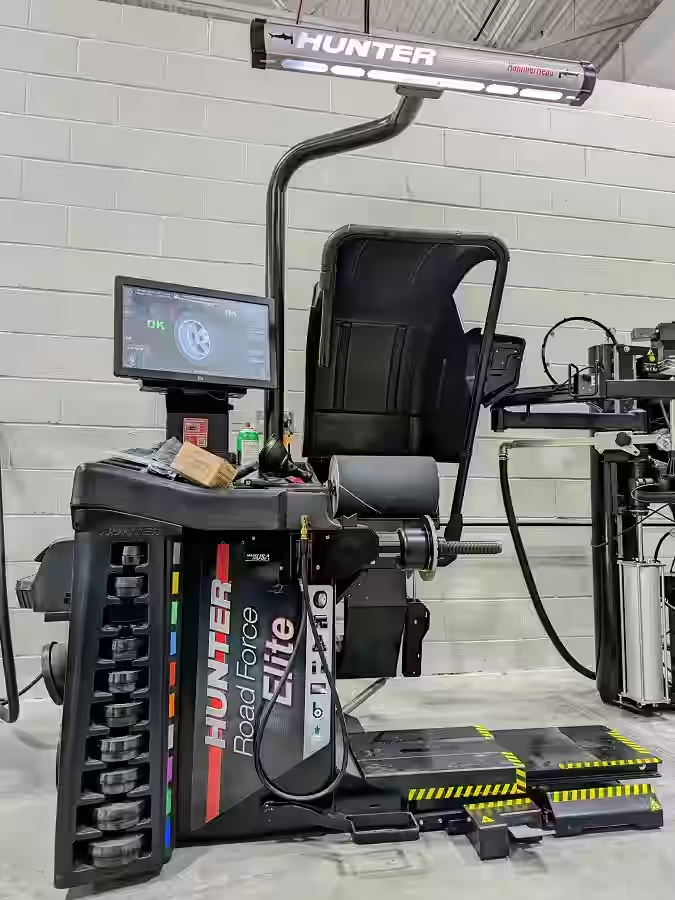
- Semi-Automatic Balancers: Use automatic gauges for distance and diameter, but rely on manual width input or clip-on arm selection. They provide exceptional durability and accurate 1g performance at an accessible capital entry point, making them ideal for standard service shops.
- Touchscreen Graphic Units: Modern touchscreen interfaces feature intuitive visual menus, real-time diagnostic reporting, and step-by-step weight application wizards. Programs like "Hidden Weight / Fast & Easy Split" allow operators to split counterweights neatly behind wheel spokes on high-end alloy rims without complex manual calculations.
- Fully Automatic 3D Systems: Feature touchless sonar, pneumatic clamping, automated hood-closure spin activation, and automatic laser positioning. They maximize throughput, requiring minimal technician input and removing operator error from high-volume operations.
For a full breakdown of equipping your service bays, explore our Automotive Shop Equipment Complete Guide.
Commercial Pricing Ranges and Equipment Investment Factors
Investing in commercial wheel balancer equipment ranges from entry-level portable units to advanced diagnostic diagnostic suites:
- Entry-Level & Portable Balancers: Range from $1,500 to $3,500. Ideal for mobile vans, auxiliary bays, or tight workshops.
- Mid-Range Semi-Automatic & Digital Balancers: Range from $3,500 to $7,500. Features automatic data entry, laser weight placement, and fast 7-second cycle times.
- High-Volume Fully Automatic & Touchscreen 3D Systems: Range from $7,500 to $13,500. Includes pneumatic clamping, Virtual Sonar, and automated diagnostic measurement.
- Heavy-Duty Fleet & Specialized Diagnostic Systems: Range from $10,000 to over $14,500 for commercial truck units built with integrated lifts and heavy-duty drive systems.
When evaluating return on investment, consider reduced labor time per tire, savings on balancing counterweight materials, and lower customer return rates due to precise balancing. At AutoTech Solutions, we help shop owners maximize productivity across Novi, MI, Charlotte, NC, Raleigh, NC, and Wade, NC with complete equipment selection, fast installation, and reliable local repair service.
Learn how to safeguard your machinery investments with our guides on Equipment Lifecycle Management for Automotive Facilities and How to Reduce Equipment Downtime in an Automotive Shop.
Frequently Asked Questions About Wheel Balancers
How do diagnostic load rollers resolve persistent wheel vibrations?
Diagnostic load rollers apply pressure directly to the tire tread during rotation, simulating actual vehicle weight on the road. This pressure measures radial and lateral force variation caused by tire stiffness imbalances, ply distortion, or wheel rim runout. By detecting structural tire defects that standard free-spin dynamic balancers cannot see, load rollers allow technicians to force-match the tire's highest point with the wheel rim's lowest point, solving stubborn ride quality issues instantly.
What setup is required for balancing oversized or specialty alloy rims?
Balancing custom alloy or oversized wheels requires specialized rim protection and precision placement software:
- Pneumatic or Soft-Clamping Adapters: Protect delicate clear coats and custom wheel faces from scoring.
- ALU / ALU-S Software Modes: Allow technicians to select precise inner-rim plane positions for adhesive weights.
- Hidden Weight / Split Weight Programs: Calculate how to split a single counterweight into two hidden placement points behind adjacent spokes, keeping weights invisible from the outer profile.
- Specialty Centerless Cone Adapters: Ensure exact centering for hub-centric and lug-centric wheels.
How does Virtual Sonar technology measure rim width automatically?
Virtual Sonar is an intelligent software algorithm that calculates the outer rim width plane without requiring a physical 3D outer sonar sensor arm. Upon measuring distance and diameter via the inner automatic gauge, the software analyzes the inner plane and compares the wheel signature against a massive built-in database of standard rim profiles. It calculates the second correction plane with up to 95% accuracy on steel rims, reducing cycle times and eliminating physical sensor maintenance.
Conclusion
Upgrading your facility with high-performance wheel balancer equipment boosts bay productivity, minimizes labor costs, and delivers smooth ride quality that builds long-term customer trust. Whether you need compact mobile balancers for on-site services or heavy-duty fleet machines, choosing equipment tailored to your shop's volume ensures maximum return on investment.
At AutoTech Solutions, we are your one-stop partner for sales, professional installation, preventative maintenance, and emergency service across Michigan and the Carolinas. Contact our expert team today or explore our detailed Wheel Service Equipment Guide 2026 to find the perfect machinery for your service bays!