
What Is a 2 Post Floor Plate Car Lift — and Is It Right for Your Shop?
A 2 post floor plate car lift is a two-column vehicle hoist where the hydraulic and cable components run through a steel base plate along the floor between the columns, rather than overhead. This design eliminates the need for a structural crossbar at the top of the lift, making it the go-to choice for commercial shops with limited ceiling clearance.
Quick answer for shop managers evaluating floor plate lifts:
- Best for: Low-ceiling commercial bays (typically 13'6" or under)
- Common capacities: 9,000 lb, 10,000 lb, and 12,000 lb
- Key advantage: No overhead crossbar means more vertical clearance for tall vehicles and constrained ceilings
- Key trade-off: The floor plate between columns can interfere with rolling equipment like transmission jacks
- Concrete requirement: Minimum 6-inch slab at 3,000 PSI for proper anchoring
- Typical price range: $2,195 to $6,500+ depending on capacity and brand
For automotive service facilities, the choice between a floor plate and a clearfloor lift often comes down to one simple constraint: how much ceiling height you actually have.
Many commercial shops — especially older buildings, converted warehouses, and smaller independent garages — were never designed with overhead lift clearance in mind. A clearfloor (overhead) model typically demands around 162 inches of ceiling height. A floor plate model can fit in a bay as low as 13'6", and some compact models are engineered for even tighter clearances.
That single difference drives a large share of lift purchasing decisions across professional shops today.
But ceiling height is just the starting point. Capacity, arm configuration, concrete specs, safety features, and long-term maintenance costs all affect whether a floor plate lift will keep your bays productive — or create new headaches.
This guide breaks it all down in plain language so shop managers can make a confident, well-informed equipment decision.
Understanding the 2 Post Floor Plate Car Lift and How It Works
To understand why the 2 post floor plate car lift is such a lifesaver for space-constrained shops, we have to look at its mechanical skeleton.
In a standard clearfloor lift, the heavy-duty equalization cables and hydraulic hoses run through an overhead bar. This overhead bar acts as a bridge, keeping the columns perfectly synchronized and stable. However, that bridge requires serious overhead real estate.
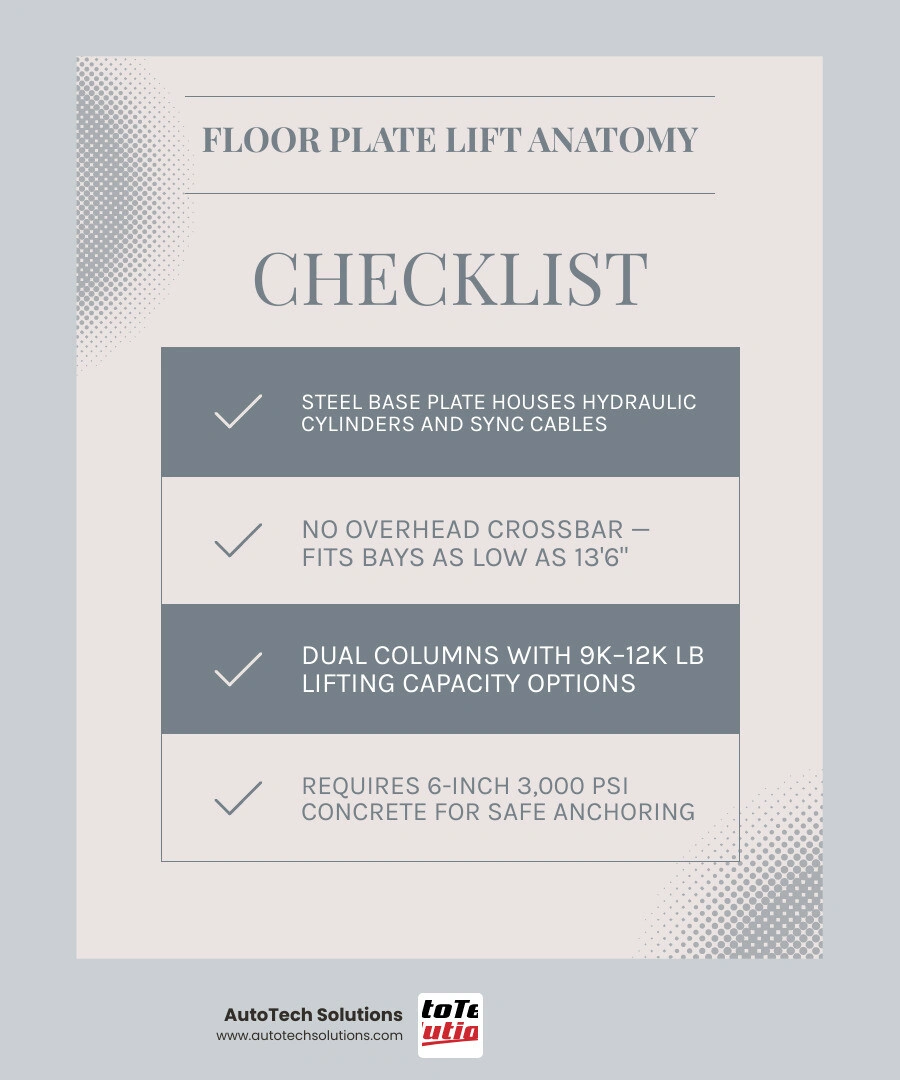
A floor plate lift (often called a base plate lift) flips this design upside down. The equalization cables, hydraulic lines, and electrical connections run along the shop floor, housed securely under a heavy-duty, low-profile steel drive-over plate.
Because there is no overhead bar connecting the tops of the columns, the columns themselves can be much shorter. While a clearfloor model requires a towering column setup, a floor plate model can easily sit comfortably under low rafters.
Mechanically, a high-quality 2 post floor plate car lift relies on several key components working in tandem:
- Dual Hydraulic Cylinders: Positioned in each column, these cylinders provide the raw lifting power. They are typically engineered to withstand immense pressure, using direct-drive or chain-over sprocket systems to raise the carriages.
- Synchronization Cables: Heavy-duty steel aircraft cables run from one carriage, down through the base plate, and up to the opposing carriage. This ensures that both lifting arms rise and lower at the exact same millisecond, keeping the vehicle perfectly level.
- Chain Drive System: Many commercial floor plate lifts utilize a rugged dual-chain system. Chains are incredibly durable, requiring less frequent adjustments than cable-only lifting mechanisms in high-throughput commercial environments.
- The Base Plate: This is the steel plate that anchors to the floor. It distributes the cantilever load of the vehicle across a wider concrete footprint. Because there is no top support to keep the columns from pulling inward under load, the base plate and heavy-duty concrete anchors bear the brunt of the lateral forces.
For high-performing commercial shops, choosing a lift built with finite element analysis (FEA) is crucial. Premium models show less than 0.5mm of structural deformation under full load, ensuring a service life of 10+ years in demanding fleet and service environments. If you are looking to browse top-tier options, check out the selection at 2 Post Car Lifts | Floorplate Lifts - Stratus Auto Equipment .
Floor Plate vs. Clearfloor Lifts: Key Differences for Commercial Shops
If you are a shop owner or service manager in Novi, MI, or Charlotte, NC, you know that bay space is money. Choosing the wrong lift style can permanently bottleneck your service workflow.

The primary trade-off between floor plate and clearfloor lifts centers on overhead obstructions vs. floor obstructions.
With a clearfloor lift, the floor is completely open. You can easily roll transmission jacks, oil drains, tool carts, and engine hoists directly under the vehicle without bumping into a metal ramp. However, if a technician tries to raise a high-roof commercial transit van, the roof of the van will trigger the overhead safety shut-off bar, limiting how high you can lift the vehicle.
With a floor plate lift, you lose that perfectly flat floor. There is a steel plate (usually about 1 to 2 inches tall) sitting directly between the columns. While it features tapered edges to allow vehicles to drive over it easily, it is a physical barrier. Rolling a fully loaded tool cart or a hydraulic transmission jack over this plate requires a bit of muscle and careful maneuvering.
However, because there is no overhead bar, there is no physical limit to how high a tall vehicle can go—other than your actual ceiling. If you are lifting a high-profile box truck, a camper, or a commercial van with ladder racks, the open-top design of a floor plate lift gives you the freedom to raise the vehicle as high as your physical building allows.
To help you weigh these factors, here is a direct comparison of how these two configurations stack up in a commercial environment:
| Feature | Floor Plate (Base Plate) Lift | Clearfloor (Overhead) Lift |
|---|---|---|
| Minimum Ceiling Height | 10' to 11' (Model dependent) | 12' to 14'+ |
| Floor Access | Obstructed by drive-over steel plate | 100% unobstructed, completely flat |
| High-Profile Vehicle Access | Uncapped at the top (limited only by ceiling) | Limited by physical overhead crossbar |
| Equipment Movement | Requires rolling jacks over the plate | Seamless movement of jacks and tool carts |
| Structural Load Distribution | Heavily reliant on concrete floor anchors | Stabilized by overhead crossbar |
| Ideal Applications | Low-ceiling bays, high-roof vans, older buildings | Modern bays, heavy transmission work, quick-lube |
For a broader look at the industry's top offerings, you can explore professional options at 2-Post Car Lifts - Eagle Equipment or check out 2 Post Car Lifts for Sale - Shop Top Brands .
Overhead Clearance and Ceiling Height Requirements
When planning your shop layout, ceiling clearance is the absolute, non-negotiable metric. If your rafters sit at 11 feet, a clearfloor lift is simply out of the question.
A professional 2 post floor plate car lift is specifically engineered to maximize vertical space in low-clearance environments. For instance, standard commercial floor plate lifts like the Challenger CLFP9 feature an overall column height of just 111-7/8 inches (9 feet, 3-7/8 inches). This allows them to fit comfortably under a standard 10-foot ceiling while still providing up to 79 inches of rise height.
Other models, such as the Forward BP9, require a minimum ceiling height of only 113 inches. This means you can transform an older, low-ceiling service bay into a fully operational, high-revenue-generating space.
However, when calculating your clearance, you must account for the height of the vehicle plus the distance it will be raised. Lifting a tall commercial van on a low-ceiling lift requires careful planning to avoid sending the vehicle's roof into your lighting fixtures or rafters. For a step-by-step breakdown of how to prepare your building for a new lift installation, read our comprehensive Automotive Lift Installation Guide.
Floor Plate Design Impact on Shop Workflow and Equipment Movement
In a busy commercial shop, efficiency is measured in flat-rate hours. Every minor inconvenience—like struggling to roll a heavy tool cart over a steel floor plate—accumulates over the course of a week.
Because the drive-over plate sits right in the middle of the service bay, your technicians will have to navigate it daily.
- Transmission Jacks: If your shop performs heavy transmission swaps, rolling a high-lift transmission jack over the floor plate can be challenging. Technicians must balance the jack carefully as the wheels climb over the 1.5-inch steel ridge.
- Oil Drains: Mobile oil drains with small casters can catch on the drive-over plate, potentially causing spills if rolled too quickly.
- Technician Fatigue: Tripping hazards are a constant concern in any industrial environment. The drive-over plate is a minor floor obstruction that technicians must remain mindful of during under-car service.
To mitigate these issues, top-tier manufacturers design these plates with ultra-low profiles and heavily chamfered (sloped) edges. This allows vehicles and larger-wheeled equipment to pass over smoothly. It is a trade-off, but for shops in Raleigh, NC, or Novi, MI operating out of older facilities, it is a trade-off that makes professional vehicle lifting possible where it otherwise wouldn't be.
Selecting the Right Lifting Capacity and Vehicle Compatibility
Choosing the right capacity for your 2 post floor plate car lift is about matching your lift to your daily work order mix. Buying too little lift limits your services; buying too much lift wastes capital.
Additionally, you must consider the arm configuration.
- Symmetric Arms: All four arms are of equal length. This configuration is ideal for heavier, longer vehicles like trucks and large SUVs because it centers the vehicle's weight directly between the columns.
- Asymmetric Arms: The front arms are shorter than the rear arms. This allows you to position the vehicle slightly forward, shifting the center of gravity and allowing the vehicle's doors to open past the lift columns. This is incredibly helpful for interior work and passenger car service.
For shops handling a diverse mix of passenger vehicles and medium-duty commercial trucks, you can explore tailored options at 2 Post Car & Truck Lifts - Redline Engineering .
Choosing a 2 Post Floor Plate Car Lift for Light-Duty Vehicles
If your shop primarily services passenger sedans, compact crossovers, and light SUVs, a 9,000 lb capacity floor plate lift is the industry standard. These lifts are cost-effective, highly versatile, and draw less power.
When servicing low-profile sports cars or modified tuner vehicles, pay close attention to the initial pad height. Standard lifts typically have a minimum pad height of 4 inches, which can scrape the rocker panels of lowered vehicles.
Specialized low-profile floor plate lifts, such as those sourced through Good Price Floor Plate Auto Two Post Lift Suppliers in China - Neon Intelligent Technology , offer ultra-low initial heights of 90mm to 110mm (approximately 3.5 to 4.3 inches). This allows low-clearance vehicles to drive directly over the arms without the need for wood blocks or custom ramps.
Heavy-Duty 2 Post Floor Plate Car Lift Options for Commercial Fleets
For shops servicing commercial fleets, delivery vans, or heavy-duty work trucks (like Ford F-250s or Chevy Silverado 2500s), a 12,000 lb capacity floor plate lift is highly recommended.
As vehicles grow heavier due to heavy battery packs in hybrids and EVs, a 12,000 lb lift provides the structural safety margin your technicians need.
When lifting heavy, wide-bodied vehicles, standard lift pads are not enough. You must use heavy-duty frame cradle adapters to prevent the vehicle from slipping off the lift pads. Lifting a heavy, high-center-of-gravity commercial vehicle without frame cradles is a major safety hazard. Heavy-duty floor plate lifts should always be outfitted with stackable adapters to reach frame rails safely.
For high-capacity needs, check out options like the APlusLift 10000LB 2-Post Floor Plate Heavy Duty Car Lift with 3 Year to ensure your shop can handle heavy-duty frames.
Professional Installation and Concrete Specifications
A two-post lift is only as strong as the concrete beneath it. Because floor plate lifts do not have an overhead bar to help stabilize the columns, they place massive tension on the concrete anchor bolts. Under a heavy load, the columns naturally want to pull inward toward each other.
To prevent catastrophic column deflection or anchor pull-out, you must adhere strictly to the manufacturer's concrete specifications.
- Concrete Depth: For standard 9,000 lb to 10,000 lb lifts, a minimum of 4 inches of 3,000 PSI concrete is required. For heavy-duty 12,000 lb lifts, a 6-inch concrete slab rated at 3,000 PSI or higher is non-negotiable.
- Cure Time: Never install anchor bolts in freshly poured concrete. The slab must cure for a minimum of 28 days to reach its full structural design strength.
- Anchoring Bolts: Heavy-duty expansion anchors must be torqued to exact manufacturer specifications. If an anchor is over-torqued, it can crack the surrounding concrete; if under-torqued, it can pull free under load.
- Seismic Requirements: Depending on your local building codes in regions like North Carolina or Michigan, you may need larger base plates and specialized seismic anchors to meet local structural safety standards.
Because the physics of a floor plate lift are so demanding, non-certified installation is highly discouraged for commercial businesses. Protecting your technicians, your customers' vehicles, and your business liability requires professional installation. To find out what to look for in a certified installation team, consult our Car Lift Installers Complete Guide.
Essential Safety Features and Maintenance for Commercial Lifts
In a high-volume automotive shop, your lifts are running multiple cycles every single day. Operating heavy machinery always carries inherent risk, which is why understanding safety features and maintaining a strict service schedule is vital.
Critical Safety Features:
- Mechanical Safety Locks: These are the heavy steel teeth inside the columns that physically hold the carriage in place once raised. Never, under any circumstances, work under a vehicle supported solely by hydraulic pressure. Always lower the lift onto the mechanical locks before starting service.
- Automatic Arm Restraints: When the lift is on the ground, the arms swing freely. As soon as the carriage rises a few inches, automatic gear teeth must lock the arms in place to prevent them from swinging out from under the vehicle's lifting points.
- Slack Chain/Cable Safety Device: If an equalization cable or chain loses tension or snaps, secondary mechanical locks must instantly engage to prevent the carriage from dropping.
To keep your shop running smoothly and avoid costly downtime, partner with a professional service team for regular preventative maintenance. If your equipment does require attention, you can learn more about professional repair solutions by visiting our Two Post Lift Repair page. Keeping your lifts certified and serviced is the best way to prevent the Common Causes of Automotive Lift Downtime.
Frequently Asked Questions about Floor Plate Lifts
What is the minimum ceiling height required for a floor plate lift?
Most commercial 2 post floor plate lifts require a minimum ceiling height of 10 feet to 11 feet (120 to 132 inches). This is significantly lower than clearfloor models, which typically require at least 13'6" to 14' of clearance. Always verify the exact column height of your chosen model and add at least 2 inches of safety clearance before purchasing.
Can you use a transmission jack with a floor plate lift?
Yes, you can absolutely use a transmission jack with a floor plate lift. However, because the steel drive-over plate sits on the floor between the columns, you will not be able to roll the jack smoothly from one end of the bay to the other. Technicians must carefully lift or roll the jack over the sloped plate when positioning it beneath the vehicle's transmission.
Are floor plate lifts as safe as clearfloor models?
Yes. When properly installed by certified professionals on a concrete slab that meets the manufacturer's PSI and depth specifications, floor plate lifts are exceptionally safe and stable. Because they rely heavily on the concrete anchors to resist lateral forces, ensuring proper concrete anchoring and torque is critical to their structural safety.
Conclusion
Selecting the right 2 post floor plate car lift is one of the smartest ways to maximize the revenue potential of low-ceiling service bays. By eliminating overhead obstructions, these lifts allow you to service tall commercial vehicles and passenger cars alike, even when vertical space is tight.
However, getting the most out of your investment requires professional guidance, precise installation, and ongoing preventative maintenance.
At AutoTech Solutions, we are dedicated to helping automotive shops across Michigan and the Carolinas minimize downtime and maximize safety. From Charlotte and Raleigh, NC, to Novi, MI, we provide end-to-end support, including equipment sales, precision installation, certified safety inspections, and rapid-response repair.
Ready to upgrade your shop's lifting capabilities? Contact the experts at AutoTech Solutions today to discuss your equipment needs, or visit our Automotive Lift Installation Services page to schedule your professional installation.