When Your Lift Goes Down, Your Shop Stops Earning
Auto lift repair is a critical service for any commercial automotive facility — and when a lift fails, every bay-hour of downtime hits your bottom line directly.
Here's what you need to know fast:
- Common signs a lift needs repair: uneven lifting, hydraulic fluid leaks, slow operation, unusual noises, or safety locks that won't engage
- Most common repairs: hydraulic cylinder seals, equalizer cables, locking mechanisms, electrical controls, and anchor bolt inspection
- Inspection frequency: all commercial lifts should be inspected at minimum once per year, following ANSI/ALI ALOIM standards and OSHA guidelines
- Emergency vs. scheduled service: a vehicle stuck on a lift or a lift blocking a bay requires emergency dispatch; wear-related issues can be handled through scheduled preventive maintenance (PM)
- Repair vs. replace: if repair costs are recurring and exceed a significant portion of replacement cost, or structural integrity is compromised, replacement is worth evaluating
The right repair partner carries stocked parts, holds ALI certification, and can respond quickly — because in a busy shop, a lift that's down isn't just an inconvenience, it's lost revenue.
The sections below break down every major aspect of commercial auto lift repair: common failure points, maintenance schedules, lift-type comparisons, compliance requirements, and cost considerations.
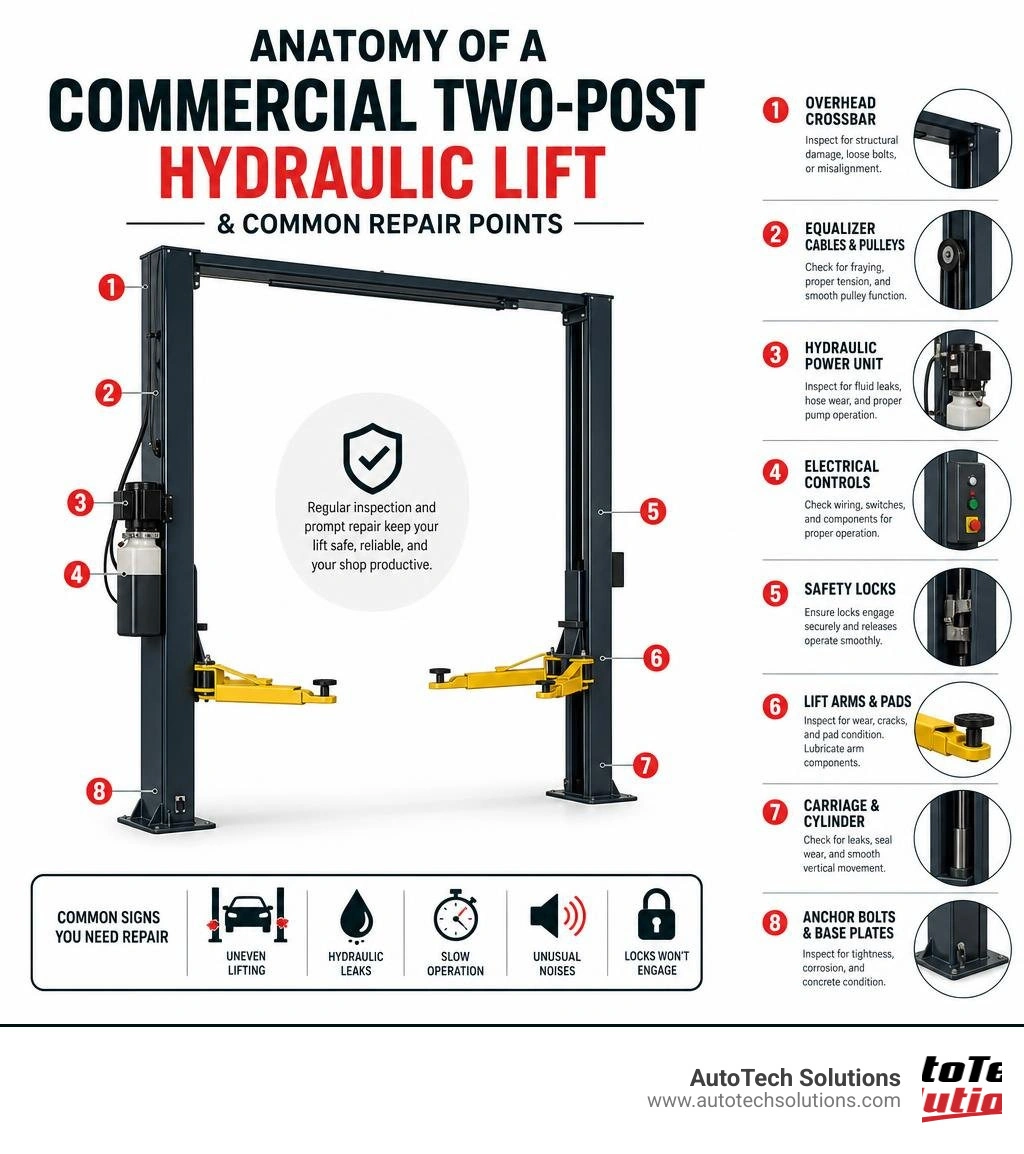
Know your auto lift repair terms:
Common Problems Requiring Professional Auto Lift Repair
In a high-throughput commercial workshop, automotive lifts are the absolute backbone of daily operations. Whether you are running a fleet service center in Charlotte, NC, or a collision repair shop in Novi, MI, a malfunctioning lift can paralyze your workflow. Understanding the primary warning signs and physical failures that necessitate professional auto lift repair is the first step toward reclaiming your shop's productivity.
When a lift begins to fail, the symptoms are rarely silent. You might notice the arms rising at different speeds, hear a metallic shudder during descent, or spot a dark, viscous puddle forming at the base of a column. Ignoring these signs doesn't just invite a sudden breakdown; it actively compromises the safety of your technicians. To protect your team and keep your bays moving, you need to understand the structural and mechanical root causes outlined in our guide on the Common Causes of Automotive Lift Downtime.
Hydraulic System Failures and Fluid Leaks
The hydraulic system is the muscular force behind almost every commercial lift. Over years of lifting vehicles weighing up to 15,000 lbs, the extreme pressure placed on the system takes its toll.
The most frequent culprit in hydraulic failure is the degradation of cylinder seals. When these internal rubber or polyurethane seals wear down, fluid bypasses the piston, leading to a slow, dangerous loss of pressure. This often manifests as a "drifting" platform or arms that slowly sink under load.
Additionally, using the incorrect fluid can ruin your system. Most commercial lifts require a high-quality SAE 10 hydraulic fluid that meets ISO 32 specifications. Introducing low-grade oil or allowing dirt and metal shavings to contaminate the fluid reservoir will rapidly score the cylinder walls, leading to expensive, premature cylinder replacement. If you notice external leaks around the hose fittings or the power unit reservoir, it’s time to call in a professional to prevent complete pressure loss.
Mechanical Wear and Cable Synchronization Issues
While hydraulics do the heavy lifting, mechanical synchronization components ensure that the load remains level. In a standard two-post lift, equalizer cables run through a series of sheaves and pulleys to ensure both carriages rise in perfect unison.
Over time, these steel cables naturally stretch and wear. If one cable becomes looser than the other, the lift will rise unevenly, placing immense torsional stress on the columns and carriages. This is a primary focus of Two Post Lift Repair.
Left unaddressed, synchronization issues can cause a vehicle to tilt, risking a catastrophic fall. Beyond cables, mechanical wear also affects the slider blocks (the plastic or composite guides inside the columns) and the pulleys themselves. When slider blocks wear down, the carriage rubs directly against the steel column, creating friction, loud squealing noises, and structural damage that cannot be easily repaired.
Preventive Maintenance vs. Emergency Repairs
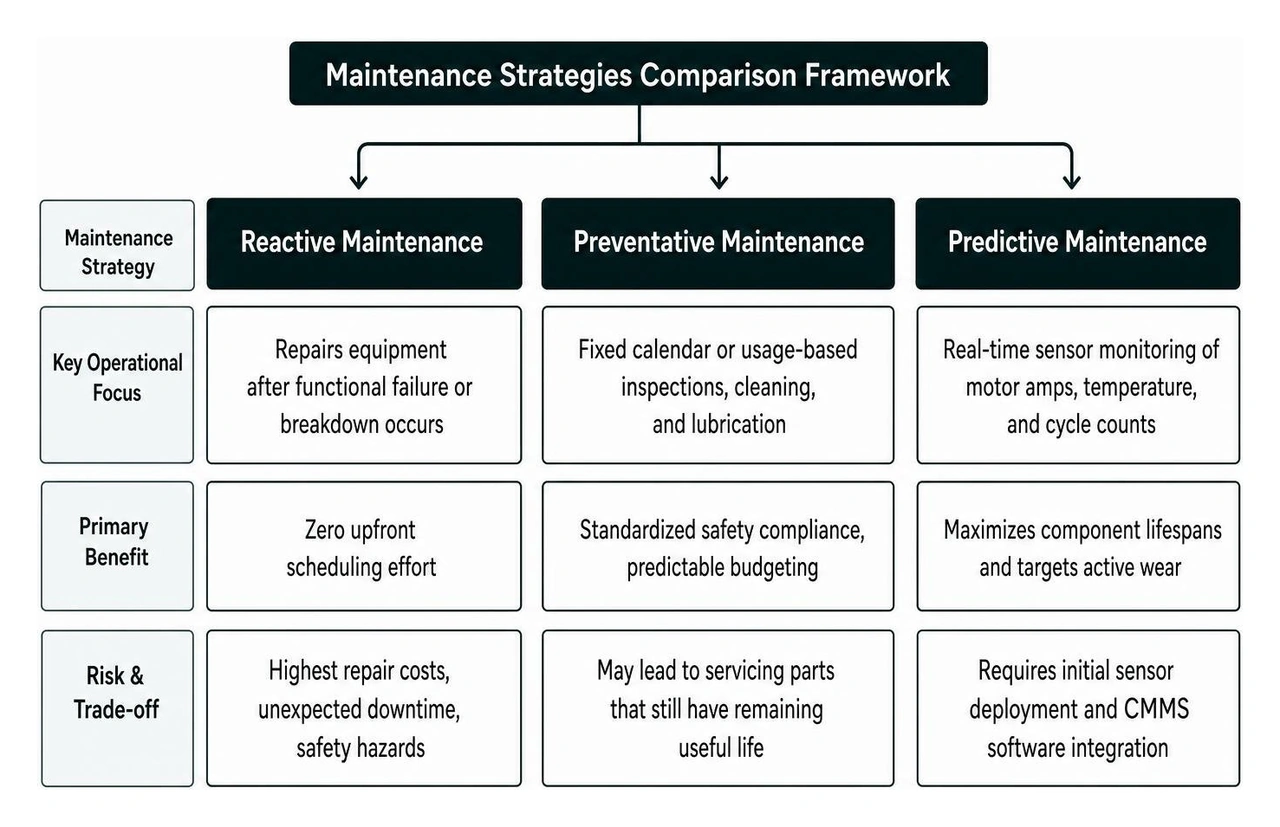
Every commercial shop owner faces a choice: pay a small, predictable amount for scheduled maintenance now, or pay a massive, unpredictable sum for emergency repairs and lost bay revenue later. At AutoTech Solutions, we specialize in helping shops transition from a reactive "break-fix" cycle to a proactive, highly efficient preventive maintenance (PM) model.
When to Schedule Emergency Auto Lift Repair
Emergency repairs are necessary when a failure halts your operations or endangers personnel. The most common emergency scenarios include:
- Vehicles stuck in the air: A lift that raises a customer's vehicle but refuses to lower due to a failed release valve, broken safety lock cable, or electrical control failure.
- Complete operational blockages: A broken lift blocking a vital bay, preventing other scheduled service work from being completed.
- Catastrophic component failure: Snapped synchronization cables, blown hydraulic hoses under load, or structural anchor bolts pulling free from the concrete.
In these high-stakes situations, you cannot afford to wait days for a technician. AutoTech Solutions offers rapid-response After Hours Automotive Lift Repair to get your critical infrastructure back online. When a lift is down and blocking your shop's productivity, our team is dispatched quickly with fully stocked service trucks to resolve the issue on the first visit. For immediate assistance, you can access our Emergency Auto Lift Repair Services.
Critical Components Replaced During Scheduled PM
Preventive maintenance is designed to catch and replace worn parts before they cause an emergency. During a standard PM visit, certified technicians systematically inspect and replace high-wear components. These include:
- Arm Restraints: The mechanical gears that lock the swing arms of a two-post lift into place. If these teeth wear out, the arms can shift under a vehicle, causing it to fall.
- Slider Blocks: These guide blocks keep the carriage centered within the column. Replacing them prevents metal-on-metal wear.
- Anchor Bolts: Technicians check the torque on the concrete anchor bolts to ensure the columns remain perfectly stable under maximum load.
- Limit Switches: Electrical safety switches that stop the lift before it hits the overhead bar or over-travels its structural limits.
By sourcing high-quality replacement parts from our inventory of Car Lift Parts for Sale, you ensure your equipment meets original manufacturer specifications and continues to operate safely.
Comparing Lift Types: Maintenance and Repair Frequency
Not all automotive lifts are engineered the same way, and their repair profiles vary significantly based on their mechanical design. The table below outlines the repair frequency, common failure points, and maintenance intensity for the most common commercial lift configurations.
| Lift Type | Repair Frequency | Primary Failure Points | Maintenance Intensity |
|---|---|---|---|
| Two-Post Lift | Moderate-High | Equalizer cables, slider blocks, arm restraint gears, hydraulic seals | Moderate (requires monthly lubrication and cable tensioning) |
| Four-Post Lift | Moderate | Cable sheaves, air-lock release cylinders, runway alignment | Low-Moderate (requires cable inspection and sheave lubrication) |
| Scissor Lift | Moderate | Hydraulic synchronization valves, pneumatic locks, hinge pins | Moderate (requires pivot point greasing and level checks) |
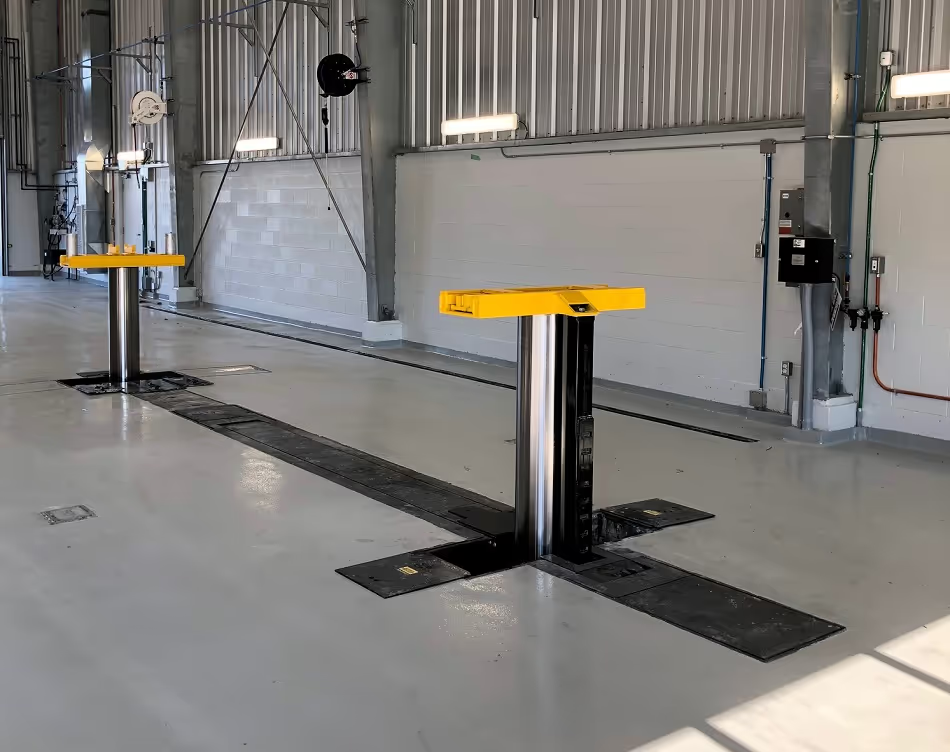
| Heavy-Duty Inground | Low | Underground hydraulic seals, casing corrosion, synchronization | High (requires specialized underground inspections) |
Two-Post and Four-Post Commercial Lifts
Two-post lifts are the undisputed workhorses of general service bays, offering incredible versatility for wheel, brake, and under-car repairs. However, because they hold vehicles by frame-engaging adapters, they experience high lateral forces. This makes regular cable tensioning and column lubrication essential.
Whether your shop utilizes symmetric or asymmetric configurations, maintaining equal cable tension is critical. For a deeper dive into the structural layout and setup of these systems, refer to our Car Lift Installers Complete Guide.
Four-post lifts, by contrast, are highly favored for alignment bays and quick-lube operations. Because the vehicle drives directly onto runways, these lifts experience less structural sway. However, they rely on complex cable routing systems with multiple sheaves and pulleys located under the runways. If these pulleys are not regularly lubricated, they seize, causing the heavy steel cables to fray and eventually snap.
Scissor Lifts and Specialty Heavy-Duty Systems
Scissor lifts and alignment racks are excellent for space-restricted bays because they lift straight up without vertical side columns. However, their mechanical complexity is high. They utilize dual hydraulic cylinders that must be perfectly synchronized electronically or hydraulically to ensure the platforms remain level.
If a synchronization valve fails, one side of the scissor lift will rise faster than the other, creating an immediate tipping hazard. Additionally, scissor lifts utilize pneumatic lock systems that require clean, dry shop air. If moisture enters your air lines, the lock release cylinders will rust and fail, requiring professional diagnostics and repair.
For specialized mobile servicing within a commercial fleet environment, some facilities evaluate portable lifting systems such as AUTOLift. However, heavy-duty commercial operations primarily rely on robust, permanently installed systems that require strict adherence to anchoring and structural standards.
Compliance, Standards, and Choosing a Repair Partner
Operating a commercial automotive shop means navigating strict safety and regulatory frameworks. Neglecting your lifts doesn't just risk equipment damage; it exposes your business to massive OSHA fines, soaring insurance premiums, and severe liability in the event of an accident.
Navigating ALI Certification and OSHA Requirements
The Automotive Lift Institute (ALI) is the independent watchdog of the vehicle lift industry. Under the national standard ANSI/ALI ALOIM (Safety Requirements for Operation, Inspection, and Maintenance), all commercial vehicle lifts must be inspected at least once a year by an ALI Certified Lift Inspector.
During an official inspection, the technician completes a rigorous, multi-page safety report covering everything from concrete integrity to electrical grounding. Lifts that pass are awarded an official ALI safety decal, which is valid for one calendar year. OSHA heavily references these ANSI/ALI standards during shop audits. If an inspector finds uninspected lifts or unresolved safety hazards, they can issue immediate "stop-use" orders, shutting down your bays on the spot.
For more information on national compliance, you can review the Automotive Lift Institute Safety Standards. By partnering with AutoTech Solutions, you ensure that your equipment is always compliant, protecting your business from liability.
Key Factors Influencing Auto Lift Repair Costs
When selecting an auto lift repair company, shop owners must look beyond the hourly labor rate. True repair costs are heavily influenced by:
- Technician Certifications: Uncertified handymen may charge less upfront, but their lack of training can lead to misdiagnosed issues, recurring failures, and voided equipment warranties.
- Parts Availability: A cheap repair service that has to order every single seal and cable from overseas will leave your bay dead for weeks. AutoTech Solutions keeps a vast inventory of common parts in stock to minimize your downtime.
- Turnaround Times: Every day a lift is down costs your shop hundreds of dollars in lost labor revenue. Fast, professional dispatch is always the most cost-effective choice.
If you are setting up a new facility or expanding your current shop floor, proper initial setup is key to preventing future repair headaches. Learn more about professional layout and anchoring in our comprehensive guide to Automotive Lift Installation.
Frequently Asked Questions
How often should commercial automotive lifts be inspected?
According to OSHA regulations and ANSI/ALI ALOIM standards, all commercial vehicle lifts must undergo a professional safety inspection at least once every 12 months. In addition to these annual professional inspections, shop owners should mandate daily pre-use checks by their technicians. These quick daily walkthroughs should focus on checking for visible hydraulic leaks, verifying that safety locks engage cleanly, and ensuring that lift pads and arm restraints are undamaged.
What are the concrete and anchoring requirements for commercial lifts?
Most standard two-post and four-post commercial lifts require a concrete floor with a minimum thickness of 4 to 6 inches, rated at a compressive strength of at least 3,000 PSI. The concrete must be fully cured (typically 28 days minimum) before anchoring.
Special care must be taken with post-tension slabs, which contain steel cables under high tension (often around 33,000 lbs). Drilling into a post-tension cable can cause catastrophic structural failure of the slab. Always consult structural blueprints or utilize ground-penetrating radar before drilling anchor holes.
Is it more cost-effective to repair or replace an older lift?
The decision to repair or replace hinges on three main factors:
- Structural Integrity: If the columns are bent, rusted through, or the concrete anchor holes have become oblong and unsafe, the lift must be replaced immediately.
- Parts Availability: Older, discontinued lift models may no longer have certified replacement parts available, making safe repairs impossible.
- Frequency of Breakdowns: If a lift is constantly leaking, slipping, or breaking down, the cumulative cost of emergency repairs and lost bay productivity will quickly outpace the cost of installing a modern, reliable replacement. Many top-tier lifts, such as those from Direct Lift, offer robust 5-year structural warranties that provide long-term financial peace of mind.
Conclusion
At the end of the day, your commercial shop's profitability is directly tied to the uptime of your equipment. A broken lift isn't just a mechanical failure; it is a bottleneck that stalls your technicians, delays customer deliveries, and eats away at your hard-earned revenue.
From our locations in Charlotte, Raleigh, and Wade, North Carolina, to Novi, Michigan, AutoTech Solutions is dedicated to keeping your shop operational. Whether you need a rapid-response emergency repair, a routine preventive maintenance plan, or a fully compliant annual safety inspection, our factory-trained technicians are ready to deliver.
Don't wait for a snapped cable or a blown seal to halt your operations. Partner with the region's leading vehicle service equipment specialists and experience the peace of mind that comes with professional support. Contact us today to schedule your next service visit or to discuss a custom preventive maintenance program for your facility through the AutoTech Solutions Service Repair and Equipment Support portal.