
Why Your Auto Shop Can't Afford to Skip Air Compressor Preventative Maintenance
Air compressor preventative maintenance service is the scheduled, proactive care your shop's compressed air system needs to stay reliable, efficient, and safe — before problems ever start.
Quick answer for auto shop operators:
- Service your compressor every 6 months (bi-annually)
- Service your air dryer annually
- Change air filters every 1,000 hours
- Change lubricant every 4,000–8,000 hours
- Grease motor bearings every 2,000 hours
- Drain condensate daily to prevent moisture damage
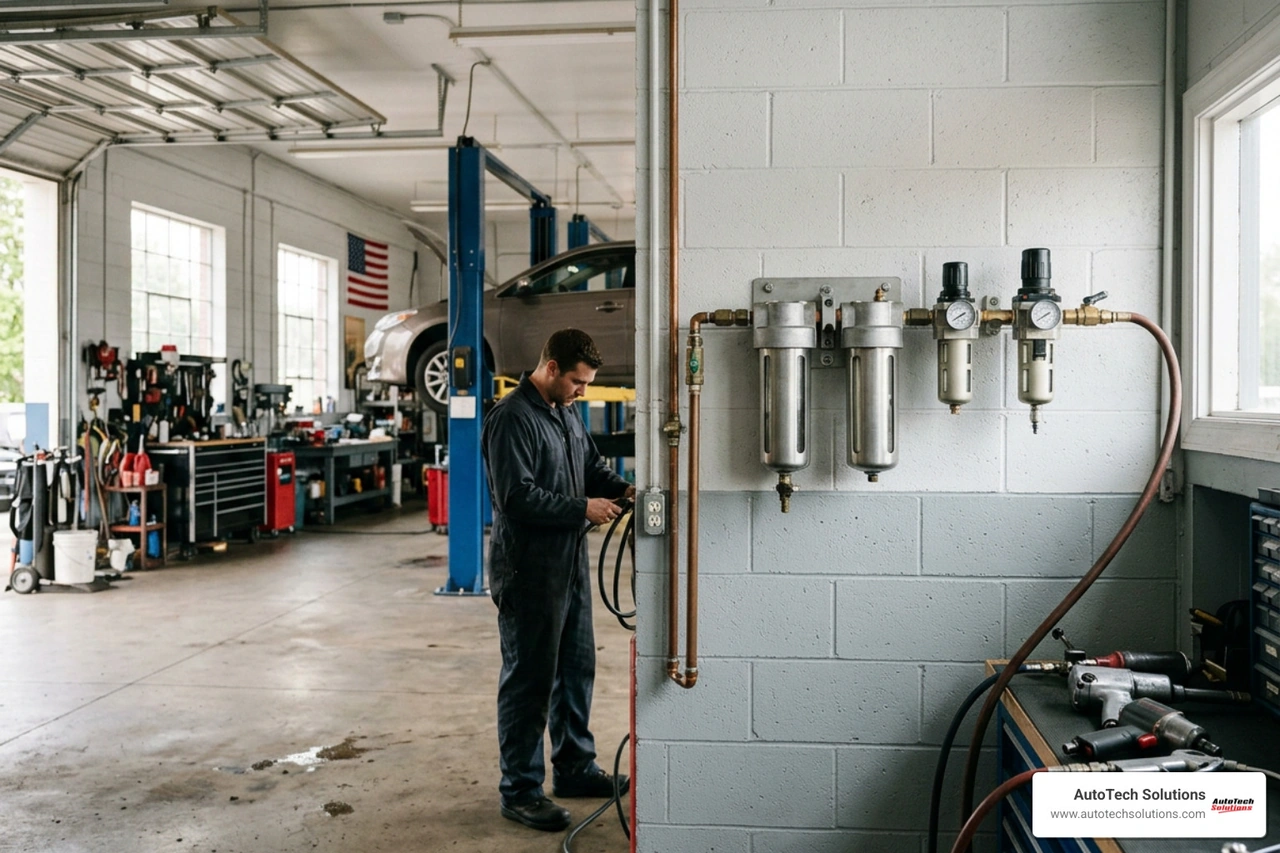
Every bay in your shop depends on compressed air. Lifts, impact wrenches, spray guns, tire equipment — they all run on it. When your compressor goes down, your entire operation stops.
The problem is that most shop managers only call for service after something breaks. That's reactive maintenance — and it's almost always more expensive, more disruptive, and harder to schedule than planned care.
Auto shops are particularly tough environments for compressors. Dust, grease, temperature swings, and near-constant demand push equipment hard. A compressor that might last years in a light-duty setting can wear down fast without regular attention.
The good news? Most of the costly failures are preventable. A consistent bi-annual service schedule keeps your system running at full efficiency, extends equipment life, and protects your bottom line.
Understanding Air Compressor Preventative Maintenance Service
In automotive shop management, there are two ways to handle equipment: you can control the machine, or the machine can control you. Air compressor preventative maintenance service is about taking control.
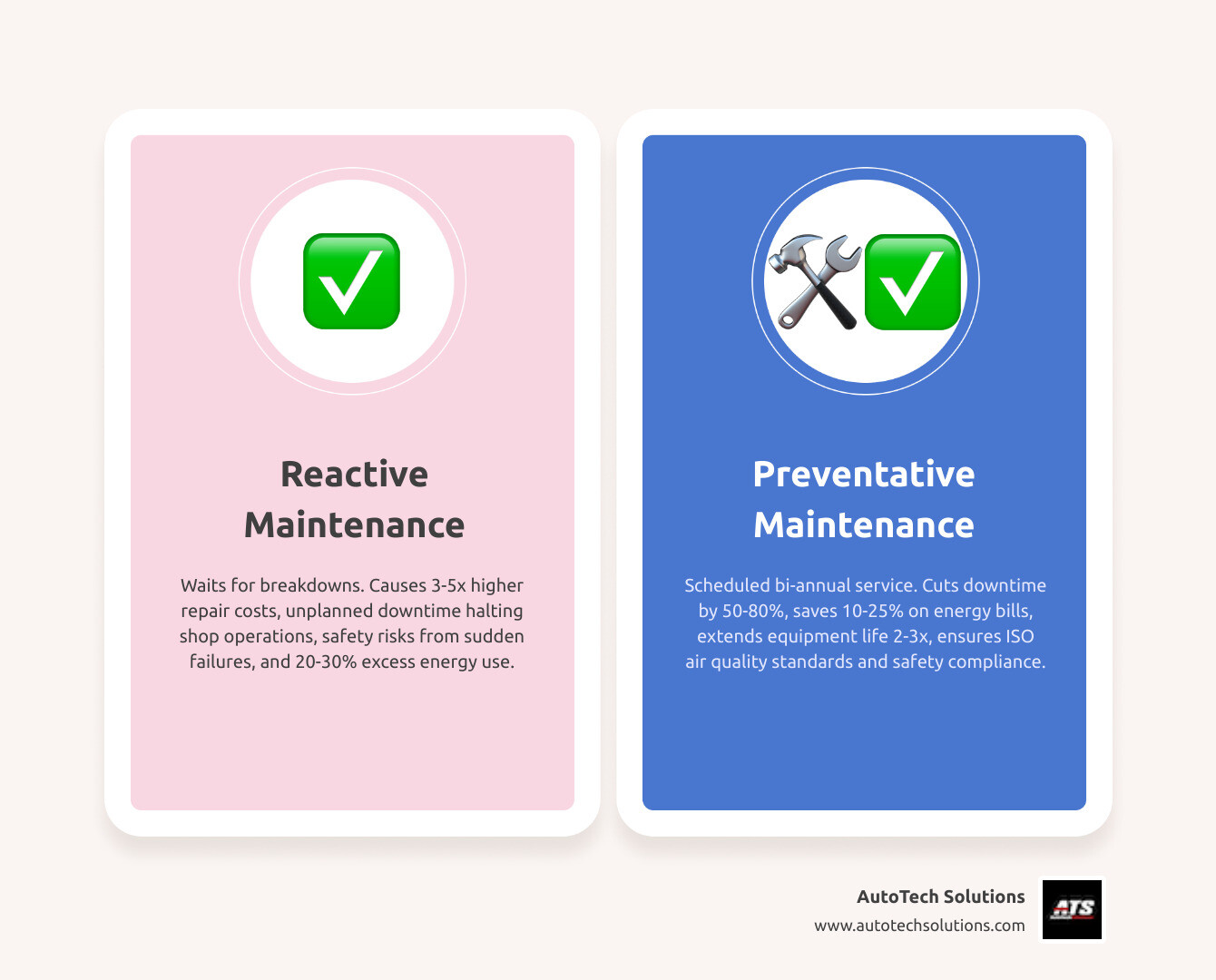
Unlike reactive maintenance—where you wait for a loud bang or a sudden drop in pressure before calling for help—preventative care is a proactive strategy. It involves scheduled inspections, cleaning, and parts replacement based on operating hours or calendar dates. While standard maintenance might just involve an occasional oil top-off, a true preventative program ensures your system meets ISO standards for air quality and operates without unnecessary energy waste.
When we neglect these systems, we aren't just risking a breakdown; we are actively throwing money away. A clogged filter makes the motor work harder, drawing more electricity. A small leak might seem silent, but it forces the compressor to cycle more frequently, accelerating wear on every internal component.
| Maintenance Type | Timing | Cost Impact | Operational Impact |
|---|---|---|---|
| Preventative | Scheduled & Proactive | Fixed, predictable budget | High uptime; extended equipment life |
| Reactive | After Failure | Emergency rates & lost revenue | Sudden downtime; "fire-fighting" mode |
Benefits of a Preventative Maintenance Program
At AutoTech Solutions, we see how a structured program transforms a shop's workflow. The primary benefit is downtime reduction. If your compressor fails at 10:00 AM on a Tuesday, your technicians are standing around while the clock ticks. Preventative care catches the frayed belt or the overheating motor before the bay goes dark.
Furthermore, there are significant cost savings. It is far cheaper to replace a $50 filter than a $5,000 motor. Beyond the hardware, you ensure safety compliance. Air receivers are pressurized vessels; regular inspections of safety valves and tank integrity prevent catastrophic accidents like fires or explosions. Finally, you get sustained performance. Your tools work at the torque they were designed for because the system maintains the correct PSI without struggle. More info about preventative maintenance services
Why Automotive Shops Require Bi-Annual Service
Why every six months? Why not once a year? The automotive shop environment is uniquely hostile to air compressors. Between sanding dust in the collision center and the oily mist in a heavy-duty repair bay, intake filters clog much faster than in a clean warehouse.
Heavy usage is another factor. Most shops run their air systems from open to close, 300+ days a year. This constant demand leads to moisture buildup. If that moisture isn't managed through bi-annual dryer checks and daily draining, it leads to internal corrosion and ruined pneumatic tools. By committing to a six-month service interval, we ensure that environmental contaminants are cleared out before they can cause permanent damage. Automotive Equipment Repair
The Comprehensive Automotive Shop Maintenance Checklist
A professional air compressor preventative maintenance service isn't just a quick "look-over." It’s a systematic deep dive into the machine's vitals.

Our technicians follow a rigorous process to ensure nothing is missed. The checklist starts with the basics:
- Intake Vents: Cleaning these ensures the machine can "breathe" without restriction.
- Air Filters: These should be changed every 1,000 hours to keep dirt out of the air end.
- Oil Filters & Lubricant: Vital for cooling and friction reduction. Lubricant typically needs changing every 4,000 to 8,000 hours, depending on whether you use synthetic or standard oil.
- Motor Bearings: These require fresh grease every 2,000 hours to prevent seized motors.
- Belts: We check for tension and signs of fraying. A snapped belt is a common cause of "emergency" calls that could have been avoided.
- Condensate Drains: Ensuring these are functional prevents water from backing up into the tank.
For those running specific setups, you can refer to this Rotary Screw/Rotary Vane Compressor Maintenance Checklist to see the level of detail required for industrial-grade equipment.
Essential Tasks for Rotary Screw and Reciprocating Models
Different compressors have different needs.
- Rotary Screw Models: These are the workhorses of modern shops. Maintenance focuses on the oil-flooded system. We pay close attention to the separator elements, which keep the oil out of your air lines. Cooling systems—including radiators and fans—must be blown out to prevent overheating.
- Reciprocating (Piston) Models: These often require more frequent oil changes, sometimes every 500 to 1,000 hours. We inspect the piston valves for carbon buildup and ensure the vibration isolators are intact to prevent tank fatigue.
Regardless of the model, testing the safety shutoff systems is non-negotiable. You can find more specific tasks here: Reciprocating Compressor Maintenance Checklist.
Maintaining Air Quality with Dryers and Separators
The compressor creates the air, but the treatment system makes it usable. In a paint booth, even a tiny drop of oil or water can ruin a high-end finish.
- Refrigerated Dryers: These should be serviced annually. We clean the condenser coils and test the drain valves to ensure they are actually ejecting water.
- Desiccant Dryers: We check the desiccant beads for oil contamination, which can "poison" the material and stop it from absorbing moisture.
- Oil/Water Separators: To stay environmentally compliant in states like North Carolina and Michigan, you must ensure that the oil you've removed from the air doesn't end up in the local sewer system.
For a deep dive into air quality components, review the Refrigerated Air Dryer Maintenance Checklist.
Optimizing Performance and Detecting Common Issues
Optimization is the difference between a system that "works" and one that thrives. One of the most common "silent killers" in an auto shop is the air leak.
A single 1/4-inch leak can cost a shop thousands of dollars a year in wasted energy. During a professional air compressor preventative maintenance service, we look for:
- Pressure Drops: If there is a significant difference between the pressure at the tank and the tool, you likely have a clogged filter or an undersized pipe.
- Overheating: Often caused by low oil levels or dirty coolers. If a compressor runs too hot, the oil breaks down faster, leading to premature air end failure.
- Contamination: If you see "milky" oil, water is getting into the lubricant. If you see metal flakes, a bearing is failing.
- Vibration Analysis: Excessive shaking usually points to a mounting issue or an unbalanced pump, which can eventually crack the air lines.
By catching these issues early, we help you manage shop equipment across multiple locations without the headache of constant repairs. Managing Shop Equipment Maintenance Across Multiple Locations
Leveraging Remote Monitoring for Air Compressor Preventative Maintenance Service
Welcome to the era of Industry 4.0. Modern industrial compressors can now be equipped with remote monitoring tools. These systems track data in real-time, sending proactive alerts to your phone or our service center before a fault occurs.
Instead of guessing when a filter is clogged, the system measures the pressure differential and tells you exactly when it's time for a change. This data-driven approach maximizes energy efficiency and ensures you never miss a service window. Service, Repair, and Equipment Support
The Role of Genuine Parts and Factory-Trained Technicians
It can be tempting to buy "will-fit" parts from a generic online retailer. However, genuine parts are 100% designed for your specific equipment. They maintain the system integrity and ensure that warranties remain valid.
At AutoTech Solutions, our factory-trained technicians perform a comprehensive 28-point inspection during every visit. We don't just change the oil; we check the voltage and amps, test safety valves, and inspect anchoring bolts. This level of expertise is critical for complex tasks like a new Air Compressor Installation or a system overhaul.
Professional Service vs. In-House Maintenance Strategies
We often get asked: "Can't my lead tech just handle this?"
There is certainly a place for in-house maintenance. Your team should be doing daily visual inspections and draining the condensate tanks. They should keep the area around the compressor clean and listen for new, unusual noises.
However, professional service is required for the "heavy lifting." Adjusting pressure switches, performing vibration analysis, and conducting internal inspections of the air end require specialized tools and diagnostic equipment that most shops don't keep on hand. Furthermore, having a certified record of professional maintenance is often a requirement for insurance and warranty claims.
Choosing the Right Air Compressor Preventative Maintenance Service Plan
Not every shop needs the same level of care. A small 2-bay shop in Wade, NC, has different needs than a massive collision center in Charlotte or a heavy-duty fleet facility in Novi, MI.
AutoTech Solutions offers flexible plans ranging from basic semi-annual inspections to comprehensive "Total Responsibility" plans. These plans often include:
- Priority Assistance: If you do have an issue, you go to the front of the line.
- Emergency Response: We offer fast response times (often within 4 hours) to get you back up and running.
- All-Inclusive Pricing: No surprises on your invoice; parts and labor for scheduled visits are covered.
Regular maintenance on your compressor is just as vital as Automotive Paint Booth Maintenance—both are essential for a high-quality output.
Frequently Asked Questions
How often should an automotive air compressor be serviced?
For most automotive shops, we recommend a bi-annual (every 6 months) service. However, if your compressor reaches 2,000 operating hours before the six-month mark, you should service it then. Environmental factors like high heat or heavy dust can also shorten these intervals.
What are the risks of neglecting preventative maintenance?
Neglect leads to "budget jeopardy." You might save $400 today by skipping a service, but you risk a $6,000 emergency repair and $10,000 in lost productivity next month. Beyond the money, neglecting safety valves and tank drains creates a genuine safety hazard for your staff.
Can our shop staff perform air compressor maintenance in-house?
Your team should handle the daily "housekeeping" tasks: checking oil levels, draining moisture, and cleaning the intake area. However, leave the filter changes, belt tensioning, and safety valve testing to factory-trained technicians. A professional inspection catches the "small" issues that an untrained eye will miss.
Conclusion
Your air compressor is the heartbeat of your shop. When it's healthy, work flows smoothly, and your customers are happy. When it fails, everything stops.
AutoTech Solutions is dedicated to keeping shops across Michigan and the Carolinas—from Raleigh and Wade to Charlotte and Novi—running at peak performance. Whether you operate a light-duty repair shop or a heavy-duty collision center, our expert support and fast repair response are designed to minimize your downtime.
Don't wait for a breakdown to realize how much you depend on your air system. Invest in a professional air compressor preventative maintenance service today and keep your bays moving. Preventative Maintenance Programs