
Commercial Car Floor Jacks for Sale: Professional Types and Bay Applications
Commercial automotive facilities require lifting equipment that balances speed, stability, and rugged hydraulic engineering. Selecting the right lifting configuration directly impacts bay turnover and operational safety. While entry-level service tools might suffice for infrequent tasks, commercial repair shops demand heavy-duty jacks engineered for thousands of continuous cycles without pressure bleed or structural fatigue.
Understanding the functional differences among floor jack designs ensures that your technicians use the correct tool for specific chassis designs and vehicle weight classes. For broader context on how lifting equipment fits into professional shop operations, the American Society of Mechanical Engineers publishes widely referenced safety and design standards for portable automotive service equipment.
Sourcing Low-Profile Car Floor Jacks for Sale for Service Bays
Modern passenger vehicles, performance sports coupes, and unibody crossovers feature low ground clearance and extensive aerodynamic undertrays. Standard lifting equipment often fails to reach designated structural points without crushing rocker panels or side skirts.
Low-profile floor jacks resolve this issue by offering ultra-low collapsed saddle heights, often between 3.25 and 3.75 inches. Key advantages include:
- Subframe and Pinch-Weld Access: Slim chassis profiles slide beneath low ground clearances to seat squarely on reinforced unibody pinch welds or suspension mounting perches.
- Dual-Piston Rapid-Lift Hydraulics: High-efficiency dual-pump systems build pressure quickly, lifting the saddle to contact the chassis in as few as 3.5 pumps.
- Chassis Protection: Wide, rubber-padded saddles prevent metal-on-metal slippage and eliminate damage to protective undercoatings.
In busy service bays, low-profile jacks provide the versatility needed to service low-clearance sedans alongside standard passenger vehicles without switching lifting hardware.
Long-Reach and Rolling Bridge Jacks for Service Bay Lifts
When lifting points are recessed deep beneath extended front overhangs or long wheelbases, standard frame jacks lack the reach to position the saddle safely. Long-reach jacks feature extended chassis bodies—frequently exceeding 30 to 40 inches in overall length—allowing technicians to position the saddle beneath engine cradles or central differential housings while keeping the pumping handle clear of the bumper.
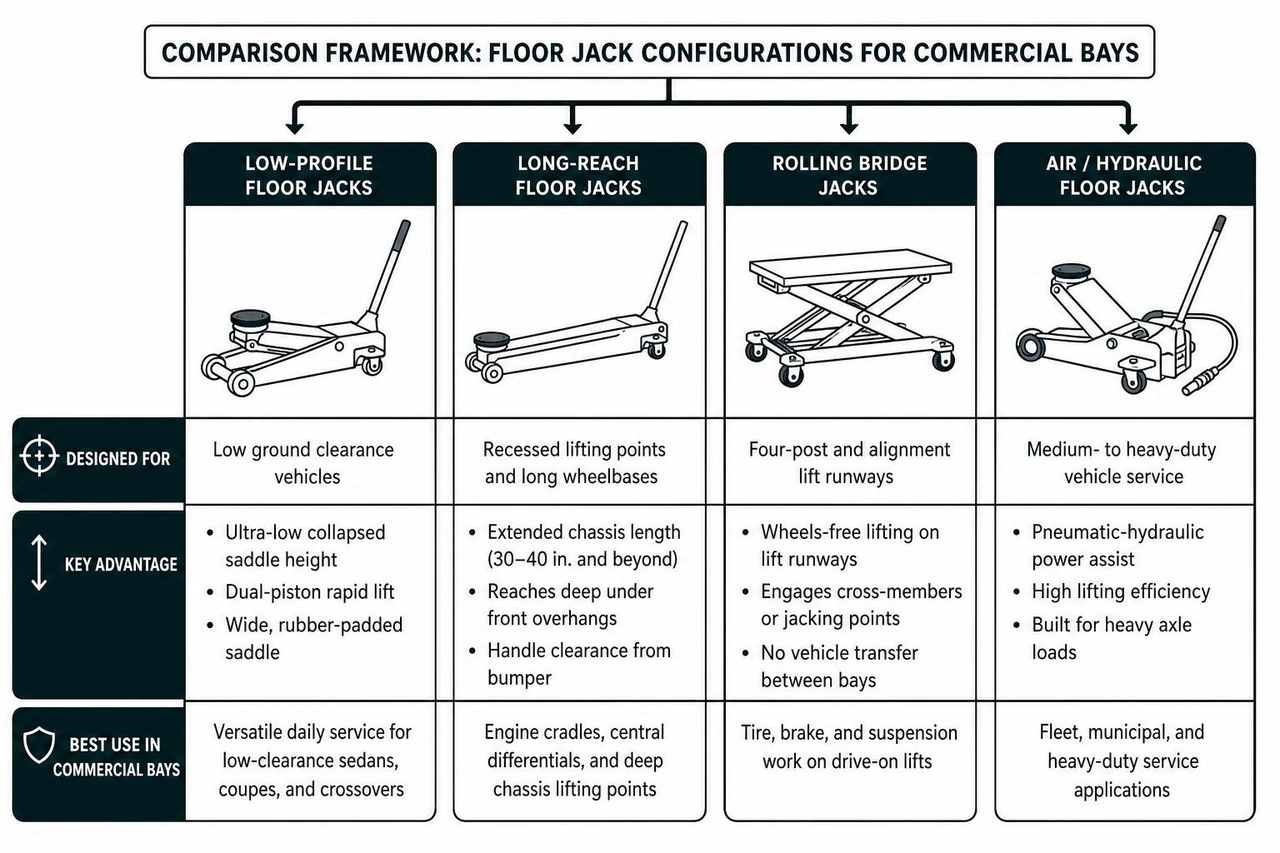
For facilities equipped with drive-on four-post or alignment lifts, rolling bridge jacks provide integrated wheels-free lifting capability. These pneumatic or hydraulic scissor units roll smoothly along the inner rails of the lift runways. By engaging cross-members or dedicated jacking points directly on the lift, rolling bridge jacks eliminate the need to transfer vehicles between bays for tire, brake, and suspension servicing. When updating or expanding existing alignment racks, sourcing compatible car lift parts keeps your primary lift systems operational and fully compliant.
High-Capacity Air/Hydraulic and Pneumatic Units
Medium- and heavy-duty commercial service facilities, municipal fleet barns, and vocational repair shops handle heavy axle loads that quickly wear down manual hydraulic pumps. Integrating an air-hydraulic floor jack into your bays utilizes shop air lines to power a high-pressure pneumatic-hydraulic booster pump.
Operating at standard commercial compressor pressures (90 to 150 PSI), air/hydraulic jacks deliver effortless, rapid lifting under severe mechanical loads. Technicians simply actuate a handle-mounted pneumatic valve or foot trigger to raise commercial axle assemblies, utility trucks, and delivery chassis smoothly. For heavy tandem axles, low-bed commercial trailers, and high-tonnage transport rigs, utilizing a high-tonnage 20 ton car jack ensures complete hydraulic stability without straining shop personnel.
Engineering Specifications: Hydraulic Efficiency and ASME-PASE Compliance
Commercial lifting equipment must perform consistently under continuous duty cycles. Investing in professional-grade garage gear requires reviewing critical engineering specifications, hydraulic circuit protections, and third-party certifications.
The American Society of Mechanical Engineers' safety standard for portable automotive service equipment (ASME-PASE) outlines rigorous design, stability, and overload thresholds. Certified floor jacks feature structural safety valves that prevent the cylinder from extending beyond its rated tonnage, alongside internal bypass circuits that prevent over-pumping when the ram reaches its mechanical stroke limit.
| Specification Feature | Professional Steel Jacks | Billet Aircraft Aluminum Jacks | Air/Hydraulic Heavy-Duty Jacks |
|---|---|---|---|
| Typical Rated Tonnage | 3 Ton – 4 Ton (6,000 – 8,000 lbs) | 2 Ton – 3 Ton (4,000 – 6,000 lbs) | 10 Ton – 22+ Ton (20,000 – 44,000 lbs) |
| Minimum Saddle Height | 3.375 in. – 4.25 in. | 3.5 in. – 3.8 in. | 8.0 in. – 9.5 in. |
| Maximum Lift Height | 20.25 in. – 24.25 in. | 16.75 in. – 19.125 in. | 19.0 in. – 22.0 in. |
| Unit Weight | 70 lbs – 104 lbs | 42.7 lbs – 63.3 lbs | 85 lbs – 190 lbs |
| Primary Structural Material | Heavy-gauge welded plate steel | CNC billet & plate aluminum | Solid cast iron & heavy plate steel |
| Ideal Bay Application | General automotive service, high volume | Mobile bay service, trackside, quick pits | Municipal fleets, vocational trucks, buses |
Equipping your facility with heavy-duty garage tools and equipment certified to these standards minimizes structural failure risks and ensures compliance with shop safety audits.
Determining Commercial Tonnage Ratings and Lift Clearances
Selecting the appropriate jack capacity requires evaluating the gross vehicle weight rating (GVWR) across your client fleet and calculating axle load distributions:
- Axle Weight Calculation: When lifting one end of a vehicle (front or rear), the floor jack supports approximately 50% to 65% of the total vehicle weight.
- Safety Margin: Commercial best practices dictate adding a minimum 25% safety margin above the calculated axle load. A 6,000-lb full-size passenger SUV with a 60/40 front-to-rear distribution places roughly 3,600 lbs on the front axle; a 3-ton (6,000-lb capacity) jack easily accommodates this with an extensive safety overhead.
- Lift Height Clearance: Verify that the jack's maximum lift height (typically 20 to 24.25 inches on long-reach models) provides sufficient travel to unload the suspension fully, clear the tire from the floor, and leave ample clearance to position secondary mechanical stands underneath.

Steel vs. Aircraft Aluminum Billet Chassis in High-Volume Bays
Choosing between industrial-welded steel and aircraft-grade aluminum alloy depends on how your technicians use the equipment:
- Welded Heavy-Gauge Steel: Steel remains the gold standard for dedicated service bays. With rugged plate side frames, heavy front rollers, and durable powder coating, steel jacks readily handle 5,000+ commercial lift cycles. Their substantial chassis mass (often 70 to 105 lbs) delivers superior torsional stiffness when lifting offset loads.
- Billet Aluminum Racing Designs: Aluminum floor jacks weigh up to 40% less than equivalent steel models (averaging 42 to 63 lbs). Featuring side-mounted carry handles, dual parallel pump pistons, and rear swivel casters, aluminum models excel in mobile dispatch units, tire staging areas, and rapid-turnaround bays where technicians constantly transport tools between service stalls.
Shop Safety Standards, Secondary Support, and Maintenance Protocols
Safety in commercial service environments relies on strict operational procedures. Hydraulic floor jacks are designed purely for dynamic lifting; they should never be used as static, sustained load supports.

Lift Point Verification and Rated Mechanical Jack Stands
Hydraulic systems rely on pressurized fluid contained by elastomeric seals and internal check valves. A sudden pressure drop caused by seal wear, contamination, or mechanical valve failure will lower an unsupported vehicle instantly.
To maintain OSHA and industry safety compliance:
- Deploy Rated Pin-Style Jack Stands: Always transfer the vehicle load immediately to a pair of rated mechanical jack stands placed directly beneath certified factory lifting points, such as solid frame rails, heavy axle tubes, or reinforced subframe junctions.
- Cross-Beam Adapters: When servicing unibody passenger vehicles, utilize cross-beam jack adapters. These attachments span across structural chassis rails, distributing hydraulic lifting force across two contact points to prevent frame distortion.
- Universal Joint Control: Ensure your jacks feature universal joint release mechanisms. Unlike direct-gear releases, universal joint assemblies allow technicians to rotate the handle for smooth, feather-controlled descents from any handle angle.
Hydraulic Cylinder Care, Fluid Bleeding, and Preventive Maintenance
Preventive maintenance keeps your hydraulic equipment operating safely and extends the service life of internal components. Technicians should follow a consistent maintenance schedule:
- Air Purging (Bleeding): Trapped air within the hydraulic circuit causes spongy pumping action and reduces stroke height. To purge the system, open the release valve two full turns, pump the operating handle rapidly through 10 to 15 full cycles to vent aerated fluid back into the reservoir, close the release valve, and test stroke firmness.
- Fluid Level Inspections: Maintain proper fluid levels using clean, high-grade ISO viscosity hydraulic jack oil. Never substitute brake fluid, engine oil, or transmission fluid, as their chemical additives will deteriorate internal nitrile wiper seals and cause cylinder leaks.
- Magnetic Filtration Systems: Premium commercial jacks integrate internal magnetic drain plugs or filtration elements within the oil circuit. These capture microscopic ferrous wear particles generated by the pump pistons, protecting the main ram surface from scoring and premature seal failure.
Commercial Selection Guide: Floor Jacks Across Vehicle Classes
Matching your lifting hardware to your specific service workload keeps bays running efficiently. For a comprehensive overview of equipment layouts across light-duty, commercial, and collision repair bays, review our automotive equipment solutions guide.
Evaluating Heavy-Duty Car Floor Jacks for Sale for Fleet Maintenance
Fleet maintenance facilities handling municipal utility vans, heavy-duty diesel pickups, and vocational chassis require specialized lifting gear. These vehicles feature elevated suspension travels, heavy solid live axles, and gross vehicle ratings often exceeding 10,000 to 14,000 lbs.
When outfitting fleet bays, look for:
- Wide-Track Stance: Extra-wide side plates and heavy-duty front rollers prevent chassis twisting when lifting high-center-of-gravity utility bodies.
- Extended Lifting Range: Units with a starting height of 4.25 inches and an extended stroke of 20 to 24 inches ensure you can raise tall light-truck suspension systems without requiring unsafe wooden blocking.
- Overload Protection Valves: Factory-set hydraulic relief valves prevent operators from attempting lifts beyond the jack’s rated structural threshold.
Outfitting General Service Bays for Multi-Vehicle Throughput
High-volume general automotive service operations see a wide mix of sedans, European imports, SUVs, and half-ton pickups. To maintain smooth vehicle intake:
- Standardize on 3-Ton to 4-Ton Low-Profile Units: Standardizing your general bays on 3-ton or 4-ton low-profile long-reach jacks provides the flexibility to handle compact front-wheel-drive sedans and extended-wheelbase SUVs with a single tool.
- Ergonomic Foot Pedals: Built-in rapid-advance foot pedals allow technicians to bring the lifting saddle into initial contact with the chassis hands-free, freeing their hands to center rubber saddle pads precisely on pinch welds.
- 360-Degree Ball-Bearing Casters: Industrial-grade rear swivel casters with sealed ball bearings ensure smooth rolling across bay floors, even over metal grates, air lines, and shop expansion joints.
Frequently Asked Questions About Commercial Floor Jacks
What tonnage capacity is required for commercial repair facilities?
For general automotive repair shops servicing passenger cars, crossovers, and half-ton trucks, a 3-ton (6,000-lb) or 4-ton (8,000-lb) hydraulic floor jack serves as the optimal baseline. Fleet repair facilities that regularly service 3/4-ton to 1-ton commercial vans, utility trucks, and heavy vocational equipment should deploy 5-ton to 10-ton hydraulic units or 20-ton air/hydraulic jacks to maintain appropriate safety margins.
Why must commercial technicians avoid using floor jacks as sustained supports?
Hydraulic floor jacks rely on dynamic hydraulic fluid pressure sealed by internal O-rings, check valves, and wiper cups. Fluid thermal contraction, minor internal valve seepage, or accidental handle contact can cause the lifting arm to lower unexpectedly. Commercial safety regulations (including OSHA and ASME-PASE protocols) mandate that raised vehicles must be lowered onto mechanically locked, rated jack stands before any diagnostic or under-vehicle repair begins.
How frequently should commercial hydraulic floor jacks undergo preventive maintenance?
In professional automotive shops, technicians should perform visual inspections daily to check for hydraulic oil leaks, frame cracks, bent linkages, and caster wear. Hydraulic air purging and fluid level verifications should be completed quarterly, while full structural and seal inspections should occur annually to maintain workplace safety standards.
Maximize Bay Productivity with AutoTech Solutions
Maintaining high-volume bay throughput and technician safety requires durable lifting equipment backed by reliable service. At AutoTech Solutions, we are a dedicated one-stop partner for automotive shop equipment sales, professional car lift installation, certified service, and proactive preventative maintenance across Michigan and the Carolinas.
Whether you are updating general service stalls, configuring heavy fleet bays, or expanding a multi-bay repair facility, our local teams in Charlotte, NC, Raleigh, NC, Wade, NC, and Novi, MI deliver fast turnaround, expert support, and commercial equipment designed to minimize shop downtime.
Explore our comprehensive commercial lifting solutions and heavy shop equipment by visiting the AutoTech Solutions equipment catalog or contacting your regional service specialist today.