Find Fast, Reliable Hydraulic Hose Repair for Your Shop
When you need hydraulic hoses repair near me, start by calling a qualified commercial equipment service provider that can verify the hose size, pressure rating, fittings, and routing for your automotive lift or shop equipment. Ask whether they offer:
- Mobile on-site service for equipment that cannot be taken out of the facility
- Custom hose fabrication and certified crimping with new hose and matching fittings
- Same-day or emergency availability for burst lines, leaks, or sudden pressure loss
- Pressure and safety checks before the equipment returns to service
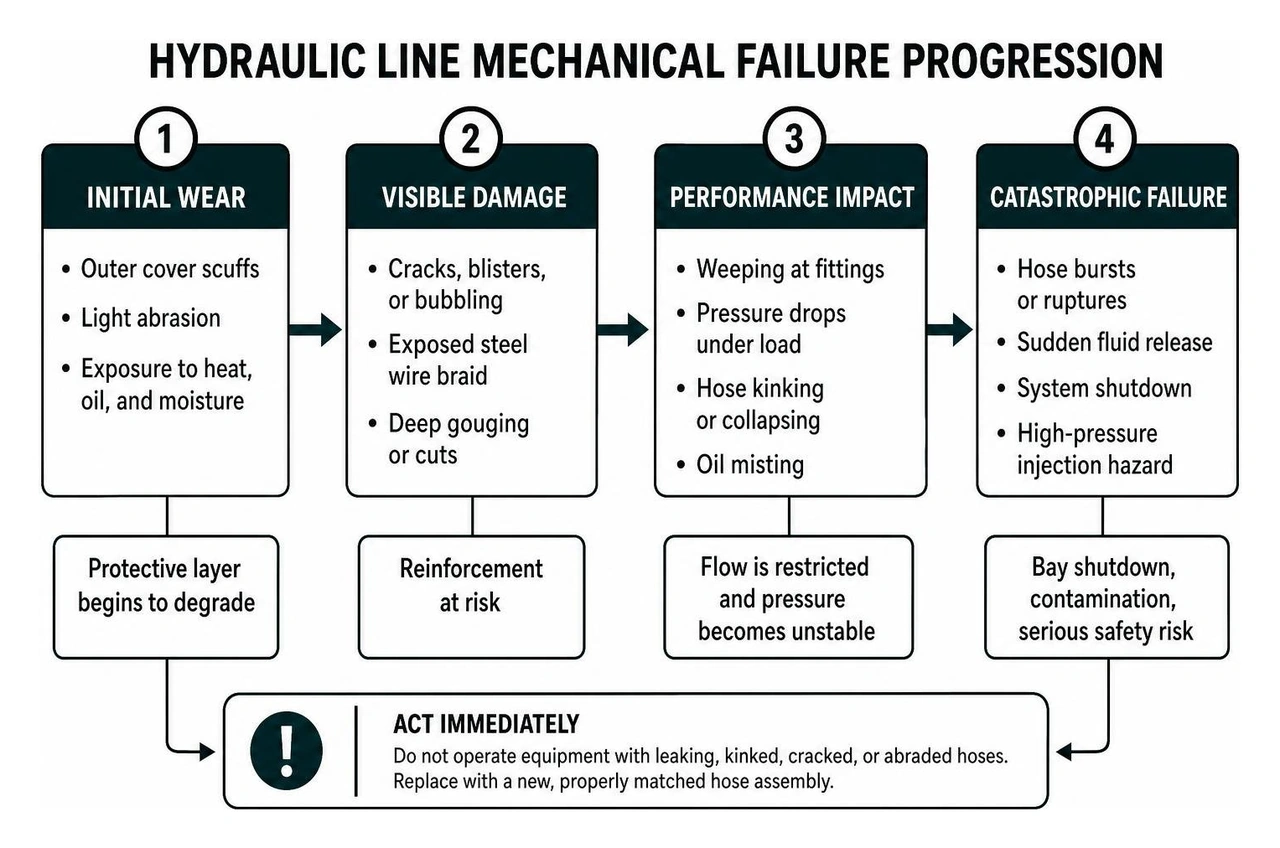
Do not keep operating a lift or other hydraulic shop machine with a leaking, kinked, cracked, or abraded hose. A failed line can stop a bay, contaminate the work area with fluid, and create a serious high-pressure injection hazard.
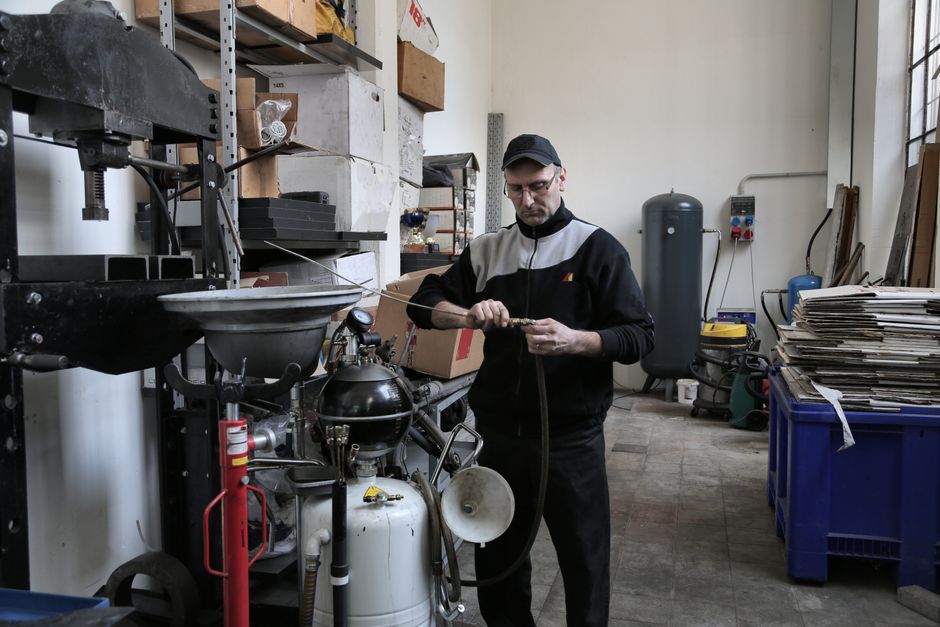
The fastest option depends on the failure. A local hose counter may build a common replacement while you wait, while a mobile technician can measure, fabricate, and install a hose at your facility when downtime makes transport impractical. Either way, the goal is not to patch an old hose, but to install a properly matched new assembly that can safely handle the system's working pressure.
AutoTech Solutions Staff helps commercial automotive and industrial facilities keep essential equipment safe, productive, and ready for work.

Pairing hose replacement with comprehensive hydraulic lift cylinder repair, complete auto lift repair, and routine lift inspection services ensures long-term facility reliability.
For additional industry guidance on hydraulic system safety, refer to the Hydraulic machinery overview.
Critical Warning Signs Your Shop Equipment Needs Immediate Hose Replacement
Operating high-capacity commercial automotive equipment demands zero tolerance for compromised fluid conductors. When a line degrades, total hydraulic pressure failure is rarely far behind, leading to unexpected fluid leakage, bay shutdowns, and equipment stoppage. In heavy-duty automotive facilities, a line failure brings daily operations grinding to a halt. Recognizing physical degradation early allows shop managers to arrange professional automotive equipment repair before an uncontrolled line blowout occurs.

Physical warning indicators demand rapid action. Look for outer cover blisters or bubbling, which point to fluid leaking past the inner tube and migrating along the reinforcement layers. Exposed steel wire braid, deep gouging, and surface cracking signify that environmental exposure and friction have eliminated the protective outer layer. Once moisture reaches the inner carbon steel wire braid, rust sets in, severely weakening burst thresholds.
Furthermore, weeping around end fittings, persistent pressure drops under load, and hydraulic oil misting represent critical hazards. If your commercial lift exhibits fluid weepage near the cylinder base or pump manifold, coordinating hydraulic lift cylinder repair and line replacement is essential to keep shop operations completely safe.
Internal Kinking vs External Abrasion Hazards
Hydraulic lines on commercial machinery face two mechanical failure pathways: internal kinking and external abrasion. External abrasion occurs when lines rub continuously against columns, overhead crossbeams, or adjacent shop infrastructure. Installing protective nylon sleeves or heavy wire wrap armor shields the hose from severe friction points.
Internal kinking, by contrast, happens when an assembly is forced past its minimum bend radius during installation or operation. Standard 1/4-inch hydraulic lines generally require a bend radius of roughly 4 inches, whereas high-flexibility hose lines can safely achieve a tighter 2.5-inch bend radius. Exceeding rated bend thresholds crushes the internal carcass, restricts dynamic flow, creates localized heat buildups, and breaks internal wire reinforcement strands.
Why Re-Crimping Used Hoses Jeopardizes Shop Safety
Attempting to cut away a blown section and re-crimp used fittings onto an aged hose creates severe industrial safety hazards. High-pressure hydraulic lines frequently operate at dynamic pressures between 2,000 and 5,000 PSI. Re-crimping compromised rubber risks immediate fitting detachment under peak impulse loads.
High-pressure fluid injection occurs when pinhole leaks penetrate skin, causing catastrophic soft-tissue trauma requiring immediate surgical intervention. Furthermore, modern crimp couplings rely on biting into fresh elastomer. Premium hydraulic components are engineered to endure up to 1,000,000 impulse cycles when matched strictly with new hose stock. Preserving burst pressure safety factors mandates installing brand-new, certified assemblies built to strict SAE standards.
Options for Fast Hydraulic Hoses Repair Near Me in Commercial Facilities
Commercial facilities cannot afford prolonged equipment stoppage when an overhead lift or shop press fails. When searching for reliable hydraulic solutions, shop managers can choose between dedicated walk-in fabrication counters and fully equipped mobile service units.
| Service Option | Typical Turnaround Time | Primary Advantage | Best Use Case |
|---|---|---|---|
| Walk-In Counter Service | 10 to 20 minutes on-site | Immediate build while you wait | Detachable lines brought directly to the counter |
| Mobile On-Site Dispatch | 45-minute to 1-hour ETA | Zero machine disassembly or travel | Fixed shop infrastructure and multi-bay equipment |
| Emergency After-Hours | Rapid 24/7/365 availability | Eliminates morning downtime | Unexpected evening or weekend line blowouts |
For operations running late shifts, securing after hours automotive lift repair prevents a failed line from disabling morning bay turnover.
On-Site Mobile Dispatch vs Counter Service for Hydraulic Hoses Repair Near Me
When hydraulic lines fail across commercial shops in Charlotte, NC, Raleigh, NC, Wade, NC, or Novi, MI, facility managers face a choice between mobile dispatch and retail counter service. Counter service allows technicians to bring a failed line directly to a local shop, where specialized crimpers cut, match, and fabricate a replacement while you wait in under 15 minutes.
Mobile service trucks bring the entire fabrication workshop directly to your facility. Fully equipped service vehicles carry up to $165,000 in replacement hose stock, fittings, high-speed cut-off saws, and variable-die crimpers. With emergency dispatch units achieving rapid arrival windows, mobile technicians assess line routing, build the new assembly on-location, torque connections to spec, and verify system pressures without requiring your staff to leave the building.
Evaluating Response Time and Capabilities for Hydraulic Hoses Repair Near Me
Evaluating an emergency hydraulic repair provider requires reviewing key shop capabilities:
- Broad Adapter Inventory: Immediate access to standard and specialty fittings, including JIC 37°, ORFS (O-Ring Face Seal), SAE O-ring boss, and metric threads.
- Internal Contamination Control: Use of high-pressure foam projectile cleaners to purge internal cutting debris before final end-fitting installation.
- Pressure Rating Verification: Ensuring replacement lines match or exceed dynamic machine operating pressures up to 5,000 PSI.
- Turnaround Velocity: Consistent 45-minute to 1-hour emergency response windows to minimize workflow disruptions.
Technical Sizing and Matching Criteria for Custom Hydraulic Assemblies
Fabricating custom hydraulic assemblies for commercial shop machinery requires rigorous adherence to the industry-standard STAMPED process (Size, Temperature, Application, Material, Pressure, Ends, Delivery).
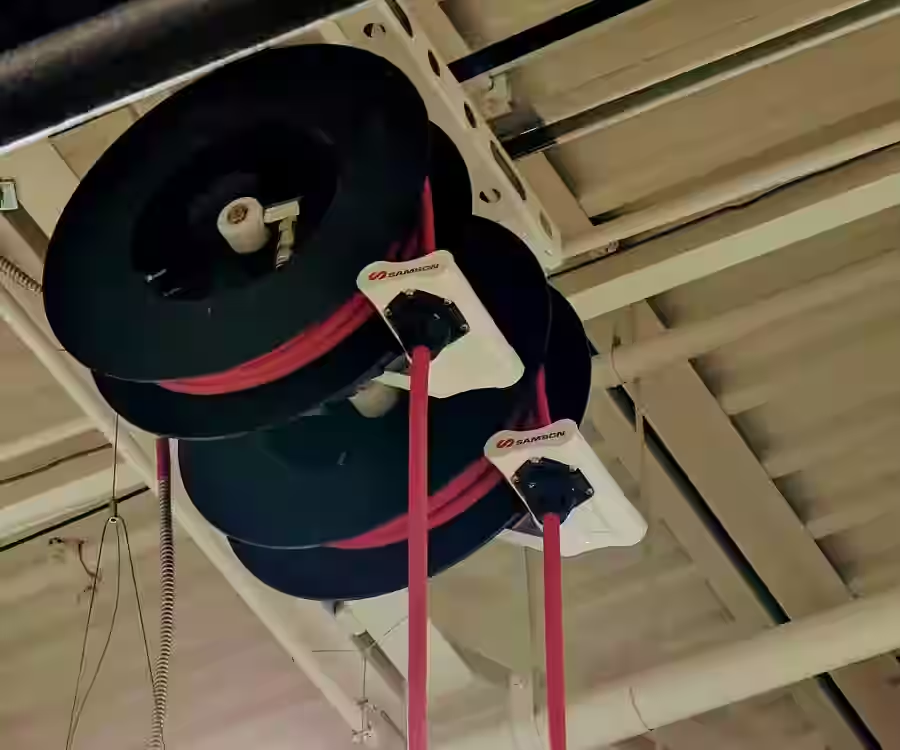
Sizing centers on the inner diameter (I.D.) rather than the outer cover profile. Undersized lines create fluid velocity spikes, excessive fluid friction, and severe thermal buildup. Operating temperature ranges must account for ambient shop conditions as well as hydraulic oil spikes. Application criteria evaluate flexibility needs, dynamic flexing cycles, and whether four-wire spiral braid construction is necessary over standard two-wire braided configurations.
Matching the chemical composition of the inner tube ensures compatibility with specialized hydraulic oils and petroleum-based fluids. Matching working pressure ratings safeguards machinery during high-pressure cycles, while identifying exact end fittings prevents thread stripping and port damage. When maintaining heavy machinery, combining proper hose matching with timely hydraulic motor repair and regular two post lift repair keeps your shop assets operating smoothly.
Matching Fittings and Hose Pressure Ratings
Hydraulic connections must match system port designs precisely. While traditional NPT tapered threads rely on metal-to-metal thread deformation, modern commercial equipment utilizes elastomeric sealing, such as SAE O-ring boss or O-Ring Face Seal (ORFS) couplings, to eliminate weeping under intense vibration.
Dynamic working loads frequently produce rapid impulse pressure spikes that exceed normal operating gauges. High-pressure ratings on replacement lines must incorporate a 4:1 safety factor between continuous working pressure and minimum burst pressure, ensuring structural integrity during heavy automotive lift cycles.
Contamination Control During Hose Fabrication
Cutting a reinforced rubber hose generates particulate contamination, dispersing abrasive rubber dust and metal filings inside the fresh line. If an assembly is installed without thorough internal cleaning, circulating debris travels directly into sensitive directional control valves, scoring cylinder packings and clogging small pilot orifices.
Professional fabrication relies on high-pressure foam projectile purging. Technicians shoot dense foam pellets through the hose bore using compressed air to sweep out cutting debris before crimping end couplings. Capping the assembly with clean seal capsules guarantees that zero foreign particles contaminate your shop's bulk hydraulic oil reservoirs.
Preventative Maintenance to Maximize Hydraulic Line Service Life
Implementing structured preventative maintenance protocols prevents unscheduled commercial shop downtime. Daily operations create structural wear across hydraulic infrastructure, making routine visual checks essential for long-term reliability.
Facility supervisors should inspect line routing across all bays monthly, verifying that lines do not twist during machine movement. Confirm that mounting clamps remain torqued to specification; loose clamping allows high-pressure lines to whip and vibrate during pump engagement, causing metal fatigue at fitting collars. Furthermore, monitoring hydraulic oil operating temperatures prevents fluid breakdown and protects the inner elastomer tube from premature hardening.
Partnering with a dedicated preventative maintenance and repair provider for automotive equipment ensures that commercial shop systems undergo thorough physical inspections. Combining scheduled line inspections with comprehensive car lift maintenance ensures long-term operational efficiency and worker safety.
Frequently Asked Questions About Commercial Hydraulic Hose Repair
How quickly can a custom hydraulic hose be fabricated for shop equipment?
Walk-in counter services build custom assemblies while you wait in roughly 10 to 15 minutes. For on-site service, mobile dispatch trucks arrive equipped to measure, cut, purge, and crimp replacement lines on-location within a 45-minute to 1-hour window.
What factors determine the total cost of hydraulic hose replacement?
Pricing depends on the hose inside diameter, working pressure rating, reinforcement layers (two-wire braid vs. four-wire spiral), specialty fitting materials (JIC, ORFS, SAE flange), overall length, and whether the job is handled at a service counter or via 24/7 mobile dispatch.
Can a blown hydraulic hose on a commercial car lift be patched temporarily?
No. Commercial hydraulic lifts operate under thousands of pounds of pressure. Surface patches, clamps, or compression sleeves cannot safely contain dynamic working pressures, presenting severe burst hazards and fatal high-pressure fluid injection risks. Blown lines must always be replaced with a certified new assembly.
Conclusion: Keeping Commercial Shop Equipment Running Without Costly Delays
Minimizing equipment downtime requires fast, professional hydraulic repair capabilities. A blown hydraulic line halts service bays, delays shop throughput, and introduces serious shop safety risks. By relying on certified custom hose fabrication, strict contamination control, and rapid on-site mobile dispatch, facility managers can eliminate extended outages and maintain maximum productivity.
At AutoTech Solutions, our experienced technicians deliver comprehensive commercial facility maintenance, emergency response, and equipment support across North Carolina and Michigan. Whether your commercial facility requires rapid emergency hydraulic line replacement or routine infrastructure maintenance, connect with our team for dedicated service, repair, and equipment support to keep your shop running at peak performance.