Why a Collision Repair Alignment System Matters for Shop Performance
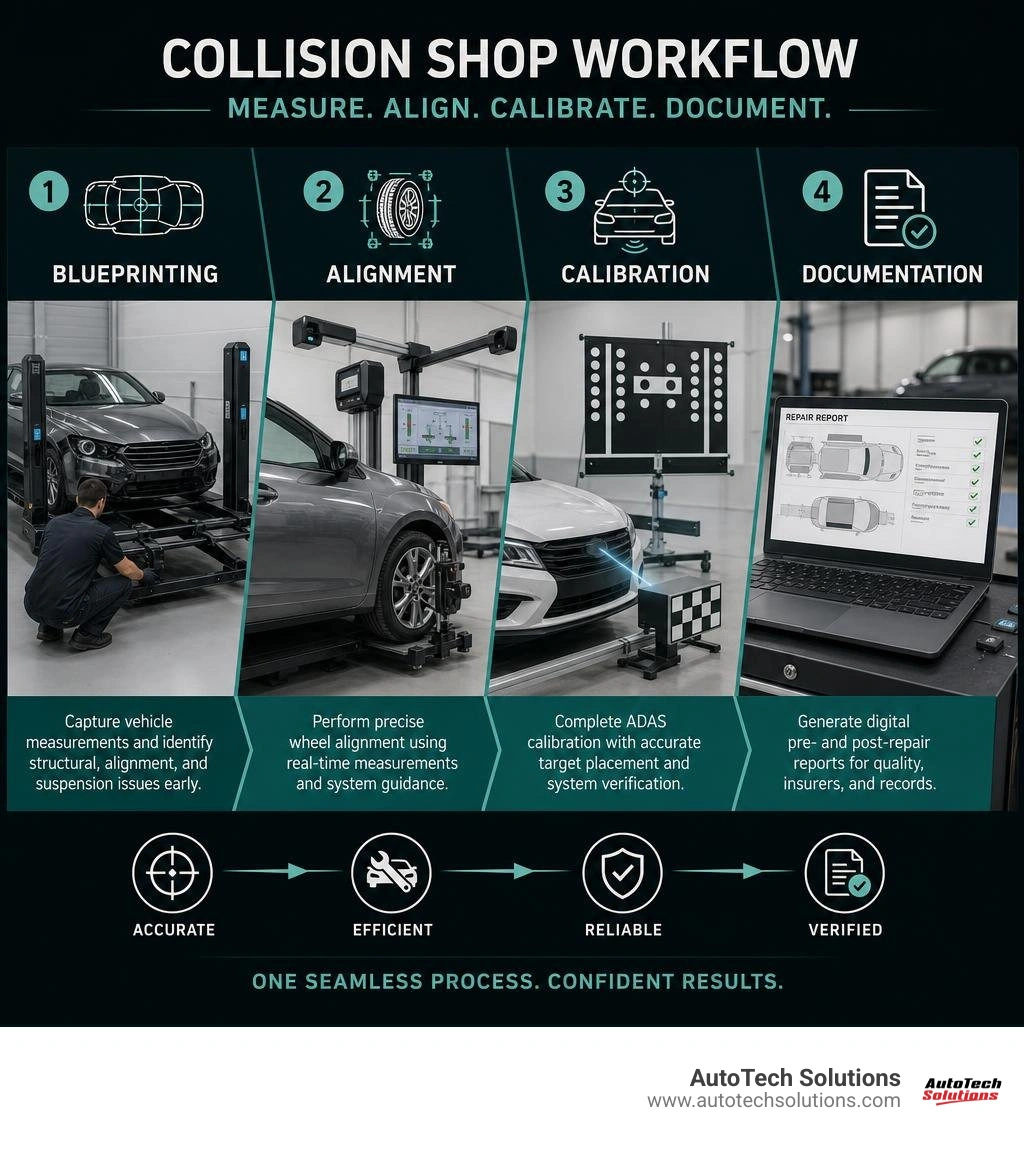
A collision repair alignment system helps professional collision shops measure repair-related geometry issues early, guide accurate alignment work, and document results before a job leaves the facility.
For a quick buying answer, prioritize a system that offers:
- Pre-repair blueprinting to identify alignment, structural, or suspension concerns before the estimate is finalized.
- Integrated alignment and ADAS calibration so technicians can complete related work in one bay.
- Floor-compensation technology that maintains precise target placement without relying on manual strings, tape measures, or level floors.
- Digital pre- and post-repair reports for insurers, quality control, and compliance records.
- Mobile or frame-rack-compatible equipment if bay space and lift availability are limited.
- OEM procedure coverage and support that match the makes your collision center repairs.
The right system is more than an alignment tool. It supports a faster, more predictable repair workflow. Shops that sublet alignment and ADAS work can add roughly three days to a repair timeline, while in-house capability can keep these services within a single day. Early measurements also help teams find hidden issues during blueprinting instead of discovering them after body and paint work are complete.
Modern packages can combine wheel alignment with static ADAS calibration in the same work area. That matters because calibration setup can otherwise consume valuable bay time. Automated guidance and validated target positioning can reduce setup time while creating a clear digital record of the completed process.
AutoTech Solutions Staff will help you compare the system capabilities that best fit your shop's workflow, space, and long-term operating goals.
Collision repair alignment system further reading:
Understanding Collision Repair Alignment Systems
A modern collision repair alignment system is engineered specifically for the demanding environment of full-service body shops and collision centers. Unlike standard retail tire shop aligners that primarily focus on basic toe and camber adjustments, a collision-grade aligner functions as a full structural diagnostic center. It measures complex vehicle geometry—including setback, axle offset, track width difference, wheelbase difference, and body symmetry—to determine whether a chassis or suspension assembly has suffered impact damage.
When a collision occurs, force transfers through the frame, subframes, control arms, and steering linkage. Even subtle impacts can bend a control arm by a fraction of a degree or shift a subframe just enough to destroy proper handling dynamics. If a shop attempts to repair body panels and calibrate advanced safety systems without verifying base structural geometry, the entire repair process becomes compromised.
Integrating advanced diagnostic alignment hardware with an auto body shop frame machine allows technicians to establish precise spatial reference points. At AutoTech Solutions, we help shop owners select systems that give their repair teams an immediate, complete picture of underlying chassis integrity.
Uncovering Hidden Damage Before Repair Begins
One of the greatest operational hazards in a collision center is discovering structural or suspension damage late in the repair cycle. Picture this scenario: a vehicle undergoes frame pulling, body panel replacement, refinishing, and final detailing over six days. On day seven, during final prep, the vehicle is put on an alignment rack, only for the technician to discover a bent strut tower or shifted rear cradle that prevents correct alignment. The job instantly comes to a screeching halt, parts must be ordered, paint work might need rework, and cycle times balloon out of control.
An advanced collision repair alignment system prevents this bottleneck by enabling pre-repair diagnostic checks. By conducting a fast pre-scan and suspension audit right when the vehicle arrives:
- Technicians immediately identify hidden suspension bending, subframe displacement, or unibody twisting.
- Estimators can write complete, accurate damage reports during the initial intake phase rather than submitting constant supplemental estimates.
- Parts procurement starts immediately for all structural and mechanical items, eliminating mid-repair waiting periods.
Using comprehensive software platforms that cross-reference geometry data against massive databases—such as WinAlign software covering over 285 million vehicles—technicians quickly catch non-visible structural distortion before a single bolt is turned.
Blueprinting with a Collision Repair Alignment System
Blueprint planning has become the industry standard for high-throughput collision repair centers across Michigan and North Carolina. Complete teardowns and pre-repair audits during the estimate phase eliminate guesswork and streamline shop throughput.
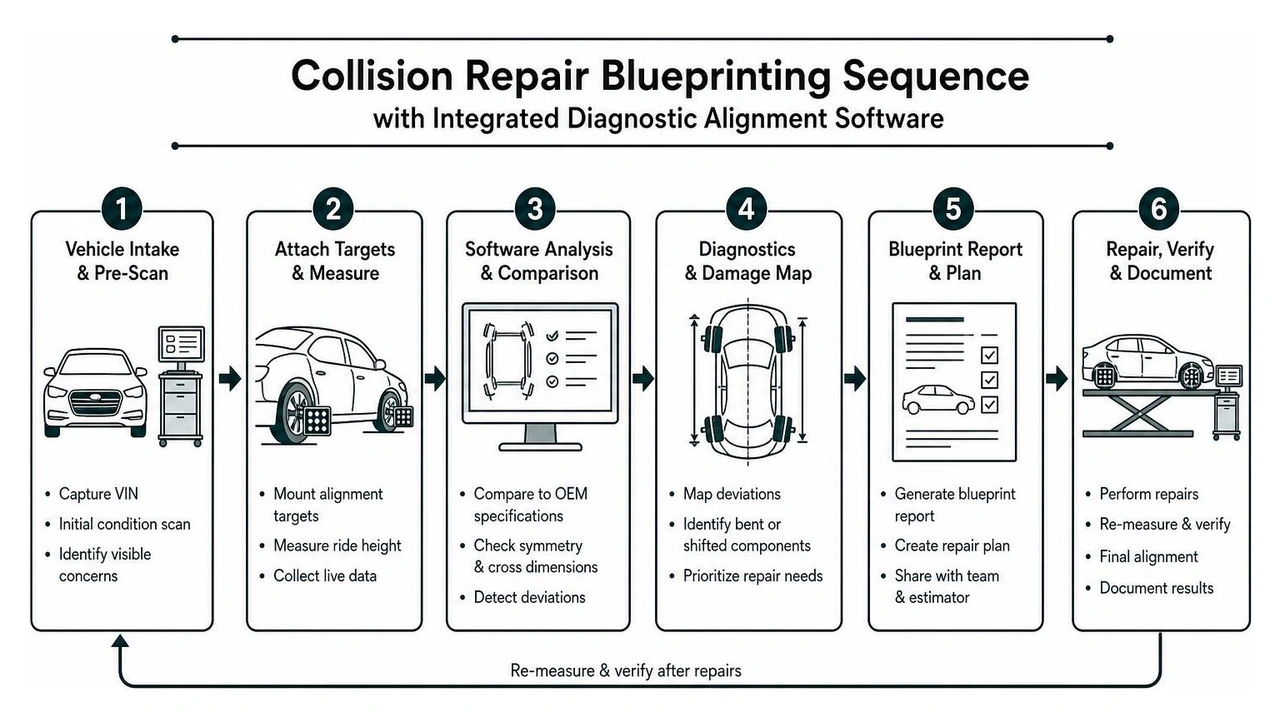
During blueprinting, the collision alignment machine executes a comprehensive suspension body dimension audit. It measures symmetry angles and compares live ride height measurements against factory OEM specifications. More than 20 million vehicles on the road today require exact ride height verification to perform valid alignment service, while over 60 million vehicles benefit from specialized control arm movement monitoring features.
By identifying geometric misalignment at the very beginning, your team can coordinate repair operations smoothly with our automotive frame repair complete guide, ensuring frame pulling and mechanical installation align perfectly with factory dimensional tolerance standards.
Key Features to Look for in a Collision Repair Alignment System
Selecting the ideal equipment for your facility requires evaluating hardware precision, software depth, bay footprint, and speed. Modern collision alignment packages must handle advanced chassis diagnostics while simultaneously laying the foundation for sensor and camera calibration.

Key hardware features to look for when evaluating systems include:
- High-Definition Digital Imaging Cameras: Continuous tracking of high-resolution wheel targets without requiring physical cables or electronic sensors on the wheels.
- Quick-Clamping Wheel Targets: Non-flexible, tire-clamping target assemblies that eliminate metal-to-metal contact on expensive rim faces, reducing setup time and preventing cosmetic wheel damage.
- Integrated ADAS Fixtures: Systems designed to share spatial tracking data directly with static target stands, eliminating redundant layout measurements.
- Comprehensive Software Features: Diagnostic suites including live ride height adjustment, control arm movement monitors, automatic bushing calculators, and symmetry diagnostics. To keep hardware running smoothly over time, consult our guide on collision center equipment maintenance.
Integrated ADAS Calibration and Single-Bay Efficiency
Advanced Driver Assistance Systems (ADAS)—including forward collision warning, adaptive cruise control, lane departure prevention, surround view monitoring, and blind-spot detection—rely on accurate thrust angle and centerline alignments. If a vehicle's thrust line is out by even a fraction of a degree, a forward-facing radar or camera aimed 150 feet down the road will misinterpret target lanes and trigger false braking or steering interventions.
Traditionally, shops performed wheel alignments in one bay and then moved the vehicle to a separate dedicated space for static calibration, forcing technicians to re-measure vehicle centerlines with physical floor strings, plumb bobs, and tape measures. That outdated workflow consumes massive amounts of shop floor space and human labor.
Modern integrated alignment and ADAS solutions combine all alignment and static calibration tasks into a single bay using the same optical measurement hardware. Laser guidance and time-of-flight camera systems eliminate manual measurements entirely, confirming exact target positioning in X, Y, and Z space.
This combination yields massive efficiency gains compared to traditional manual OEM procedures:
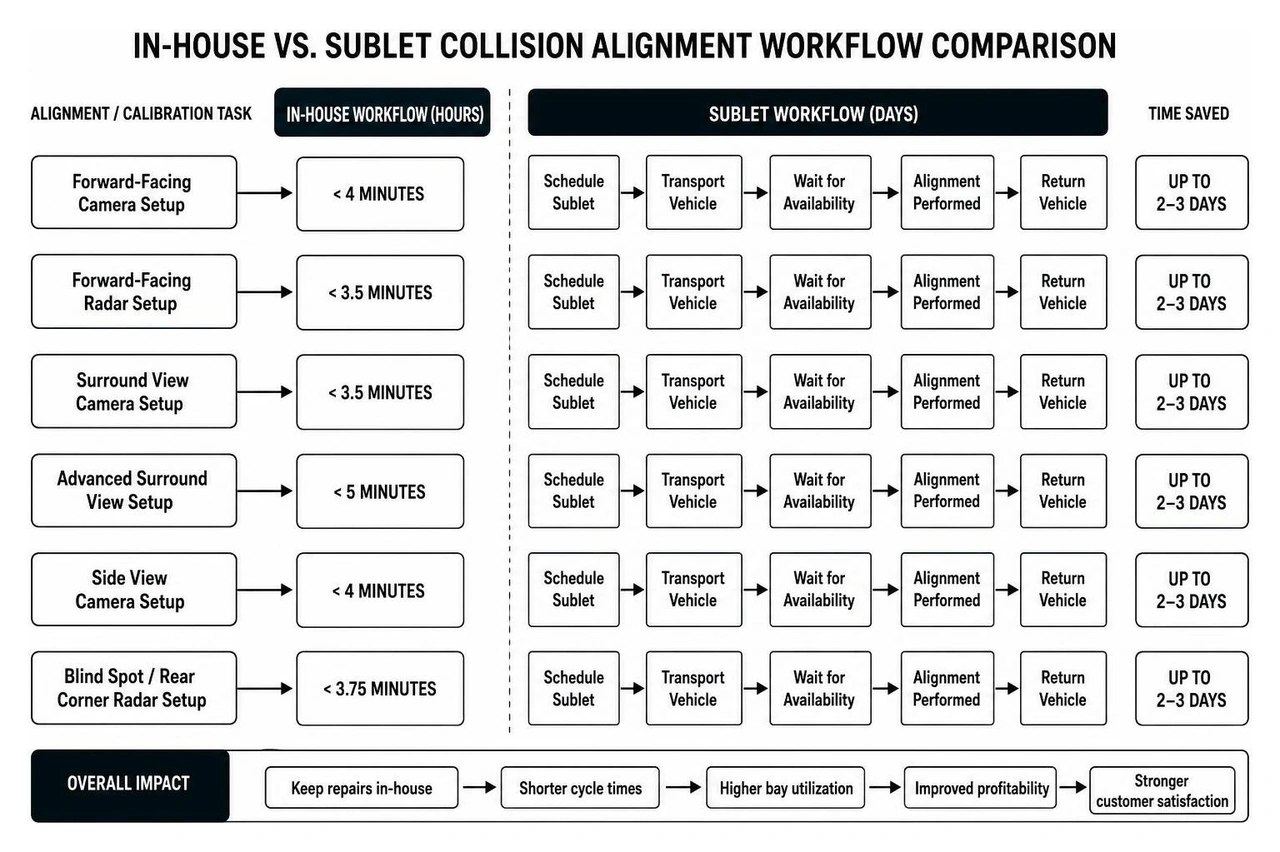
- Forward-Facing Camera Setup: Reduced from 25 minutes down to under 4 minutes (over 70% setup time reduction).
- Forward-Facing Radar Setup: Reduced from 25 minutes down to under 3.5 minutes.
- Surround View Camera Setup: Reduced from 20 minutes down to under 3.5 minutes.
- Advanced Surround View Setup: Reduced from 50 minutes down to under 5 minutes.
- Side View Camera Setup: Reduced from 20 minutes down to under 4 minutes.
- Blind Spot / Rear Corner Radar Setup: Reduced from 13 minutes down to under 3.75 minutes.
To understand proper layout requirements during shop design, refer to our comprehensive adas equipment installation complete guide.
Floor Compensation and Mobile Bay Flexibility
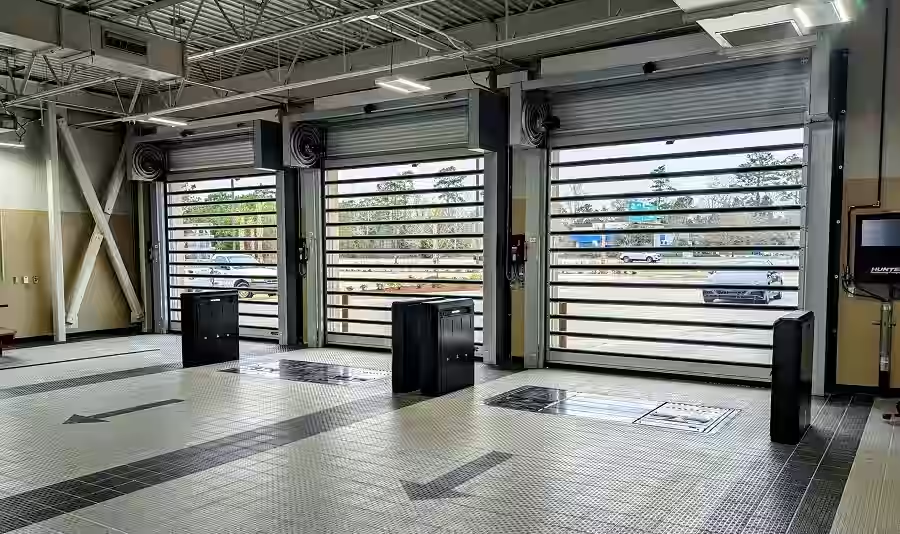
In an ideal world, every shop floor would be perfectly flat and level within a millimeter. In reality, body shop floors slope toward floor drains, exhibit settling cracks, or feature subtle pitch variations across bay boundaries. Standard OEM calibration procedures usually require absolute floor levelness, which can force shops into expensive concrete leveling projects.
Modern collision alignment platforms solve this issue through integrated floor compensation algorithms. Gimbal-mounted lasers and time-of-flight cameras calculate floor slope variations and automatically compensate target height and angle positioning in real time.
Furthermore, shop space is always at a premium. Modern mobile collision aligner configurations offer:
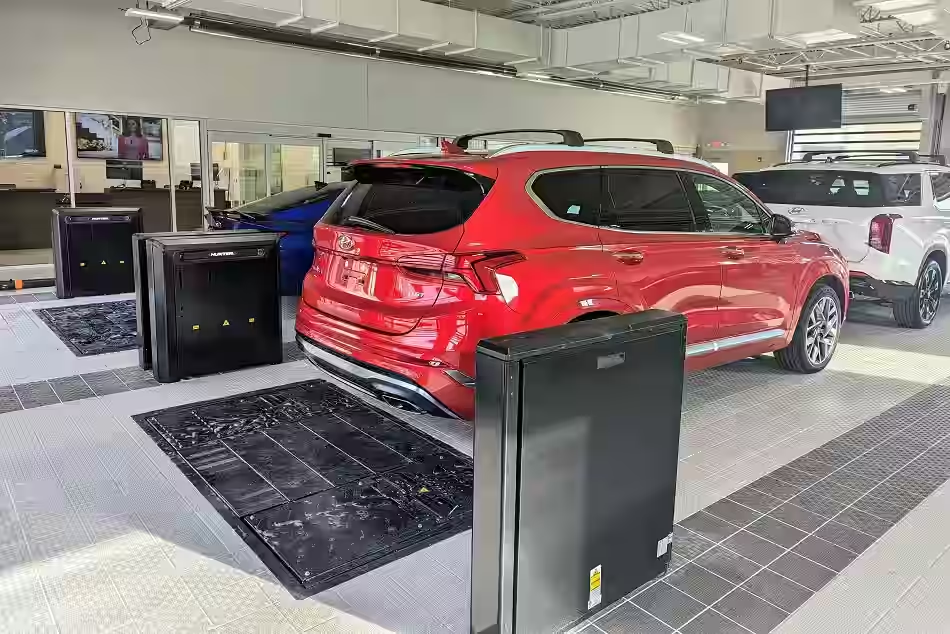
- Battery Backup Systems: Allowing technicians to unplug the unit and roll it across the shop to another bay or frame rack without powering down or losing active vehicle setup data.
- Portable Turn Plate Kits: Enabling accurate measurement and front wheel turn angle compensation directly on existing frame racks or flat bay floors.
- Interchangeable Target Arrays: Allowing seamless switching between standard alignment ramps, two-post lifts, or unibody bench systems.
For full layout planning and structural floor preparation details, visit our collision center equipment install guide.
Financial Impact: In-House Alignment vs. Subletting
Many shop owners historically viewed alignment and calibration work as specialized tasks best handed off to sublet vendors or dealership service departments. However, operating models in 2026 clearly demonstrate that subletting creates operational friction, degrades profitability, and increases liability risk.
Reducing Repair Cycle Times from Days to Hours
In the collision industry, length of rental (LOR) and overall repair cycle time dictate operational success and insurer relations. A typical collision repair timeline averages around 7 days, encompassing intake, blueprinting, body structure pulling, panel replacement, paint, reassembly, mechanical adjustments, alignment, and full ADAS calibration.
Subletting alignment and calibration work severely disrupts this cycle:
- The Sublet Delay: Scheduling a flatbed tow truck, transporting the vehicle to an external facility, waiting for an open service slot, waiting for work execution, and arranging return transport typically adds 3 full days to the overall repair schedule.
- The In-House Advantage: Performing alignment and ADAS services in-house reduces that entire diagnostic, alignment, and calibration sequence down to 1 single day (or less).
Cutting two to three days off average repair cycle times pleases insurance partners, dramatically reduces fleet car rental expenses, increases total monthly shop throughput, and delights customers who want their vehicles back quickly. Facilities operating in high-volume regions constantly refine workflow speed to maintain high customer satisfaction and maximize bay throughput.
Financial ROI of an In-House Collision Repair Alignment System
From a pure revenue perspective, sending alignment and calibration out the door means giving away high-margin labor revenue. Sublet providers mark up service charges, but the body shop retains only a fraction of the gross profit while bearing the transportation logistics and administrative scheduling costs.
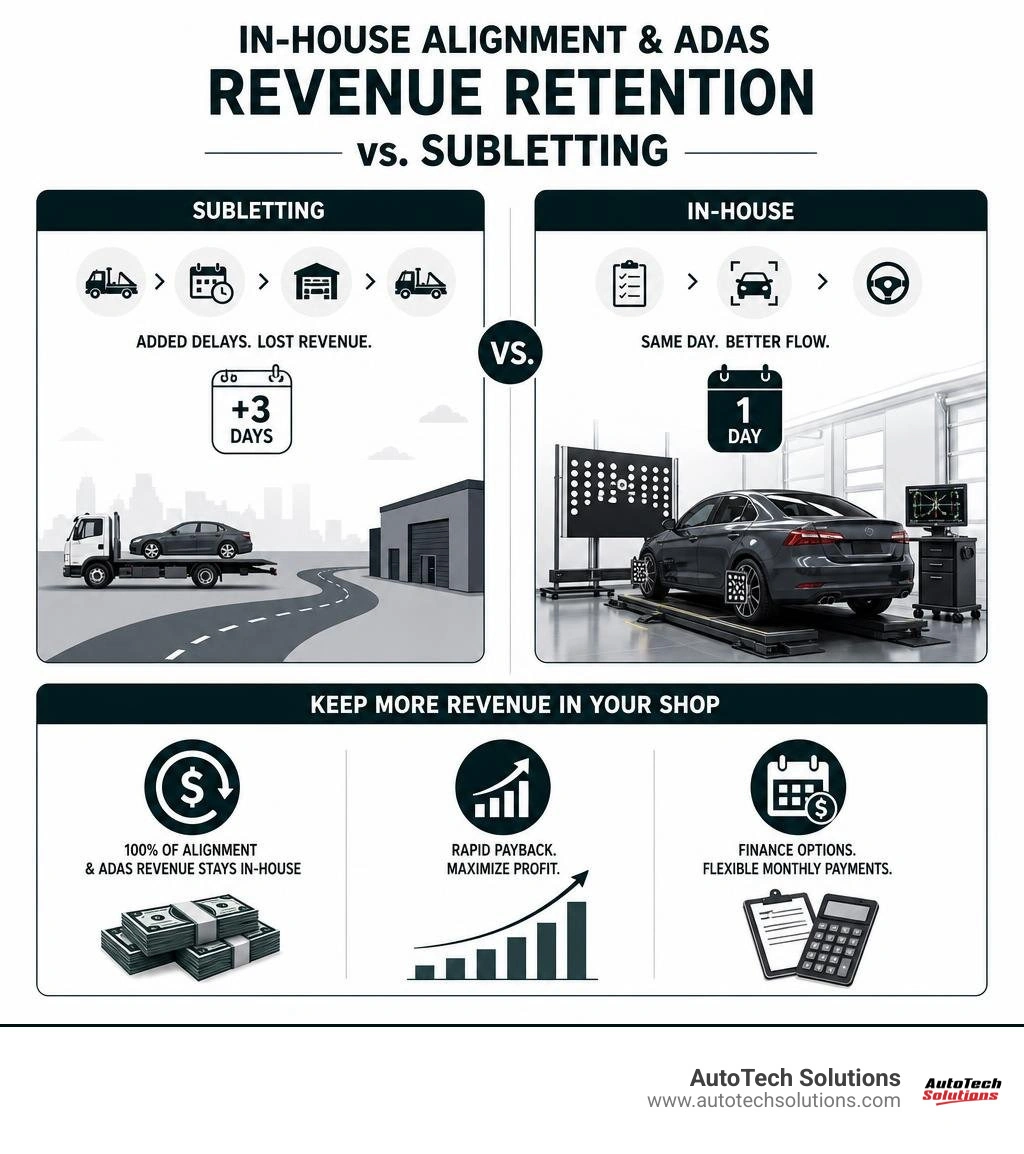
Consider the internal financial dynamics:
- Revenue Retention: Instead of paying $150–$250 for a sublet alignment and $300–$600 for sublet ADAS calibrations, that revenue stays 100% inside your shop.
- Flexible Capital Outlays: Equipment financing and leasing programs—such as dedicated equipment finance structures—allow collision centers to spread capital expenditures over manageable monthly installments.
- Rapid Payback: In high-volume shops, performing just 15 to 20 alignments and 8 to 10 static ADAS calibrations per month covers the monthly lease payment entirely, converting every subsequent procedure directly into pure profit.
- Hardware Longevity: Leading system platforms back their hardware with robust multi-year part warranties, protecting capital investments. For additional component insights, check out our guide on wheel alignment machine parts.
Service centers throughout Charlotte, NC, Raleigh, NC, Fayetteville, NC, and Novi, MI rely on high-precision internal bay setups to keep operations profitable and predictable.
Compliance, Documentation, and OEM Approvals
In modern collision repair, doing the physical work is only half the job—proving that the vehicle was restored safely to exact OEM factory tolerances is equally essential. Insurers, vehicle manufacturers, and customer safety regulations require comprehensive digital documentation before a claim is closed.
Insurance-Ready Pre-and Post-Scan Documentation
When an insurer reviews a collision claim, they want verified, tamper-proof evidence justifying required procedures. A modern collision repair alignment system integrated with digital cloud management solutions (such as HunterNet 2) automatically captures, archives, and outputs comprehensive digital reporting packages.
These digital records include:
- Pre-Repair Audit Reports: Documenting initial toe, camber, caster, setback, axle offset, and ride height values, proving structural damage existed prior to repair.
- Target Placement Verification: Recording precise X, Y, and Z positional coordinates along with angle measurements during static ADAS target setup.
- Post-Repair Alignment Certificates: Verifying that final wheel geometry matches OEM technical specifications exactly.
- Diagnostic Scan Documentation: Confirming pre-scan fault codes, steering angle sensor recalibrations, and post-scan verification showing zero active fault codes.
Having fully memorialized, cloud-archived records shields collision shops from future liability, speeds up insurance claim approvals, and builds trust with vehicle owners. Maintaining calibration accuracy over thousands of cycles requires regular service; read our summary on adas calibration equipment maintenance for practical field tips.
OEM Approvals and Universal Vehicle Coverage
Automakers mandate strict adherence to technical repair standards to ensure driver assistance features function safely. Using unapproved or generic equipment can jeopardize vehicle safety systems and compromise shop compliance.
Leading professional collision alignment packages carry formal OEM equipment approvals across major global brands, including:
- Honda and Acura
- Toyota and Lexus
- Nissan and Infiniti
- Subaru
- Rivian
- General Motors, Ford, and Stellantis brands
When evaluating software capabilities, ensure your platform features expansive database support covering hundreds of millions of vehicle configurations. Specialized software utilities like the Control Arm Movement Monitor® (benefiting over 60 million vehicles) and Automatic Bushing Calculator® (benefiting over 10 million light trucks and vans) guide technicians through complex mechanical adjustments quickly, eliminating tedious trial-and-error shim calculations. Maintaining strict adherence to NHTSA driver assistance standards and OEM specifications ensures that every vehicle released meets factory specs.
For shops servicing heavy-duty vehicles alongside commercial light trucks, pairing your alignment setup with our rotary wheel service complete guide or wheel balancer equipment ensures your entire wheel service bay is built for performance.
Frequently Asked Questions About Collision Alignment Systems
How much space does a collision alignment system require?
Traditional standalone ADAS calibration spaces required dedicated 30x50-foot clear bays free of reflective surfaces, overhead lights, or uneven floors. Modern integrated alignment systems eliminate this bottleneck by enabling alignment and static ADAS calibrations within standard 16x24-foot service bays. Features like unlevel floor compensation and time-of-flight target positioning allow shop managers to maximize existing bay space without expensive facility additions.
Can a collision alignment system be integrated with existing frame racks?
Yes. High-performance collision alignment packages feature mobile cabinet options, battery backup power, and portable turn plate kits designed specifically for integration with unibody frame machines and drive-on alignment lifts. Technicians can measure structural geometry and perform pull corrections directly on the frame rack, then roll the alignment cabinet to an adjacent bay without losing setup calibration or rebooting software.
Why are pre-repair alignment checks critical before ADAS calibrations?
ADAS sensors and forward cameras calculate safety interventions relative to the vehicle's true mechanical thrust line, not the geometric center of the body shell. If a car has uncorrected rear axle setback, thrust line deflection, or sagged suspension ride height, calibrating a camera or radar system to the physical body shell will result in misaimed sensors. Performing a full pre-repair alignment check verifies base chassis geometry before camera or radar calibration begins, preventing dangerous sensor drift on the road.
Conclusion and Final Recommendations
Choosing the right collision repair alignment system is one of the most strategic decisions a shop manager can make. Upgrading from slow, manual layout methods or eliminating sublet dependencies transforms your collision center's operational capability.
By selecting an integrated package that features pre-repair blueprinting, laser-guided target placement, floor compensation, and comprehensive insurance-ready reporting, your facility can:
- Reduce repair cycle times from days down to hours.
- Capture high-margin labor revenue currently lost to sublet providers.
- Ensure complete compliance with strict OEM factory calibration standards.
- Uncover hidden structural damage early in the estimating process to prevent costly delays.
At AutoTech Solutions, our dedicated field teams across Charlotte, NC, Raleigh, NC, Wade, NC, and Novi, MI specialize in helping body shop operators evaluate, install, and maintain high-performance alignment equipment, car lifts, and diagnostic technologies. We minimize shop downtime through fast field service, preventative maintenance, and expert technical support tailored directly to commercial automotive facilities.
Ready to eliminate sublet delays, reclaim lost profit margins, and streamline your shop workflow? Explore Collision Shop Equipment Solutions or contact our technical team today to schedule an on-site equipment consultation.