Why Collision Welding Equipment Service Directly Impacts Your Shop's Bottom Line

Collision welding equipment service is the routine and professional maintenance, inspection, calibration, and repair of welding tools used in auto body and collision repair — including MIG welders, resistance spot welders, and plastic welding systems.
Here's what proper collision welding equipment service covers:
- Daily checks - Inspect tips, electrodes, wire feed, and gas flow before each shift
- Periodic maintenance - Clean cooling systems, dress electrodes, and check cable insulation regularly
- Professional calibration - Verify weld output matches OEM specifications, typically once per year
- Component replacement - Swap worn torches, liners, ground clamps, and inverter parts before they fail
- Software and firmware updates - Keep smart welders running with the latest manufacturer settings
Modern collision shops run on tight margins. A welder that's out of spec doesn't just produce bad welds — it creates liability, slows down technicians, and puts vehicles back on the road with compromised structural integrity.
Every minute a key piece of equipment is down, your shop loses revenue. And with today's vehicles built from advanced high-strength steels and aluminum, a poorly maintained welder isn't just an inconvenience — it's a safety risk.
That's why shop managers and owners across the industry treat welding equipment maintenance as a non-negotiable operational priority, not an afterthought.
This guide walks you through everything you need to know to keep your collision welding equipment performing at its best — from daily checks to finding the right service partner.
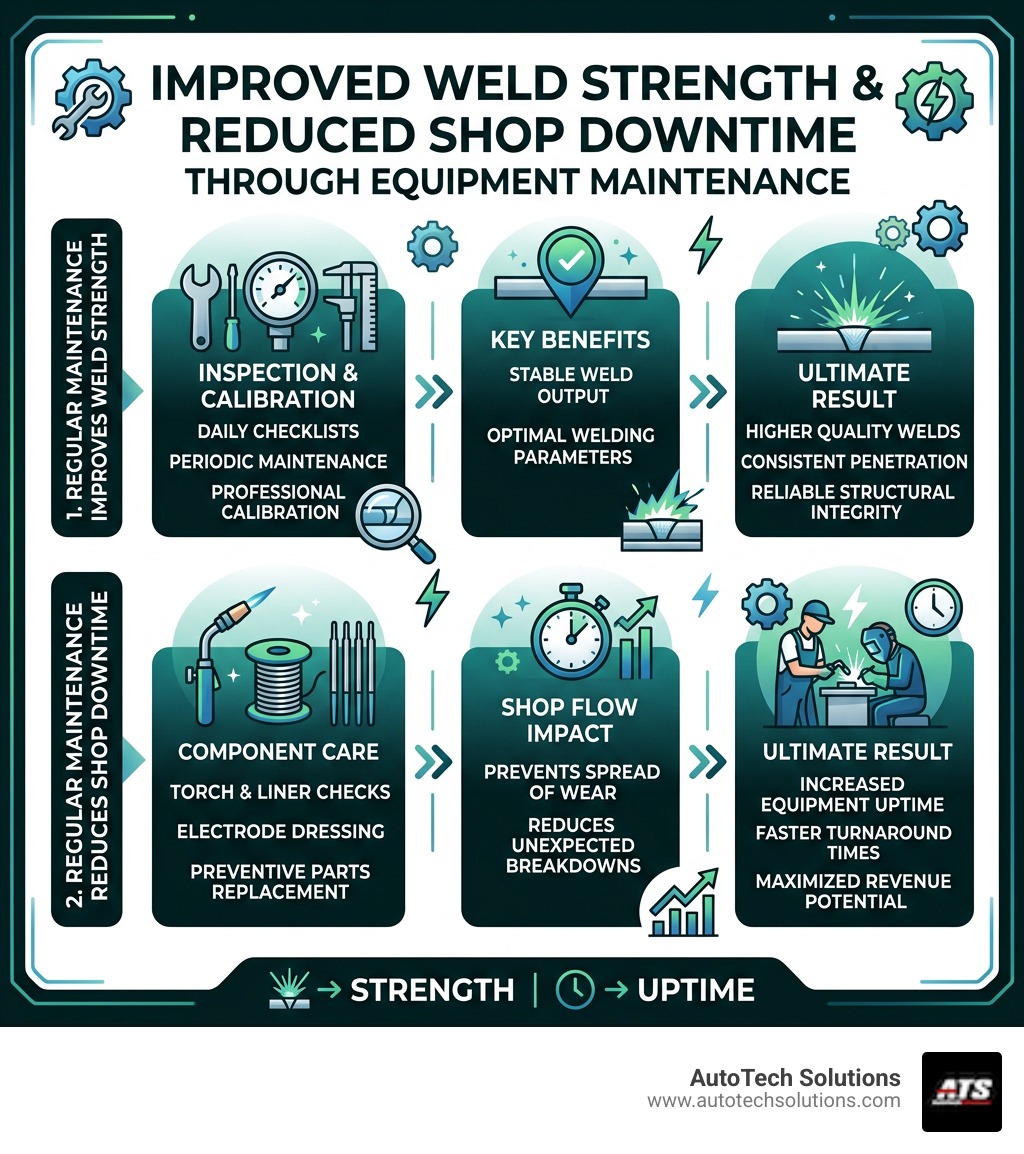
Collision welding equipment service terms simplified:
Essential Equipment Types in Modern Collision Repair
In the "good old days," a basic MIG welder and a sledgehammer might have gotten you through most body work. Today, the floor of a high-production shop in Raleigh or Novi looks more like a high-tech laboratory. The variety of materials used in modern vehicle architecture—from ultra-high-strength steel (UHSS) to carbon fiber and aluminum—requires a diverse arsenal of welding technology.
MIG/MAG and Inverter Technology
The Gas Metal Arc Welding (GMAW) setup, commonly referred to as MIG (Metal Inert Gas) or MAG (Metal Active Gas), remains the workhorse of the industry. However, the technology inside the box has shifted from heavy, transformer-based units to sophisticated inverter technology. Inverters allow for much finer control over the arc, enabling features like "pulse" welding, which is essential for thin-gauge materials and aluminum. At AutoTech Solutions, we see these machines as the heart of the shop, and their complexity means they require specialized collision welding equipment service to keep their circuit boards and cooling fans dust-free.
Resistance Spot Welders
To mimic factory-quality joins, shops rely on Squeeze-Type Resistance Spot Welders (STRSW). These machines, like the i5s Smart Spot Welder or TECNA units, use massive amounts of current and pressure to create a weld. Because they often require 3-phase, 60-amp power, their internal components are under immense stress. Proper maintenance of the water-cooling systems in these units is the difference between a perfect factory-style weld and a blown-out hole in a customer's quarter panel.
Specialized Welding Solutions
Beyond steel, shops now utilize:
- Nitrogen Plastic Welders: These use heated nitrogen gas to prevent oxidation while fusing plastic bumpers and tabs, turning a "replace" part into a "repair" profit center.
- Silicon Bronze Welding: Often used for joining high-strength steels where traditional welding would destroy the metal's heat treatment.
- Aluminum Repair Stations: Dedicated areas with specialized MIG welders and pullers to prevent cross-contamination with steel dust.
For more information on how to outfit your shop with these technologies, explore our Collision Center Solutions.
High-Strength Steel and Aluminum Requirements
The metallurgy of modern vehicles is a picky beast. High-strength steels are engineered for specific crash-energy management. If a technician applies too much heat—either through the wrong settings or a poorly calibrated machine—the steel can become brittle or lose its strength entirely.
This is why collision welding equipment service includes verifying that the machine's "smart" settings are actually delivering the voltage and amperage they claim on the screen. For aluminum, the challenge is even greater. Aluminum dissipates heat rapidly and is prone to oxidation. Pulse welding technology is a must-have here, as it "flicks" the metal into the weld pool, creating a strong bond without melting the surrounding panel. Keeping your aluminum-specific gear in top shape is a specialized task; learn more about Aluminum Repair Equipment Maintenance to avoid costly rework.
Specialized Plastic and Rubber Welding Tools
We've all seen the graveyard of plastic bumpers behind a body shop. Modern nitrogen welding technology is changing that. By using a nitrogen gas delivery system, these tools eliminate the oxygen that causes plastic to char and weaken during the repair. This allows for structural-grade repairs on tabs and bumpers that were previously destined for the landfill.
Service implications for these tools usually involve checking gas regulators for leaks and ensuring the heating elements aren't clogged with polymer residue. Adhesive removal is another critical step in this process; using the right tools to prep the surface ensures the weld actually sticks.
The Critical Role of Collision Welding Equipment Service
Why bother with a formal service schedule? If the machine turns on and wire comes out the end, isn't it fine? Not necessarily.
Weld Consistency and Liability Reduction
In the event of a secondary collision, the structural integrity of your repairs will be under the microscope. If a weld fails because the machine wasn't properly calibrated, the liability falls squarely on the shop. Regular collision welding equipment service provides a paper trail of maintenance and calibration, proving that you followed OEM repair procedures and used equipment that was functioning to factory specs.
Equipment Longevity
A resistance spot welder is a significant investment, often costing upwards of $10,000 to $20,000. Neglecting the cooling system or allowing dust to settle on the inverter boards is a fast track to a $5,000 repair bill. Think of service as an insurance policy for your most expensive tools. For those in our service area from Michigan to the Carolinas, we provide comprehensive Automotive Equipment Repair to keep these assets running for years.
Why Routine Collision Welding Equipment Service Prevents Downtime
At AutoTech Solutions, our mantra is "minimizing downtime." We know that a broken welder in the middle of a structural pull is a disaster.
- Revenue Protection: If your technicians are standing around waiting for a repairman, you're losing hundreds of dollars per hour.
- Emergency Repairs: While we pride ourselves on fast repair response, the best emergency repair is the one you never had to make because of preventative maintenance.
- Component Wear: Small things like worn feed liners or dirty drive rolls can cause "bird-nesting" of welding wire, wasting time and materials.
Our team supports shops with Service, Repair, and Equipment Support to ensure that "small things" stay small.
Benefits of OEM-Approved Servicing
Many manufacturers, such as Pro-Spot, require specific service protocols to maintain warranty compliance. OEM-approved servicing ensures:
- Factory Specifications: Your machine is tested against the exact parameters set by the engineers who built it.
- Software Updates: Modern welders are essentially computers with a torch. Firmware updates can improve arc stability and add new material profiles.
- Precision Calibration: Certified technicians use specialized meters to ensure the digital readout on your machine matches the actual output at the electrode.
Maintenance Protocols for Peak Performance
A successful maintenance program is a partnership between your technicians and your service provider. Use the table below to distinguish between what your team should do and what the pros should handle.
| Task Frequency | Component | Action Required |
|---|---|---|
| Daily | Electrodes/Tips | Inspect for wear; clean or dress as needed. |
| Daily | Wire Feed | Check for smooth tension and lack of kinks. |
| Weekly | Cables/Hoses | Inspect insulation for cuts or burns. |
| Monthly | Cooling System | Check coolant levels and look for leaks. |
| Bi-Annually | Internal Components | Blow out dust from inverter boards (low pressure). |
| Annually | Professional Service | Full calibration, software updates, and safety check. |
Identifying Signs Your Shop Needs Collision Welding Equipment Service
Your equipment will usually try to tell you it's unhappy before it quits entirely. Listen for these "cries for help":
- Erratic Arc: If the arc sounds like a bag of angry popcorn rather than a smooth hiss, you likely have a feed or ground issue.
- Error Codes: Don't just cycle the power to clear a code. Persistent codes often indicate an overheating inverter or a failing cooling pump.
- Poor Penetration: If your welds are "sitting on top" of the metal despite high settings, your machine might not be delivering the amperage it claims.
- Porosity: Pinholes in your weld usually mean a gas delivery issue—likely a leaky regulator or a clogged torch liner.
Key Components Requiring Routine Inspection
When we perform a collision welding equipment service call, we look at the high-wear items first:
- Welding Torches: The "neck" of the torch can develop micro-cracks over time, leading to gas leaks.
- Gas Regulators: These are precision instruments. A faulty regulator can lead to "surging" gas flow, which ruins weld quality.
- Ground Clamps: A weak ground is the number one cause of poor weld quality. We check for spring tension and clean contact surfaces.
- Inverter Boards: These are the "brains." We check for signs of heat stress or capacitor swelling.
- Feed Liners: Think of these like the arteries of your MIG welder. If they get clogged with metal shavings, the wire won't feed consistently.
Safety Standards and Technician Training
Safety in the welding bay isn't just about wearing a mask. It’s about the environment and the expertise of the person behind the mask.
Industry-Standard Welding Certifications
We highly recommend programs like the CWB (Canadian Welding Bureau) Automotive Repair Welding Qualification. With over 75 years of experience, the CWB Group provides training that ensures your technicians can perform superior-quality welds every time. Many OEM certification programs actually require these third-party qualifications. Training can often be done on-site with your own equipment, which helps technicians get comfortable with the specific gear they use daily.
Safety Gear and Environment
- Fume Extraction: Welding high-strength steels and galvanized coatings produces toxic fumes. High-quality dust extraction and air breathing systems are essential for long-term technician health.
- Electrical Safety: Given that spot welders pull massive amounts of current, ensuring your shop's wiring and the machine's grounding are up to code is a life-saving necessity.
- PPE: AutoTech Solutions provides a range of Auto Collision Repair Tools and safety gear to keep your team protected.
Evolution of Welding Technology and Service Implications
Technology has moved faster than many shops can keep up with. We’ve transitioned from knobs and dials to Smart Control Panels. These systems allow technicians to create personal profiles and use synergic settings—where you tell the machine the material and thickness, and it automatically adjusts the wire speed and voltage.
While this makes welding easier, it makes collision welding equipment service more technical. Technicians now need to be part-mechanic, part-IT specialist. Remote diagnostics are becoming more common, allowing service providers to "dial in" to a machine to troubleshoot software glitches without a physical visit. If you’re looking for the latest in smart tech, searching for Auto Body Tools Near Me can lead you to our regional hubs in North Carolina and Michigan.
Frequently Asked Questions about Welding Maintenance
How often should collision welding equipment be serviced and inspected?
For a standard production shop, we recommend a professional annual calibration. However, high-volume shops should consider semi-annual deep cleanings. On a daily basis, technicians must inspect tips and electrodes. If you are working toward OEM certification (like for Ford, GM, or BMW), you may be required to document these inspections and calibrations more frequently.
What are the typical costs and financing options for equipment service?
Service call fees vary by region, but the real cost to consider is the "cost of neglect." A preventative maintenance contract is almost always cheaper than a single emergency repair. At AutoTech Solutions, we help shops calculate the ROI on downtime prevention. For shops looking to upgrade to newer, more reliable equipment, we can also discuss leasing and financing options to keep your cash flow steady.
How can shops find certified technicians for collision welding equipment service?
Look for factory-trained specialists who understand the specific brands you use. AutoTech Solutions serves as a regional hub with on-site repair capabilities across Michigan, North Carolina (Charlotte, Raleigh, Wade), and down through the Carolinas. Choosing a distributor-linked service provider ensures you get genuine OEM parts and the latest software updates.
Conclusion
Your welding equipment is the backbone of your structural repair department. In an era of complex vehicle materials and strict OEM requirements, "good enough" maintenance is a recipe for disaster. By prioritizing collision welding equipment service, you aren't just fixing machines—you're protecting your technicians, your customers, and your shop's reputation.
At AutoTech Solutions, we are dedicated to being your one-stop-shop for sales, installation, and expert support. Whether you are in Novi, MI, or Charlotte, NC, our goal is to keep your hoods up and your torches lit with the fastest repair response in the industry.
Ready to schedule your annual calibration or upgrade your welding fleet? Explore our Collision Center Solutions today and let us help you minimize downtime and maximize precision.