
Why Electrical Equipment Installation Defines Your Shop's Safety and Uptime
Electrical equipment installation is the process of designing, wiring, and commissioning electrical systems and equipment — from service panels and distribution boards to lifts, compressors, and exhaust systems — so they operate safely, reliably, and in full compliance with code.
If you need a quick answer, here's what compliant electrical installation covers for a professional automotive or industrial facility:
- Design and load calculation — sizing circuits and service for all shop equipment
- Permitting — submitting plans to the Authority Having Jurisdiction (AHJ) before work begins
- Physical installation — conduit runs, panel mounting, cable terminations, grounding, and bonding
- Working space compliance — meeting NEC clearance, width, and headroom requirements around equipment
- Inspection and certification — rough-in and final inspections, followed by a completion certificate
Electricity powers everything in a modern automotive service facility. Lifts, air compressors, exhaust extraction systems, diagnostic equipment — none of it runs without a properly designed and installed electrical infrastructure behind it.
The stakes are high. The US Bureau of Labor Statistics reports over 2.5 million workplace illnesses and injuries every year — and a significant portion are preventable with proper installation practices.
For shop owners and facility managers, a failed inspection, an arc-flash incident, or an equipment shutdown isn't just a safety problem. It's a productivity problem, a liability problem, and a profitability problem.
This guide walks through everything you need to know — from code requirements and working space clearances to the step-by-step installation process — so your facility stays compliant, your technicians stay safe, and your equipment stays running.

Electrical equipment installation glossary:
Defining Electrical Equipment Installation for Professional Facilities
In a residential setting, electrical work is usually about making sure the toaster doesn't trip the breaker while the microwave is on. In a professional automotive facility, electrical equipment installation is an entirely different beast. We aren't just talking about outlets; we’re talking about the backbone of your business.
Residential vs. Commercial and Industrial Systems
While a home might run on a 200-amp single-phase service, a professional shop in Charlotte or Novi often requires much more. Industrial systems utilize three-phase power to efficiently run heavy-duty motors found in automotive lift installation. These systems are designed for higher loads, continuous operation, and harsh environments where dust, oil, and vibrations are part of the daily grind.
Infrastructure Components
A compliant installation isn't just a wire running from a box to a machine. It encompasses:
- Service Entrance: Where the utility power meets your building.
- Transformers: Stepping voltage up or down to meet equipment needs.
- Switchboards and Switchgear: The "brain centers" that distribute power across the facility.
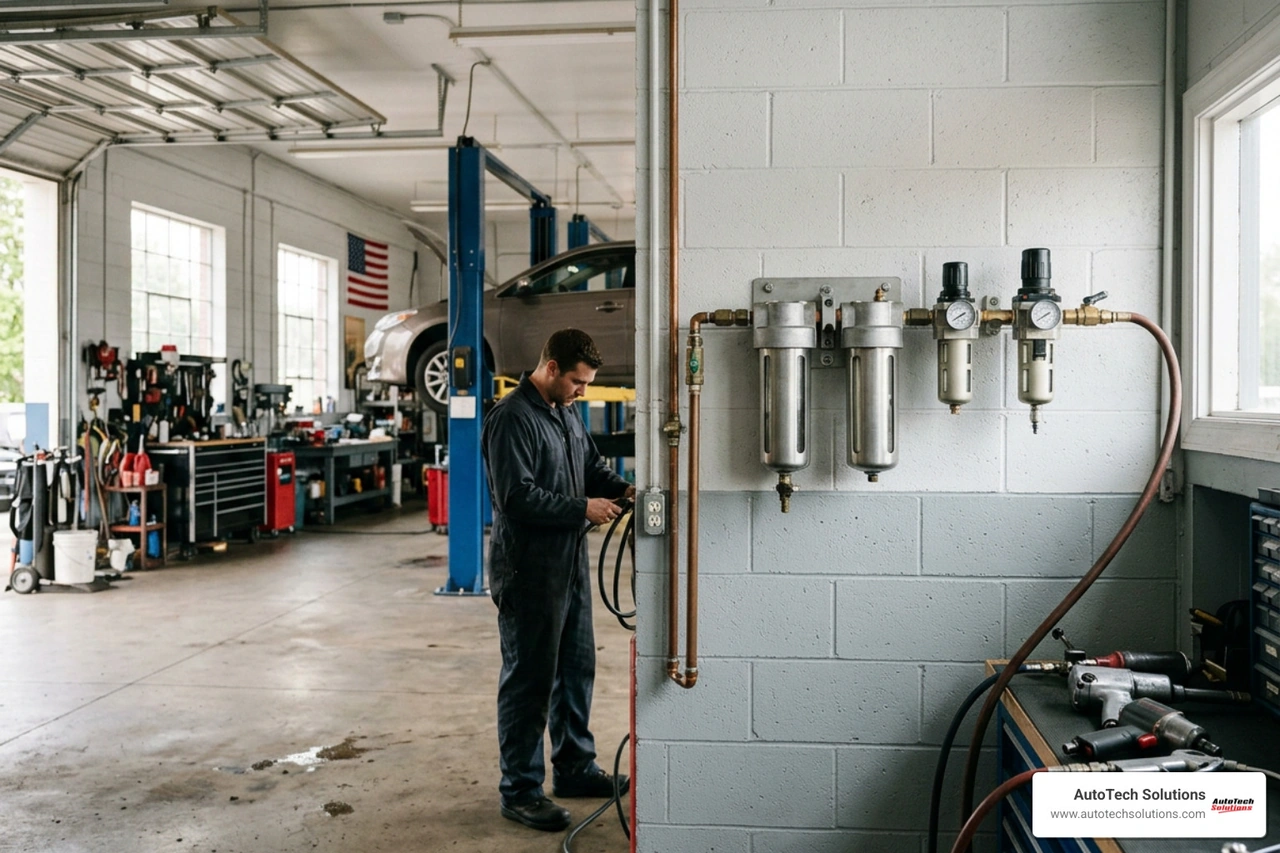
- Branch Circuits: Dedicated lines for specific equipment like air compressor installation for automotive shop.
System Integration
Modern shops are becoming "smarter." We see more integration between electrical systems and facility management software. Whether you are planning installations, upfits & facility buildouts or performing a simple upgrade, the goal is a seamless flow of power that doesn't blink when a 15,000 lb lift starts its ascent. For more on how these systems work together, check out our guide on automotive equipment installation and service.
Types of Industrial Electrical Systems
To keep the lights on and the lifts moving, we typically deal with several core systems:
- Three-Phase Power: This is the gold standard for industrial motors. It provides more consistent power delivery and allows for smaller, more efficient motors than single-phase equivalents.
- Distribution Boards: These take the main power feed and break it down into smaller circuits. In a shop, you might have a dedicated board for the collision wing and another for the mechanical bays.
- Control Panels: These house the relays, timers, and starters that tell your equipment when and how to run.
- Switchgear: This includes the circuit breakers, fuses, and switches used to protect and isolate electrical equipment. High-quality switchgear is the difference between a minor fuse blow and a catastrophic equipment failure.
Importance of Professional Installation
Why can't you just have a "handy" employee run some Romex? Because professional electrical equipment installation is about more than just "making it work."
- Operational Efficiency: Properly sized wires and balanced loads mean less heat and less wasted energy. Your equipment runs cooler and your electric bill stays lower.
- Fire Prevention: Faulty wiring is a leading cause of industrial fires. Professional installers use the right conduits and torque every connection to manufacturer specs to prevent arcing.
- Equipment Longevity: Motors hate voltage drops. If your wiring is undersized, your expensive air compressor motor will burn out years before its time.
- Compliance: If you don't have a permit and a certified inspection, your insurance company might have a very convenient excuse not to pay out if something goes wrong.
Compliance Standards for Electrical Equipment Installation
The National Electrical Code (NEC) is the law. As of April 2026, we are operating under the latest standards which emphasize safety in an increasingly digital and high-power shop environment.
NEC 2023 and OSHA 1926.403
OSHA 1926.403 sets the general requirements for electrical safety in construction and industrial settings. It mandates that all equipment must be "approved" (usually by a testing lab like UL) and installed according to the manufacturer’s instructions.
The NEC (National Electrical Code) provides the specific "how-to." For example, NEC 110.3(A)(8) now addresses cybersecurity for network-connected life safety equipment. If your shop uses high-tech ADAS equipment installation, the electrical feed must be protected from unauthorized updates that could compromise safety.
For a deeper dive into these regulations, you can review the OSHA Electrical Safety Standards or explore Electrical Systems in New Construction: Planning and Process.
NEC 2023 Updates and Reconditioned Equipment
A major focus in recent years has been Article 110. One interesting update is the move toward digital communication. Manufacturers are now allowed to provide installation instructions via QR codes or hyperlinks directly on the equipment. This means no more "I lost the manual" excuses!
Additionally, there are strict new rules for reconditioned equipment. If you are buying a refurbished switchboard, it must be restored using original equipment manufacturer (OEM) parts or parts designed by an engineer to meet the same standards. The "Authority Having Jurisdiction" (AHJ) — your local inspector in Raleigh or Novi — has the final say on whether reconditioned gear is fit for service.
Arc-Flash Hazard Mitigation
An arc-flash is essentially a massive electrical explosion. To prevent these, the NEC has lowered the threshold for mandatory labeling.
- Labeling Thresholds: Service and feeder equipment rated at 1000A or more (previously 1200A) must have an arc-flash label.
- Panic Hardware: If you have large equipment (800A or more), any personnel door within 25 feet of the working space must have "panic hardware" or fire exit hardware that opens with simple pressure. If an electrician is injured in an arc-flash event, they might not be able to turn a doorknob; they need to be able to lean against the door to escape.
The Step-by-Step Electrical Equipment Installation Process
Success in electrical equipment installation starts long before a single wire is pulled. We follow a phased approach to ensure nothing is missed.
Phase 1: Design and Planning
We start with load calculations per NEC Article 220. We look at every piece of equipment — from the downdraft paint booth installation to the coffee machine — to ensure the service panel can handle the total "demand load." This is a critical part of facility buildout equipment planning.
| Phase | Residential Focus | Industrial/Shop Focus |
|---|---|---|
| Planning | Living space convenience | Load balancing for heavy motors |
| Voltage | 120/240V | 208V, 480V, 3-Phase |
| Protection | AFCI/GFCI for life safety | Arc-flash mitigation & GFCIs in wet bays |
| Conduit | Often optional (NM cable) | Mandatory metallic raceways |
Phase 2: Physical Installation and Wiring
This is the "rough-in" stage. We run conduit, mount panels, and pull wire. A key best practice is following specific torque specifications. For example, when joining sections of a switchboard like the Power-Style QED-2, ground bus splices must be torqued to exactly 100 lb-in. Failing to do this can lead to loose connections that heat up and fail. You can find more detail in the installation instructions for switchboards.
Phase 3: Inspection and Certification
Before the walls are closed (if applicable) and before the power is turned on, the AHJ must perform a rough-in inspection. Once everything is connected, a final inspection is conducted. Only then do you receive the Completion Certificate that allows the utility company to energize your full service.
Essential Working Space and Clearance Requirements
One of the most common mistakes we see in shops is using the space around electrical panels as "bonus storage" for tires or oil drums. This is a major code violation and a safety hazard.

Working Space for Equipment 600V or Less
Per NEC Table 110.26(A)(1), there are three dimensions you must maintain for any equipment that might need servicing while energized:
- Depth: Usually a minimum of 3 feet. If there are live parts on both sides of the workspace, this can increase to 4 or 5 feet depending on the voltage.
- Width: The workspace must be at least 30 inches wide or the width of the equipment, whichever is greater. The door to the panel must be able to open at least 90 degrees.
- Headroom: You need at least 6.5 feet (or 6 feet 3 inches in older construction) of clear vertical space. No pipes, ducts, or storage can intrude into this zone.
Access and Egress Standards
You must have an unobstructed path to get to and away from the electrical equipment. For large equipment (rated 1200A or more, or 800A in some 2023 NEC contexts), you typically need two entries/exits to the workspace unless the path is doubled in length to allow for a "safe retreat."
Best Practices for Shop Infrastructure and Safety
Beyond the code, there are "best practices" that separate a mediocre shop from a world-class facility.
Grounding and Bonding
These terms are often used interchangeably, but they are different. Grounding is connecting the system to the earth (to protect against lightning and surges). Bonding is connecting all metal parts of the equipment together to ensure a low-impedance path back to the breaker. If a "hot" wire touches a lift carriage, bonding ensures the breaker trips instantly rather than leaving the lift energized and waiting to shock someone.
Wiring Methods and Cable Management
In an automotive environment, we strictly use metallic raceways (conduit). This protects the wires from physical damage, oils, and the occasional stray tool.
- Color Coding: We follow strict color codes (e.g., green for grounding, white for neutral) to ensure any future technician can safely navigate the system.
- Strain Relief: Any wire entering a piece of equipment, like an automotive lift installation, must have proper strain relief to prevent the connections from being pulled loose.
Mitigating Risks During Electrical Equipment Installation
Safety isn't just a set of rules; it's a culture.
- GFCI Requirements: Any 15- or 20-amp outlet in a "wet" location (like a wash bay or near a sink) must be GFCI protected.
- Lockout/Tagout (LOTO): Before any service work, we use LOTO procedures to ensure no one can accidentally turn the power back on while a technician is working.
- Qualified Personnel: Only "qualified persons" — those trained in the specific equipment and the hazards involved — should perform electrical equipment installation.
Frequently Asked Questions about Electrical Installation
What are the minimum clearance requirements for shop electrical panels?
The standard "working space" is 3 feet deep, 30 inches wide, and 6.5 feet high. This space must remain completely clear of any storage, trash, or equipment at all times.
How often should industrial electrical equipment be inspected for code compliance?
While the initial installation requires a mandatory inspection, we recommend a professional safety audit every 1–3 years. Vibrations from shop equipment can loosen connections over time, and thermal imaging can help identify "hot spots" before they cause a fire.
What is the difference between grounding and bonding in a shop environment?
Think of grounding as the "safety valve" to the earth for the whole building. Bonding is the "safety net" that connects all your metal equipment together so that if a fault occurs, the circuit breaker trips immediately.
Conclusion
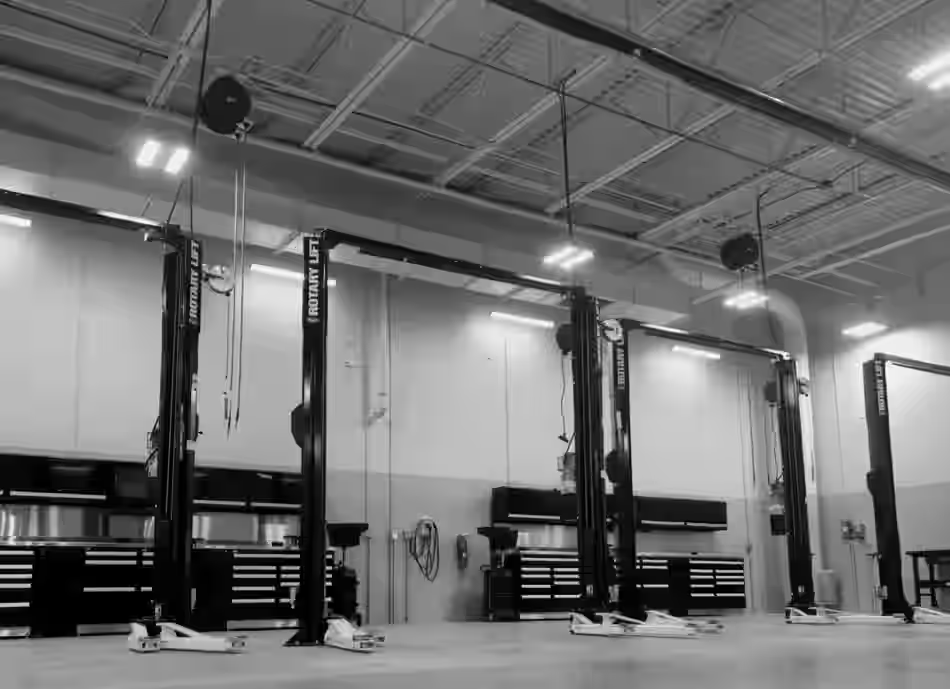
Compliant electrical equipment installation is the silent partner in your shop's success. It doesn't get the glory of a shiny new 2-post lift or a high-end diagnostic suite, but without it, none of those tools can do their job.
By adhering to NEC 2023 standards, maintaining proper clearances, and ensuring every connection is torqued to spec, you aren't just checking a box for the inspector. You are protecting your employees from arc-flash events, shielding your expensive equipment from power surges, and ensuring that when you flip the switch on Monday morning, the shop hums to life without a hitch.
At AutoTech Solutions, we understand that downtime is the enemy of profitability. That’s why we provide one-stop-shop support across Michigan and the Carolinas — from initial facility buildout equipment planning to long-term preventative maintenance. Whether you are installing a single car hoist installation or building a 20-bay facility from the ground up, we ensure your infrastructure is "beyond the wires" in terms of quality and compliance.
Ready to upgrade your facility or ensure your current setup is up to code? Get expert support for equipment installation and service from the team that knows automotive shops inside and out. Let's build something that lasts.