
The Real Cost of Waiting for Equipment to Fail
Predictive maintenance planning is the practice of using real-time equipment data, sensors, and analytics to forecast failures before they happen — so your shop can intervene at exactly the right time, not too early and not too late.
If you manage an automotive service facility, collision center, or industrial shop, here's what you need to know at a glance:
What predictive maintenance planning involves:
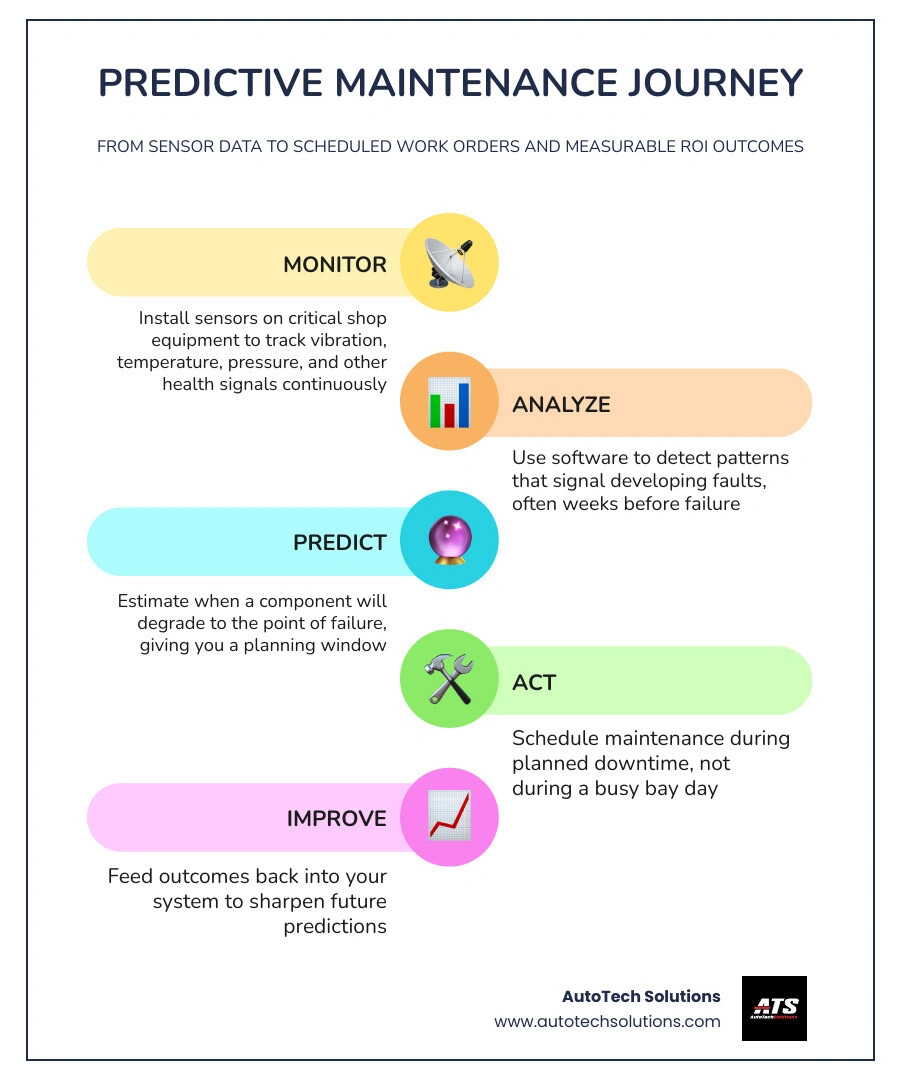
- Monitor — Install sensors on critical shop equipment to track vibration, temperature, pressure, and other health signals continuously
- Analyze — Use software to detect patterns that signal developing faults, often weeks before failure
- Predict — Estimate when a component will degrade to the point of failure, giving you a planning window
- Act — Schedule maintenance during planned downtime, not during a busy bay day
- Improve — Feed outcomes back into your system to sharpen future predictions
Most shop operators know the pain of reactive maintenance. A compressor goes down on a Monday morning. Technicians lose access to air tools. Bays go idle. Customers get rescheduled. Revenue that was never recovered.
What's easy to miss is that most of those failures didn't come out of nowhere. They developed gradually — through hidden wear, moisture buildup, misalignment — and quietly crossed a threshold while no one was watching.
That's the core problem predictive maintenance planning solves.
According to research from Deloitte, organizations that implement predictive maintenance strategies see a 5–15% reduction in facility downtime and a 5–20% increase in labor productivity. And for Fortune Global 500 companies, unplanned downtime already costs an estimated 11% of annual turnover — a number that scales painfully even at the single-location level.
The good news: predictive maintenance is no longer just for aerospace or oil and gas. The tools, sensors, and software needed to run a solid program are increasingly accessible — and the competitive advantage for shops that adopt it early is significant.
Handy predictive maintenance planning terms:
What Predictive Maintenance Planning Really Means
At its simplest, predictive maintenance planning means using actual asset condition to decide when maintenance should happen. Not guesswork. Not a wall calendar. Not "it usually lasts another six months."
The goal is to detect deterioration early, estimate the likely failure window, and turn surprise breakdowns into planned interventions. In a professional shop environment, that means fewer dead bays, fewer emergency calls, and fewer frantic searches for parts while operations wait on a silent compressor.
Predictive maintenance vs reactive, preventive, and condition-based maintenance
These strategies sound similar, but they are not the same.
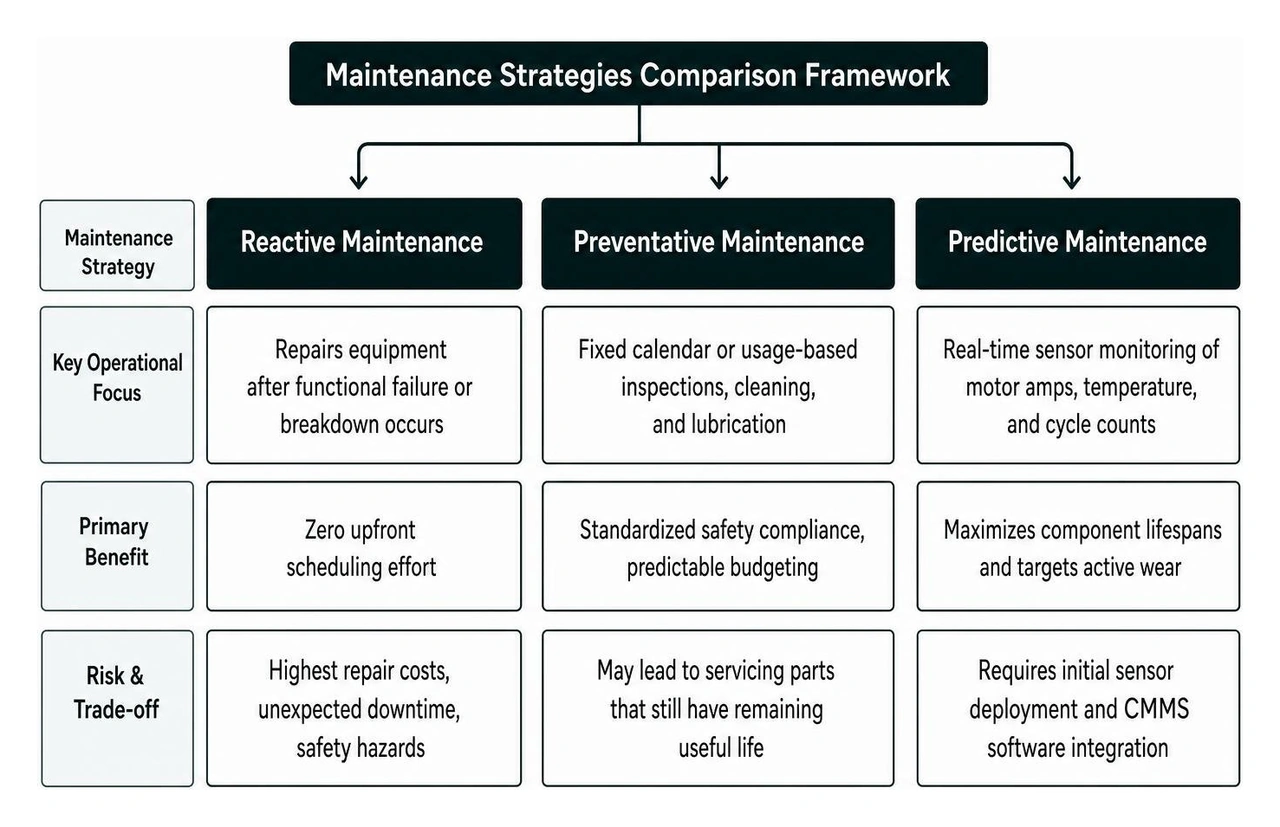
| Strategy | How it works | Strengths | Limitations |
|---|---|---|---|
| Reactive maintenance | Fix it after it fails | Simple, low planning effort | Highest downtime risk, emergency costs, lost productivity |
| Preventive maintenance | Service on a fixed time or usage schedule | Good for basic reliability and compliance | Can lead to over-maintenance or missed failures between intervals |
| Condition-based maintenance | Act when condition crosses a threshold | Better than fixed schedules | Often rule-based and may not forecast remaining life |
| Predictive maintenance | Use condition data and analytics to forecast failure timing | Best for planning, reliability, and cost optimization on critical assets | Requires data, tools, process discipline, and change management |
The biggest difference between preventive and predictive maintenance is this: preventive maintenance assumes expected wear based on history, while predictive maintenance uses current evidence from the machine itself.
Condition-based maintenance is closely related, and in many shops it is the on-ramp to predictive maintenance. If a sensor warns that temperature is high, that is condition-based. If analytics estimate that a bearing has roughly 30 operating days left and automatically trigger a work order window, that is predictive.
Why predictive maintenance planning matters in professional automotive shops
Downtime is not abstract. It shows up immediately in labor loss, bay disruption, and service delays.
The most common shop-level assets that benefit from predictive planning include:
- Air compressors
- Vehicle lifts
- Alignment systems
- Tire service equipment
- Fluid delivery systems
- Wash systems
- Shop HVAC
- Exhaust extraction infrastructure
When one of these fails, the impact is often bigger than the repair itself. A single critical asset can bottleneck multiple technicians at once. That is why a strong maintenance strategy matters so much in B2B shop environments. If you want a foundation before adding predictive layers, our guide to preventative maintenance programs is a useful starting point.
Where predictive maintenance fits in a hybrid maintenance strategy
Not every asset deserves the full predictive treatment.
A practical program usually combines several strategies:
- Run-to-failure for low-cost, non-critical items
- Preventive maintenance for straightforward assets with known service intervals
- Condition-based checks for moderate-risk systems
- Predictive maintenance for critical, failure-prone, or high-cost equipment
That hybrid approach is usually the smartest one. It is not about making every machine "smart." It is about matching maintenance effort to business risk. We often recommend building from a structured PM base first, then adding predictive layers where they produce the best return. For more on that planning logic, see planning maintenance preventive.
The Building Blocks of an Effective Predictive Maintenance Program
A good predictive maintenance program is not just sensors attached to equipment and wishful thinking. It needs five connected pieces:
- Reliable data sources
- Condition-monitoring hardware
- Analytics that can detect patterns
- Workflow integration to trigger action
- Technicians and managers who trust the output and use it
The most useful data sources for predictive maintenance planning
Sensor data gets most of the attention, but it is only part of the picture.
The most useful inputs often include:
- CMMS maintenance history
- OEM manuals and recommended tolerances
- Inspection records
- Technician notes
- PLC or control data
- SCADA or automation system data
- Energy consumption trends
- Ambient conditions such as heat, humidity, and dust

Historical records matter because prediction models need context. If a lift motor has been drawing higher current for months, and technician notes also mention slower movement, that combination is far more useful than a single temperature reading by itself.
Sensors and condition-monitoring techniques that catch problems early
Different failure modes need different monitoring methods. There is no universal sensor that magically finds everything.
The most proven techniques include:
- Vibration analysis for rotating equipment, bearings, imbalance, and misalignment
- Infrared thermography for electrical issues, friction heat, and airflow problems
- Ultrasound for compressed air leaks, arcing, and early mechanical defects
- Oil or lubricant analysis for contamination and wear particles
- Motor current analysis for electrical and load-related abnormalities
- Pressure monitoring for pneumatic and hydraulic systems
- Temperature sensing for motors, compressors, pumps, and environmental control systems
- Acoustic monitoring for abnormal sounds that indicate wear
Best-fit monitoring by equipment type:
- Air compressors: vibration, temperature, pressure, ultrasound, moisture monitoring
- Vehicle lifts: hydraulic pressure, motor current, temperature, cycle counts
- Alignment systems: calibration drift checks, power quality, environmental monitoring
- Fluid systems: pressure, flow, leak detection, motor current
- Exhaust extraction: motor current, airflow, vibration
- Shop HVAC: temperature delta, airflow, motor vibration, filter pressure drop
Wireless sensors can reduce installation cost, especially on existing equipment, but only if they are installed with a clear purpose. Baseline readings are essential. Without a "normal" reference, a reading is just a number wearing a hard hat.
How AI, machine learning, and digital twins improve predictions
Traditional threshold alarms are helpful, but AI and machine learning can go further. They can identify subtle patterns across time-series data, estimate remaining useful life, and improve accuracy as more data is collected.
Research continues to push this forward. Studies such as Predictive Maintenance Planning for Industry 4.0 Using Machine Learning for Sustainable Manufacturing show how data cleaning, feature selection, and machine learning models can improve maintenance forecasting. Newer work on Leveraging Generative AI for Modelling and Optimization of Maintenance Policies in Industrial Systems points toward AI being used not just for prediction, but for evaluating maintenance timing and policy choices.
In practical terms, AI can help with:
- Anomaly detection before humans notice obvious symptoms
- Remaining useful life estimation
- Pattern recognition across multiple signals
- Reducing false alarms over time
- Better maintenance timing based on risk and cost
Digital twins add another layer by creating a data-rich model of the asset or facility. That helps teams see equipment context, compare actual behavior with expected behavior, and support planning. Prescriptive maintenance is the next step beyond this: not just predicting failure, but recommending the best action, timing, and resource plan.
The role of CMMS and EAM in turning insights into action
A prediction that never becomes a work order is just interesting trivia.
That is where CMMS and EAM systems come in. They help convert condition insights into actual maintenance execution by supporting:
- Automated alerts
- Work order creation
- Scheduling and labor planning
- Parts planning
- Maintenance history
- KPI tracking
- Documentation and audit trail
This is especially important for multi-bay and multi-location operations. Without workflow integration, teams end up with disconnected dashboards and no consistent action path. For more on systematizing maintenance workflows, see PMS planned maintenance system.
How to Build a Predictive Maintenance Planning Roadmap
The best way to start is small, focused, and measurable. Predictive maintenance programs usually fail when organizations try to boil the ocean, monitor everything, and prove ROI later.
How to identify critical assets and choose the right pilot
Start with asset criticality. Rank equipment based on:
- Safety impact if it fails
- Effect on throughput and bay availability
- Repair or replacement cost
- Frequency of past failures
- Difficulty of detecting problems early
- Downtime consequence
A simple criticality matrix helps.

You can also use FMEA and calculate risk priority numbers based on severity, occurrence, and detectability. The best pilot assets usually have high business impact, known failure modes, and enough existing history to support analysis.
In many automotive facilities, strong pilot candidates include compressors, lifts, HVAC systems, and fluid delivery equipment. If downtime is already hurting output, review how to reduce equipment downtime in an automotive shop.
Step-by-step predictive maintenance planning process
A practical roadmap looks like this:
- Audit the current state
- Review equipment history, downtime patterns, PM compliance, and available data
- Select pilot assets
- Choose a small number of high-criticality systems
- Gather baseline data
- Collect historical maintenance records, normal operating ranges, and failure history
- Choose monitoring methods
- Match sensors and inspection techniques to actual failure modes
- Clean and organize the data
- Remove bad readings, fill obvious gaps carefully, and standardize naming and timestamps
- Set thresholds and models
- Start simple with alerts and trend rules, then add machine learning where justified
- Integrate workflows
- Define how alerts create inspections, work orders, approvals, and parts requests
- Train the team
- Make sure technicians, managers, and operators know what to look for and how to respond
- Run the pilot
- Track results, false positives, response time, and avoided failures
- Review and scale
- Improve the model, refine SOPs, and expand to more assets only after proving value
Common barriers and how to overcome them
The challenges are real. So are the rewards.
Common barriers include:
- Legacy equipment with limited built-in sensors
- Poor or incomplete maintenance history
- Sparse failure data
- Retrofit costs
- Cybersecurity concerns for connected devices
- Resistance to change
- Lack of internal analytics expertise
- Weak coordination between operations, maintenance, and IT
The fix is usually not one big technology purchase. It is disciplined implementation:
- Start with a pilot
- Use the highest-value assets first
- Validate sensor data regularly
- Keep models explainable where possible
- Build response procedures before scaling
- Secure executive support early
- Involve technicians from day one
Budgeting, staffing, and change management for long-term success
Budgeting for predictive maintenance should cover more than sensors. You may need:
- Monitoring hardware
- Installation labor
- Software or analytics platform costs
- CMMS integration work
- Training
- External implementation support
- Ongoing calibration and review
Change management matters just as much as technology. A technician who trusts the system will act on early warnings. A technician who thinks it is "just another dashboard" will wait until the machine screams.
We recommend standard operating procedures, regular review meetings, and a PDCA mindset: plan, do, check, act. For organizations managing more than one facility, managing shop equipment maintenance across multiple locations becomes essential.
Benefits, ROI, and KPIs That Prove It Works
The measurable business benefits of predictive maintenance planning
The business case is strong when predictive maintenance is targeted correctly.
Research cited earlier shows:
- 5-15% reduction in facility downtime
- 5-20% increase in labor productivity
Other commonly reported outcomes include:
- Fewer emergency repairs
- Lower overtime
- Longer asset life
- Better parts planning
- Less unnecessary scheduled maintenance
- Improved reliability and safety
- Smoother production and bay flow
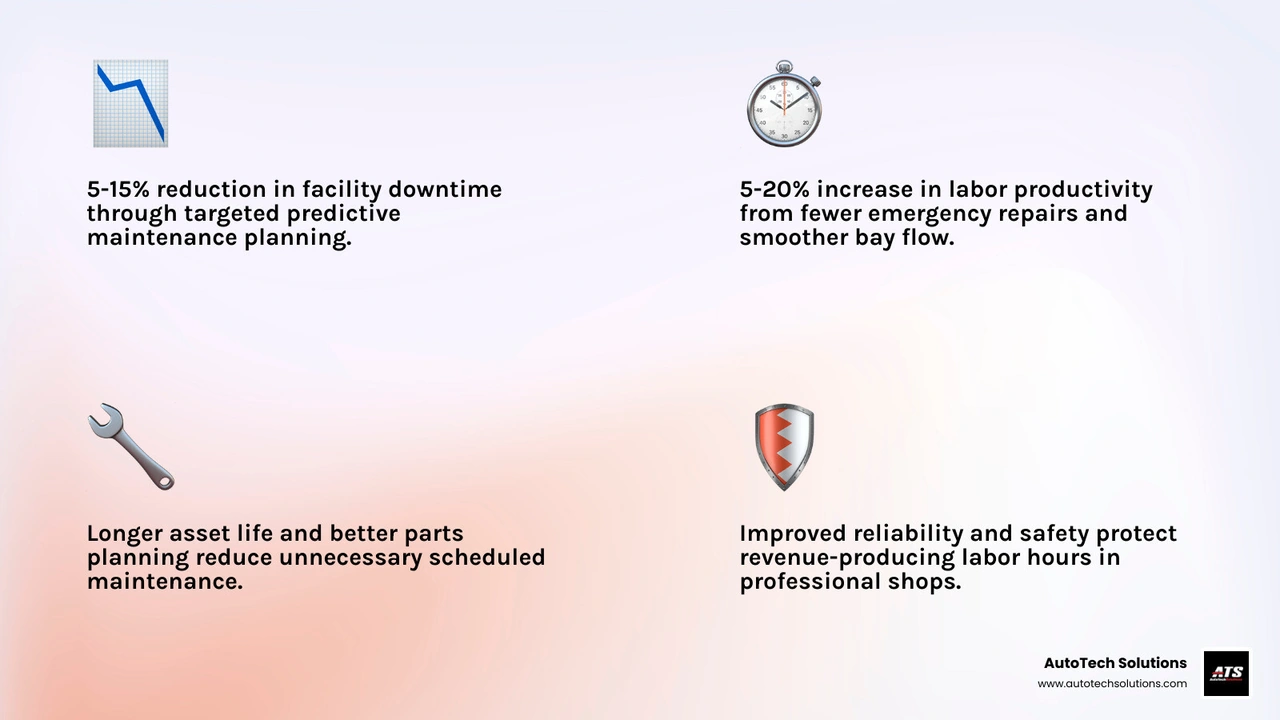
For a professional shop, this translates into more available bays, fewer schedule disruptions, and better protection of revenue-producing labor hours.
How to calculate ROI for a predictive maintenance program
A simple ROI model compares avoided losses and savings against program cost.
Look at:
- Cost of unplanned downtime per hour
- Number of breakdown hours avoided
- Emergency repair cost reduction
- Overtime reduction
- Reduced secondary damage
- Lower spare parts waste
- Asset life extension
- Program costs for sensors, software, and labor
A basic formula:
ROI = (Annual savings - Annual program cost) / Annual program cost
Also track payback period. Many predictive maintenance programs target payback in the 12-24 month range, especially when focused on critical assets.
If you need help quantifying downtime impact in shop operations, our article on the cost of downtime in dealership service departments gives useful context.
The most important KPIs to track from pilot to scale
Track a small set of KPIs consistently:
- Uptime
- Mean time between failures
- Mean time to repair
- Planned vs reactive maintenance ratio
- Schedule compliance
- Wrench time
- Maintenance cost as a percent of operating cost
- Forecast accuracy
- False positive rate
- Backlog health
- Parts stockouts tied to maintenance events
These metrics tell you whether the program is reducing chaos or just generating more notifications. Clean reporting is especially important for leadership buy-in, which is why equipment maintenance reporting for dealer groups matters once you scale.
Real-World Use Cases and the Future of Predictive Maintenance
Real-world examples that show what good predictive maintenance looks like
Across industries, predictive maintenance is already being used to monitor rotating equipment, power systems, infrastructure assets, and mission-critical environments.
Recent research such as A two-stage framework for cost-sensitive predictive maintenance using deep learning, GANs, and risk-aware clustering shows how organizations can connect remaining useful life prediction with cost-aware maintenance decisions even when failure data is limited. Work like A hybrid Bi-LSTM model for data-driven maintenance planning pushes forecasting further by incorporating uncertainty, not just single-point predictions.
For shop operations, the practical lesson is simple: the best programs do not just detect faults. They connect fault detection to maintenance timing, labor planning, and business impact.
How predictive maintenance planning applies to multi-location shop operations
Multi-location operations gain even more from a structured predictive approach because inconsistency is expensive.
Benefits include:
- Standardized reporting across sites
- Remote visibility into equipment health
- Centralized service coordination
- Better parts pooling
- Smarter service prioritization
- Benchmarking site performance
If one location has recurring compressor alarms and another has better uptime under similar conditions, that difference becomes actionable. This is where centralized maintenance processes become a major advantage. Related resources include centralized equipment service coordination for dealer groups and vendor consolidation for dealership equipment service.
What comes next: prescriptive maintenance, edge AI, and smarter planning
The next wave of maintenance technology is already taking shape:
- Prescriptive maintenance that recommends the best action
- Edge AI that analyzes data directly near the machine
- Better digital twins for system context
- More autonomous diagnostics
- Risk-aware scheduling across fleets and facilities
- Maintenance-as-a-service models
The direction is clear: better predictions, faster decisions, and less manual interpretation. The trick is not chasing every new tool. It is building a reliable process first, then layering smarter analytics on top.
Frequently Asked Questions About Predictive Maintenance Planning
Is predictive maintenance planning worth it for every piece of shop equipment?
No. Some assets should remain on preventive maintenance, and some low-cost items are perfectly fine on a run-to-failure approach. Predictive maintenance delivers the best return on critical assets where failure causes meaningful downtime, safety exposure, or repair cost.
Which equipment should be monitored first?
Start with equipment that can stop work across multiple bays or create major disruption:
- Air compressors
- Vehicle lifts
- Alignment racks
- Brake lathes
- Fluid delivery systems
- Wash systems
- HVAC supporting production areas
How long does it take to see results?
Quick wins can appear within a few months if you choose the right pilot and already have some maintenance history. A typical pilot may need a baseline period, installation time, and enough operating cycles to identify useful trends. In many cases, meaningful ROI evidence appears within 6 to 12 months.
Conclusion
Predictive maintenance planning is not magic. It is a disciplined way to listen to your equipment before it fails loudly and expensively.
For professional shops, the smartest approach is usually phased: start with critical assets, build from a solid PM foundation, connect data to work orders, and measure the results. Done well, predictive maintenance reduces downtime, improves labor productivity, and helps teams make better maintenance decisions without over-servicing equipment.
At AutoTech Solutions, we focus on helping professional automotive facilities protect uptime through equipment service, installation, and preventative maintenance support across Michigan and the Carolinas. If you want to strengthen your maintenance strategy before or alongside predictive initiatives, explore our preventative maintenance programs.