Why a Two Post Lift Is the Backbone of Every High-Volume Service Bay
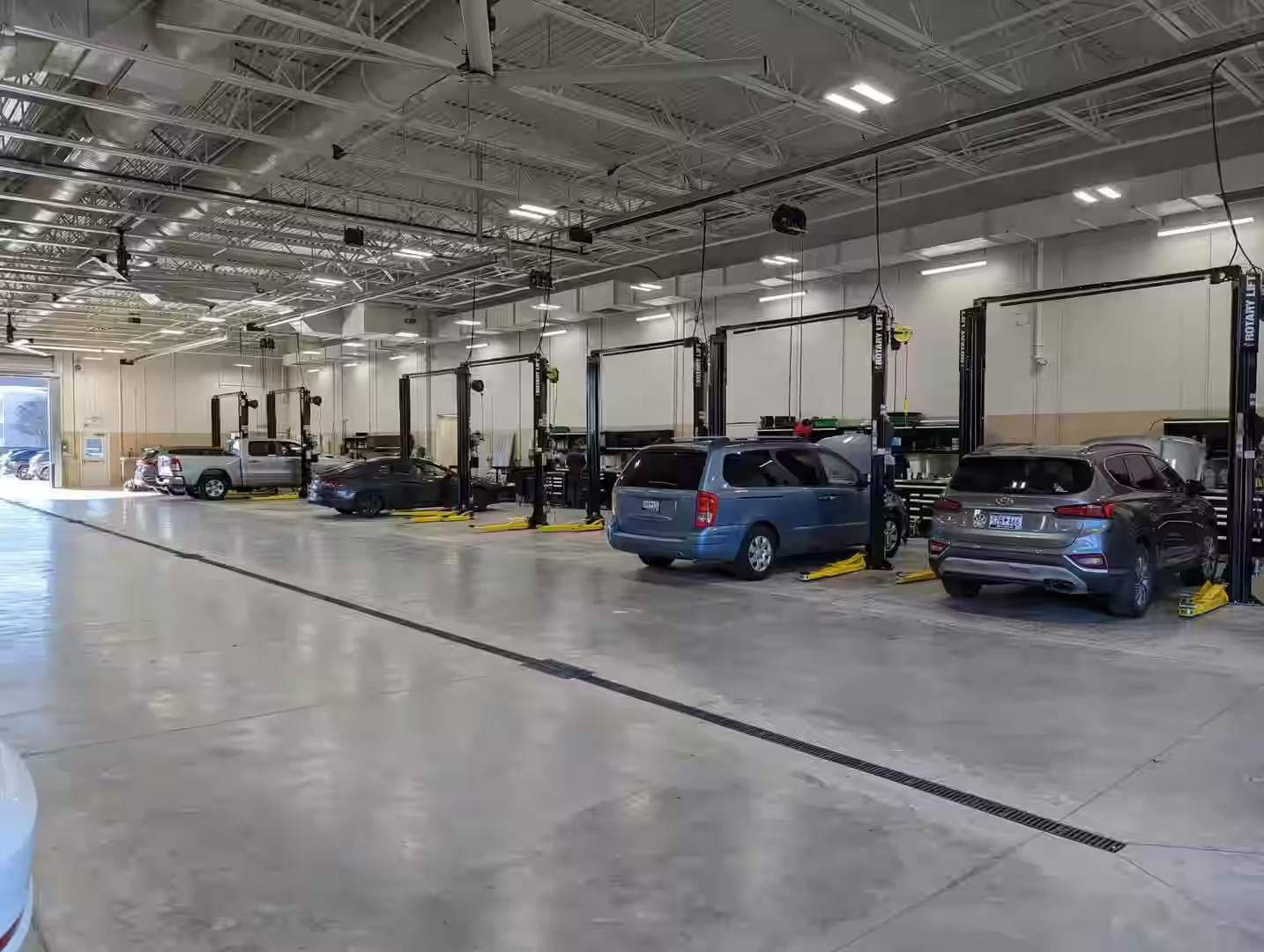
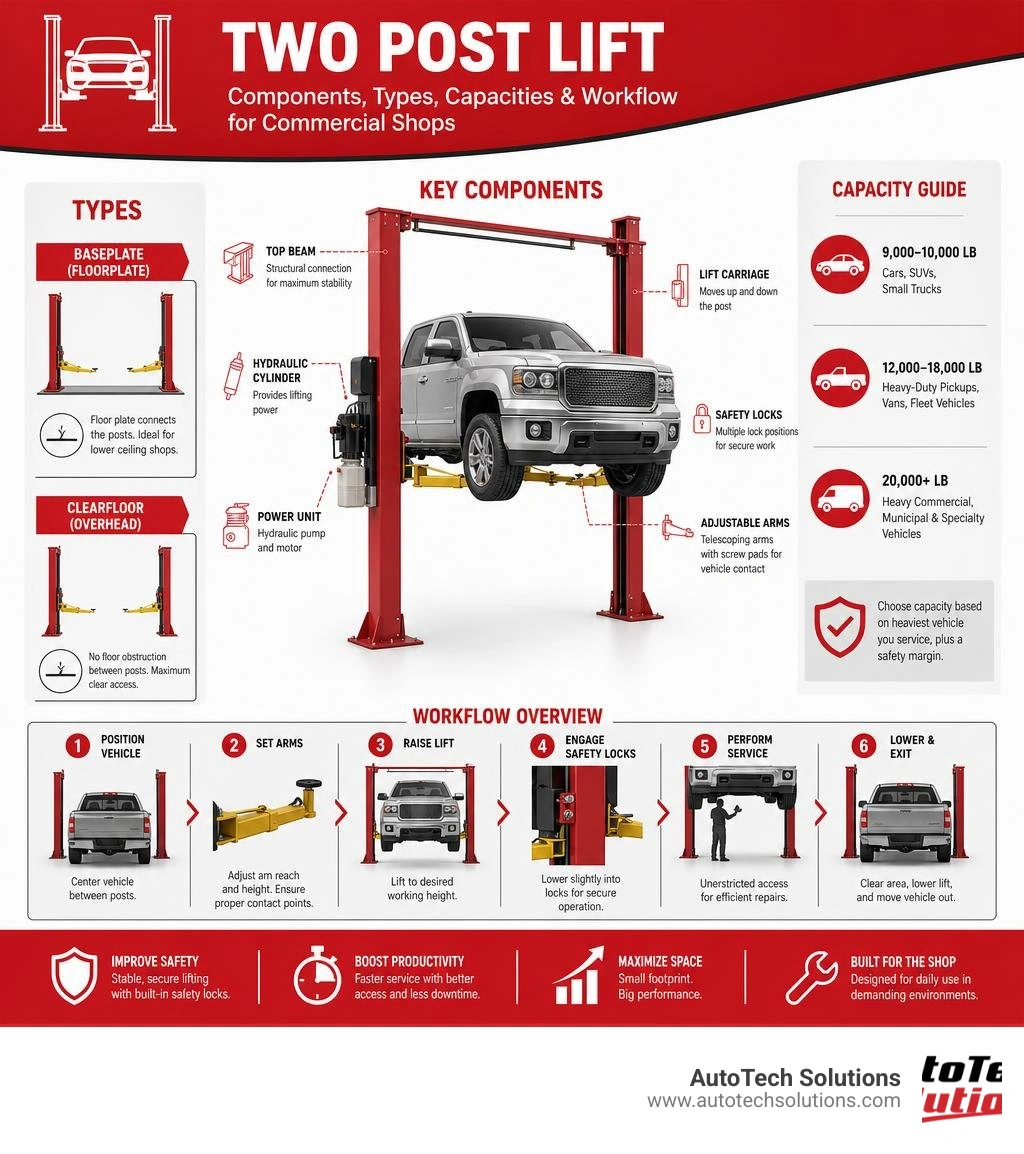
A two post lift is the single most common piece of equipment in professional automotive service facilities — and for good reason. It gives technicians full, unrestricted access to the underside of a vehicle while occupying minimal bay space. For shop managers and facility operators, that combination of access and efficiency directly translates to throughput, technician productivity, and profitability.
Here's a quick answer if you're ready to move forward:
| Goal | What to Look For |
|---|---|
| Light to medium vehicles (cars, small trucks) | 9,000–10,000 lb capacity, asymmetric arms |
| Heavy-duty pickups, vans, fleet vehicles | 12,000–18,000 lb capacity, symmetric arms |
| Low-ceiling shop | Baseplate (floorplate) design |
| Maximum floor access between posts | Clearfloor (overhead) design |
| Reduced maintenance, long service life | Direct-drive hydraulic system, ALI certified |
| Heavy commercial or municipal fleets | 20,000 lb+ capacity models |
But choosing the right lift isn't just about weight rating. The wrong configuration — wrong arm design, wrong hydraulic system, wrong floor spec — creates real operational risk and costly downtime.
This guide covers everything a facility operator needs to compare models, match lift specs to shop conditions, and make a confident purchasing decision.
Explore more about Two post lift:
Understanding the Two Post Lift: Baseplate vs. Overhead Designs
When selecting a two post lift for your commercial service bay, the first major structural choice you must make is between a baseplate (floorplate) design and an overhead (clearfloor) design. Both styles have distinct advantages and engineering purposes, and choosing the wrong one can limit the types of vehicles your shop can service or create unnecessary safety hazards.
Baseplate (Floorplate) Lifts
A baseplate lift, often referred to as a 2 Post Floor Plate Car Lift, features a heavy metal plate running along the shop floor between the two columns. This plate covers and protects the equalization cables and hydraulic lines that connect the two towers.
The primary advantage of a floorplate design is that it lacks any overhead obstructions. If your shop has low ceilings (typically under 12 feet) or if you regularly service exceptionally tall commercial vehicles like high-top transit vans, box trucks, or lifted fleet vehicles, a baseplate model is often your only viable option. However, the floor plate itself acts as a small speed bump, which can make rolling heavy toolboxes, transmission jacks, or oil drains across the bay more difficult.
Overhead (Clearfloor) Lifts
An overhead or clearfloor lift routes the equalization cables and hydraulic lines through a metal bar or beam connecting the top of the columns. This design leaves the shop floor completely unobstructed, allowing technicians to slide under-vehicle equipment, tool carts, and fluid drains with ease.
Clearfloor models are the gold standard for modern commercial shops because they maximize floor workflow. They also feature a padded overhead shut-off bar. If a tall vehicle is lifted too high, its roof contacts the padded bar, instantly killing power to the hydraulic motor to prevent vehicle and building damage. The trade-off is that these lifts require higher ceilings (usually 12 to 14 feet or more, depending on the model and any optional column extensions).
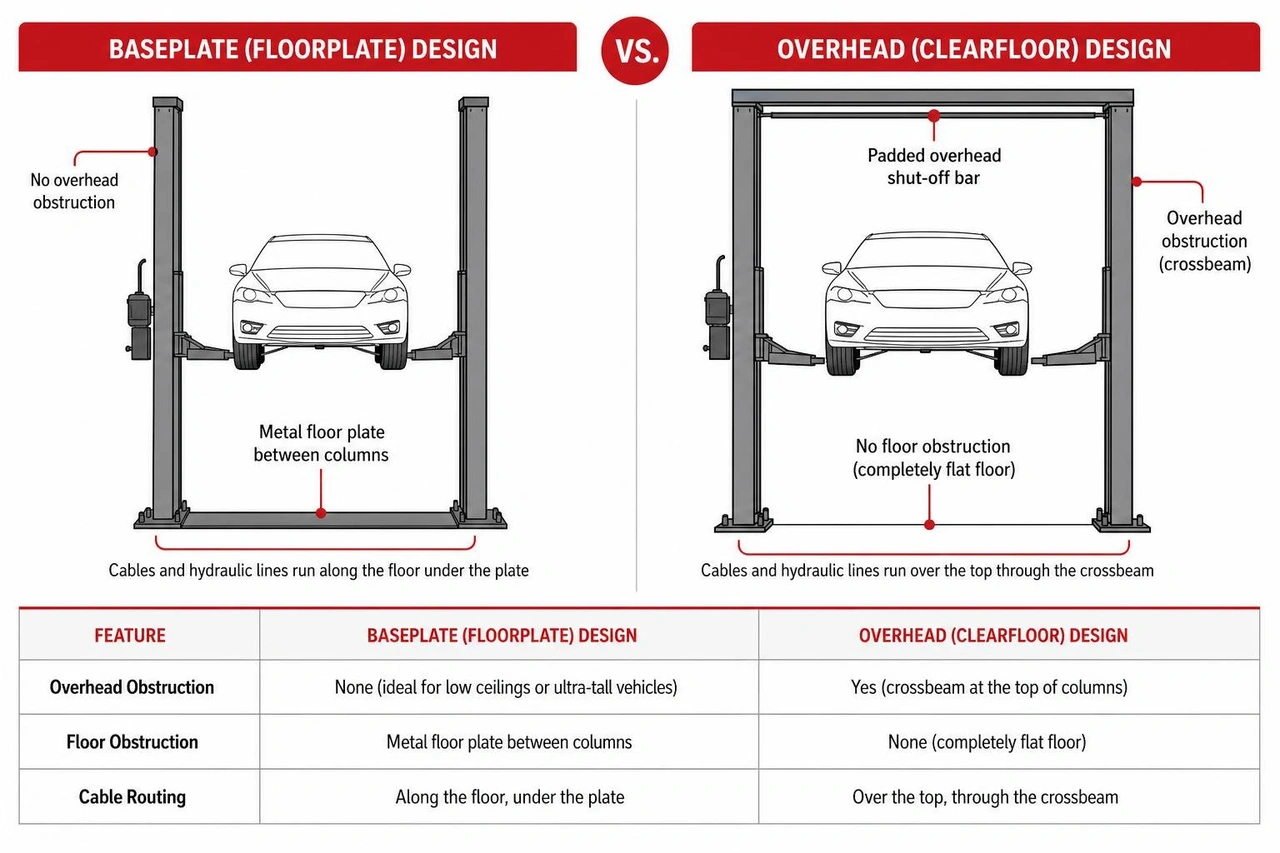
| Feature | Baseplate (Floorplate) Design | Overhead (Clearfloor) Design |
|---|---|---|
| Overhead Obstruction | None (ideal for low ceilings or ultra-tall vehicles) | Yes (crossbeam at the top of columns) |
| Floor Obstruction | Metal floor plate between columns | None (completely flat floor) |
| Cable Routing | Along the floor, under the plate | Over the top, through the crossbeam |
| Best Used For | Shops with ceilings under 12 feet; tall box trucks | High-volume shops prioritizing smooth under-car rolling access |
| Safety Cut-off | Manual monitoring | Padded overhead safety shut-off bar |
For professional shops in Michigan and the Carolinas looking to purchase or upgrade, working with a localized expert like AutoTech Solutions ensures you select the correct structural footprint for your facility.
Symmetrical vs. Asymmetrical Two Post Lift Arm Configurations
Once you have chosen the column structure, you must decide how the lift arms will support the vehicles. This is determined by column orientation and arm length, which fall into three main categories: symmetrical, asymmetrical, and bi-symmetrical.
Symmetrical Arm Configurations
In a symmetrical lift, the columns face each other directly, and all four swing arms are of equal length. The vehicle is positioned precisely in the middle of the columns, distributing the weight evenly (50/50 split) across the structure. Symmetrical lifts are highly recommended for heavier loads, such as large commercial trucks, heavy-duty pickups, and full-size SUVs, because they offer maximum drive-through clearance and balanced structural support.
Asymmetrical Arm Configurations
Asymmetrical lifts are engineered specifically for passenger cars, light crossovers, and small trucks where regular access to the vehicle's interior is required. The columns are rotated approximately 30 degrees, and the front arms are shorter than the rear arms.
This configuration pushes the vehicle's center of gravity backward, resulting in a 30/70 weight distribution. Because the vehicle sits further back on the lift, the front doors clear the columns entirely, allowing technicians to open vehicle doors fully without risking body damage.
Bi-Symmetrical (Versymmetric) configurations
If your shop handles a highly diverse mix of vehicles daily, a bi-symmetrical or "Versymmetric" arm configuration is the ultimate solution. Featured on premium models (note: product specifications vary by brand), these systems combine the benefits of both designs. This versatility is thoroughly explained in our Car Lift 2 Post Buyers Guide 2026.
Selecting the Right Lifting Capacity and Hydraulic System
Selecting the proper weight capacity and hydraulic architecture is critical to keeping your shop running efficiently while protecting your technicians.
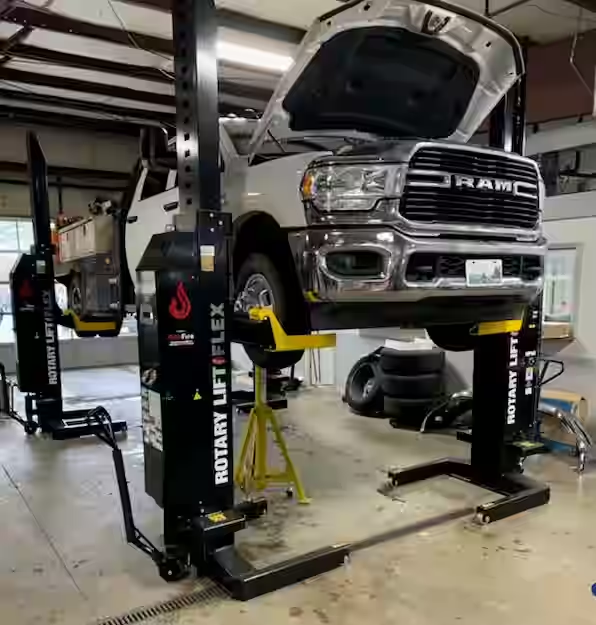
Lifting Capacities: From Light-Duty to Heavy-Duty
Two-post lifts are rated by their maximum lifting capacity, which typically ranges from 9,000 lbs to 20,000 lbs or more:
- 9,000 to 10,000 lbs: Ideal for independent repair shops and dealerships focusing on passenger cars, light SUVs, and half-ton pickups.
- 12,000 to 15,000 lbs: Built for medium-duty fleet vehicles, commercial work vans, and three-quarter-ton to one-ton utility trucks.
- 18,000 to 20,000 lbs: True commercial beasts designed for municipal fleets, heavy-duty school buses, and large commercial work trucks.
When choosing a capacity, never size your lift exactly to the heaviest vehicle you expect to service. Always build in a safety buffer. Running a lift at its absolute limit accelerates wear on hydraulic seals, carriages, and columns, leading to premature component failure and unexpected shop downtime.
Hydraulic Systems: Direct-Drive vs. Cable/Chain-Driven
The mechanical system that powers your lift is just as important as its weight rating.
Direct-Drive Systems
In a direct-drive hydraulic system, two high-pressure cylinders are placed directly inside the columns, lifting the carriages without the use of chains, pulleys, or overhead cables. Direct-drive systems are widely considered the most reliable option for high-volume commercial shops.
Because they contain fewer moving parts, there are no cables to stretch, fray, or slip off pulleys. This drastically reduces the common failure points associated with cheaper lifts and lowers your long-term maintenance costs.
Chain-Over or Cable-Equalized Systems
These lifts use a single hydraulic cylinder or smaller dual cylinders coupled with heavy-duty leaf chains and steel equalization cables to lift the carriages. While these systems are highly functional and often more budget-friendly initially, they require regular inspection, cable tension adjustments, and eventual replacement of the chains and pulleys.
For premium performance, high-end commercial models utilize patented hydraulic fluid displacement synchronization. This eliminates chains, cables, and overhead obstructions entirely, using self-lubricating steel ball bearing rollers in place of cheap plastic wear pads.
Choosing a Two Post Lift for Fleet and Commercial Vehicles
Servicing modern commercial fleets requires specialized lifting equipment. Standard passenger car adapters simply will not cut it when lifting heavy-duty vehicles with unique frame designs, high ground clearance, or delicate under-car components.
- Stackable Truck Adapters: Essential for lifting high-clearance four-wheel-drive trucks and utility vans. These adapters slide into the lift arms to bridge the gap between the arm pad and the vehicle's frame.
- Frame Cradle Pads: When lifting heavy work trucks, standard flat rubber pads can slip on greasy frames. Frame cradles cup the frame rails, locking the vehicle securely in place.
- Electric Vehicle (EV) Compatibility: Lifting EVs requires extreme care. The massive battery packs occupy the entire undercarriage, leaving very narrow lifting margins. Lifts with low-profile, wide-reaching three-stage arms are required to safely reach the designated OEM lifting points without contacting or puncturing the battery housing. For a complete breakdown of modern lift options, check out our Ultimate Automotive Lifts Guide 2026.
Commercial Shop Requirements and Professional Installation
Installing a two post lift is a highly precise engineering process that requires strict adherence to safety codes and manufacturer specifications.
Before purchasing any lift, you must verify that your service bay meets the following three requirements:
1. Concrete Floor Strength and Depth
Your concrete floor is the actual foundation of your lift. If the concrete is too thin or lacks structural integrity, the anchor bolts can pull out under load, resulting in a catastrophic structural failure.
- Minimum Specifications: Most 9,000 to 10,000 lb lifts require a minimum of 4 inches of concrete poured at 3,000 PSI strength.
- Heavy-Duty Specifications: Heavy-duty lifts (12,000 to 18,000 lbs) typically require a minimum of 6 to 6.5 inches of concrete poured at 4,000 PSI strength.
- Anchoring: Lifts must be secured using high-strength anchoring bolts (typically 3/4" x 5" or 3/4" x 6" lag bolts) torqued to exact manufacturer specifications.
2. Ceiling Height and Bay Dimensions
Always measure your clear height, taking into account overhead lights, heaters, rafters, and garage door tracks. A clearfloor lift with an overall height of 144 inches requires at least 12 feet of unobstructed ceiling height. Additionally, ensure your bay width allows for the required drive-through clearance and safe walk-around space for your technicians.
3. Electrical Power Requirements
Most professional-grade two-post lifts require a dedicated 208-230V, single-phase, 20-amp or 30-amp electrical circuit to power the high-performance 2 HP to 4 HP hydraulic motors. Some heavy-duty commercial lifts may require three-phase power.
Because of the massive liabilities involved, professional installation is non-negotiable for commercial operations. AutoTech Solutions provides certified Car Lift Installation Service across Michigan and the Carolinas, ensuring your equipment is perfectly leveled, anchored, and tested to meet local safety codes.
For more details on preparing your shop, refer to our Car Lift Installers Complete Guide and the Automotive Lift Installation Guide.
Safety Standards, Preventative Maintenance, and Lifespan
In a busy commercial shop, your lifts are constantly working. Ensuring they are safe and properly maintained is the best way to protect your employees and your bottom line.
The Importance of ALI Certification
When shopping for a lift, always look for the Automotive Lift Institute (ALI) Gold Certification label. This independent, third-party certification proves that the lift model has been thoroughly tested and complies with rigorous ANSI/ALI ALCTV safety standards. Purchasing non-certified lifts to save a few dollars exposes your business to serious insurance liabilities and OSHA-related compliance concerns.
Key Safety Features to Look For
- Multi-Position Mechanical Locks: These heavy-duty steel locks should automatically engage as the lift rises, securing the carriage at multiple heights so the hydraulic system is not holding the weight during service.
- Automatic Arm Restraints: When the lift is on the ground, the arms should swing freely. As soon as the lift begins to rise, automatic gear locks must engage to prevent the arms from shifting under the vehicle.
- Padded Overhead Shut-off: Instantly stops the hydraulic pump if a vehicle's roof contacts the overhead beam.
Preventative Maintenance and Lifespan
A well-maintained, high-quality two post lift in a professional shop can easily last 15 to 20+ years. However, achieving this lifespan requires a commitment to regular Car Lift Maintenance.
- Daily Inspections: Technicians should perform a quick pre-shift visual check. Inspect arm lock engagement, check for hydraulic fluid leaks around cylinder seals, and verify that the safety locks click in sync.
- Monthly Maintenance: Lubricate the column tracks where the carriages slide, check the tension of the equalization cables, and inspect hydraulic fluid levels.
- Annual Safety Inspections: Many states require annual lift inspections performed by an ALI-certified inspector to maintain commercial compliance.
If you ever experience an issue, from a blown seal to a faulty lock mechanism, prompt Two Post Lift Repair is essential to prevent minor wear from turning into major structural damage.
Frequently Asked Questions About Two-Post Lifts
What is the minimum concrete thickness required for a two-post lift?
For light-duty lifts up to 10,000 lbs, you generally need a minimum of 4 inches of concrete rated at 3,000 PSI. For heavier commercial lifts (12,000 to 18,000 lbs), you must have at least 6 to 6.5 inches of 4,000 PSI concrete. Always consult the manufacturer's manual before drilling, and ensure your anchors are embedded to the specified depth.
How often should a commercial two-post lift be inspected?
Commercial lifts should undergo basic visual inspections daily by the operating technicians. A more thorough mechanical check should be conducted monthly. Additionally, professional shops are highly encouraged (and often legally required) to have an annual safety inspection performed by an ALI-certified inspector.
Can you lift electric vehicles on a standard two-post lift?
Yes, but you must use extreme caution. Electric vehicles are exceptionally heavy due to their battery packs, and their designated lifting points are often located in very narrow bands along the outer frame. You must ensure your lift has the proper capacity, low-profile arms, and specialized adapters to avoid damaging the battery housing.
Conclusion
A high-quality two post lift is the heartbeat of a profitable commercial service department. By understanding the structural differences between baseplate and clearfloor designs, selecting the right arm configurations, and prioritizing professional installation and preventative maintenance, you can maximize your shop's efficiency and keep your technicians safe.
At AutoTech Solutions, we specialize in helping automotive businesses minimize downtime. From equipment sales and certified installation to rapid-response repairs and preventative maintenance, we support light-duty, heavy-duty, and collision shops from Michigan down to the Carolinas.
Ready to upgrade your service bays with premium, reliable lifting technology? Explore our complete inventory at the AutoTech Solutions Equipment Catalog or contact our expert team today to schedule your installation or safety inspection.