
Why Vehicle Frame Straightening Requires Professional Shop Infrastructure
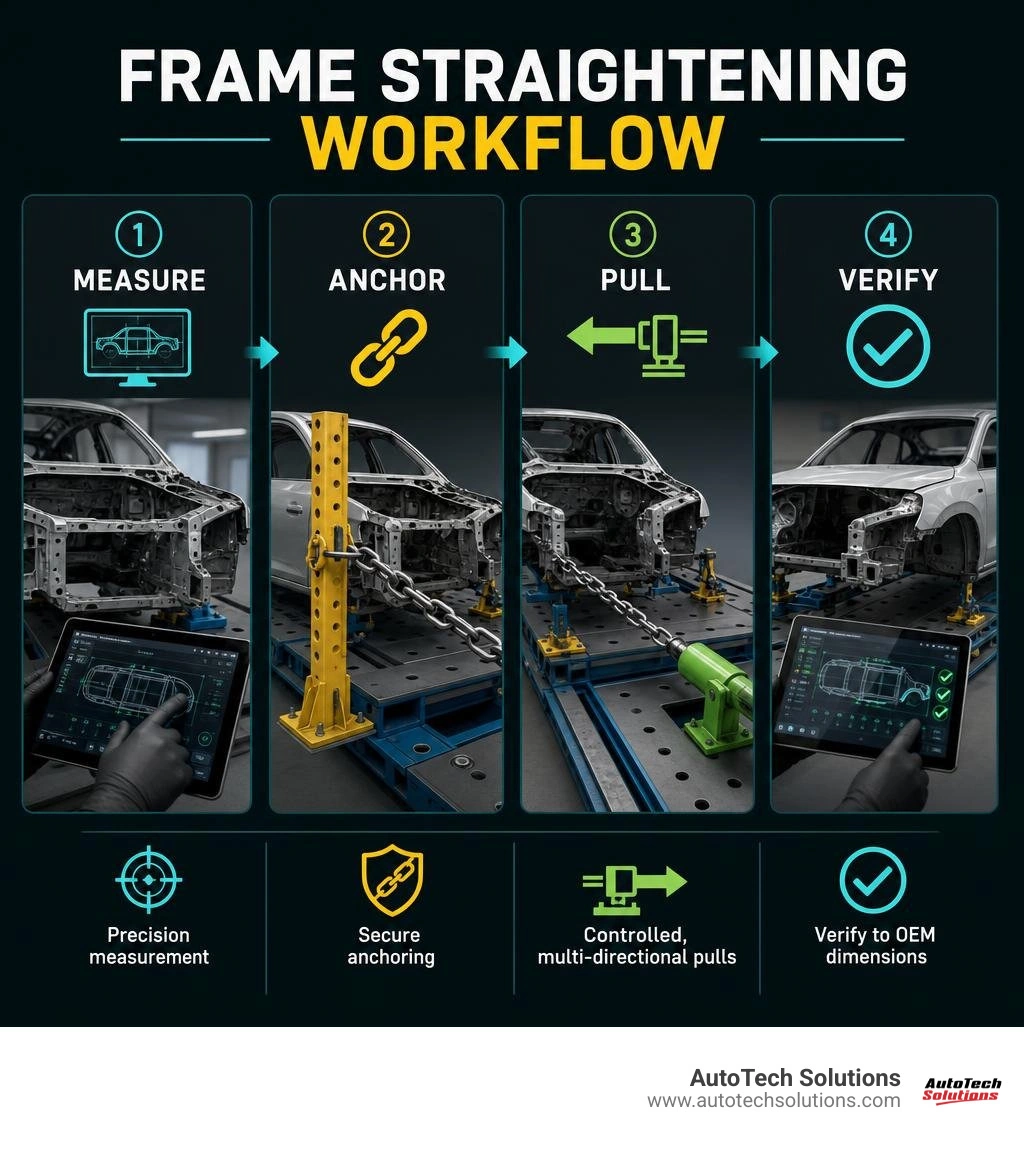
Vehicle frame straightening is the professional process of measuring and restoring collision-damaged vehicle structures to manufacturer-specified dimensions. For a commercial collision shop, it depends on a stable frame rack, secure anchoring, hydraulic pulling equipment, and computerized measuring technology - not visual estimates alone.
| Core requirement | Why it matters to the shop |
|---|---|
| Computerized measurement | Identifies structural movement that may be hidden from view and compares it with OEM dimensions |
| Frame rack and anchoring system | Holds the vehicle structure securely while controlled pulling forces are applied |
| Hydraulic pulling towers | Allow technicians to correct distortion in measured, multi-directional stages |
| Verification workflow | Confirms final dimensions before the repair moves to the next production stage |
A few millimeters of structural misalignment can affect panel fit, suspension geometry, and the calibration of modern driver-assistance systems. That makes accurate measurement, equipment uptime, and a repeatable workflow essential for safe repairs and predictable shop throughput.
This guide explains the equipment, installation considerations, and professional processes behind effective structural restoration. AutoTech Solutions Staff will start with the infrastructure that supports reliable frame-straightening operations.
Vehicle frame straightening further reading:
Commercial Frame Straightening Infrastructure and Professional Tools
Equipping a modern collision center for high-volume structural repair requires robust floor infrastructure and dedicated machinery. According to industry market analysis, the North American automotive collision repair service market is projected to reach $72.02 billion by 2034. As shop bay utilization directly impacts profitability, establishing an efficient, ergonomically sound frame pulling station is critical for maintaining high cycle speeds and technician safety.
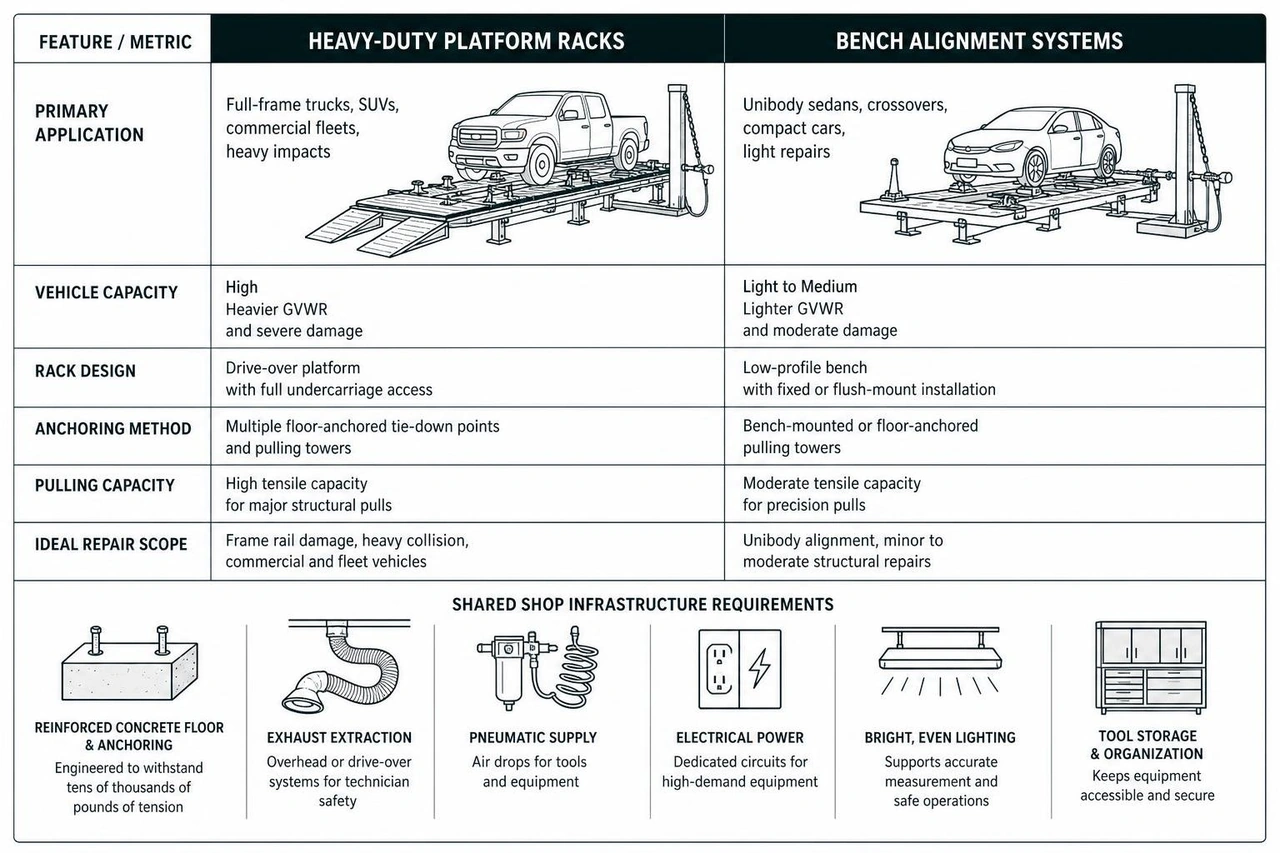
At AutoTech Solutions, we assist commercial facilities across Novi, MI, Charlotte, NC, Raleigh, NC, and Wade, NC in selecting, layout-planning, and installing commercial-grade frame machines. A standard frame setup must seamlessly incorporate shop-level systems, including overhead or drive-over exhaust extraction systems, pneumatic supply drops, and heavy-duty concrete anchoring pads capable of withstanding tens of thousands of pounds of tension.
| Feature / Metric | Heavy-Duty Platform Racks | Bench Alignment Systems |
|---|---|---|
| Primary Application | Full-frame trucks, SUVs, commercial fleets, heavy impacts | Unibody sedans, crossovers, compact cars, light repairs |
| Pulling Capacity | Multi-tower 10 to 20-ton hydraulic pulling power | Modular 5 to 10-ton hydraulic pulling power |
| Mounting Efficiency | Fast drive-on ramps with integrated lift mechanisms | Pin-point universal clamping, lower profile setup |
| Footprint Requirements | Requires large dedicated bay space and high ceiling clearance | Compact footprint, ideal for flexible bay utilization |
| Measuring System Integration | Overhead or floor-based 3D laser/electronic systems | Integrated magnetic/laser scanning arms |
Structural Distortion Diagnostics and Equipment Assessment
Before applying tension to any structural member, commercial facilities rely on systematic diagnostic evaluation. Visual inspections alone are fundamentally inadequate for modern unibody and frame designs, where subtle structural shifts can remain hidden beneath cosmetic outer body panels. A distortion shift of just 2 to 3 millimeters can displace suspension mounting points, cause severe tire scrub, and misalign Advanced Driver Assistance Systems (ADAS) radar modules.
Technicians perform a comprehensive load vector analysis to determine how impact forces traveled through the vehicle chassis. By consulting our detailed Automotive Frame Repair Complete Guide, shop managers can train their service advisors and technicians to assess three-dimensional frame movement across length, width, and height axes:
- Sway: Lateral displacement where the frame or unibody shifts to one side off its centerline.
- Sag: Vertical deformation where a frame section droops downward due to direct vertical impact or extreme buckling.
- Mash: Axial deformation where structural frame rails compress or buckle along their length, shortening the vehicle wheelbase.
- Twist: Torsional distortion where one corner or rail is elevated higher than the opposite side, twisting the floorpan architecture.
Advanced Equipment for Vehicle Frame Straightening
Modern vehicle frame straightening is a highly technical discipline rooted in precise metallurgical manipulation and physics. When collision forces enter a chassis, structural components absorb energy through controlled collapse zones. Restoring these components without inducing severe stress failure requires specialized shop equipment engineered for immense force generation and fine control.
To reverse structural deformation without compromising metal integrity, collision centers utilize heavy-duty platform racks outfitted with multi-directional hydraulic pulling towers. These systems generate up to 20,000 lbs (10 tons) or more of hydraulic pulling force. You can explore complete equipment options in our Auto Body Shop Frame Machine guide.
Modern Measuring Technologies in Vehicle Frame Straightening
The transition from manual tram gauges and tape measures to computerized 3D measurement has elevated structural repair from approximate estimation to absolute precision. Commercial laser measuring platforms project dynamic laser beams across target targets anchored to critical reference points on the vehicle undercarriage.
These targets communicate in real time with electronic databases containing factory-mandated three-dimensional dimensions directly from vehicle manufacturers. As hydraulic pull towers operate, the computerized software updates spatial coordinates instantaneously across X (length), Y (width), and Z (height) axes, guiding the technician to align the frame within 1 millimeter of OEM specifications. This technology is essential for collision centers handling complex structural repairs across busy commercial facilities.
Historical innovations in structural repair equipment, such as early automated clamping and measurement setups documented in Device for straightening a frame of an automobile (US Patent 5623846), paved the way for today's fully automated 3D diagnostic suites that streamline technician labor and eliminate setup guesswork.
Hydraulic Tower Mechanics and Anchoring Systems
The foundation of controlled structural pulling lies in the relationship between hydraulic mechanical advantage and chassis anchoring. To pull thousands of pounds of bent steel or high-strength aluminum back to factory positioning, the vehicle must be immobilized on the frame rack using heavy-duty pinchweld clamps or dedicated chassis adapters.
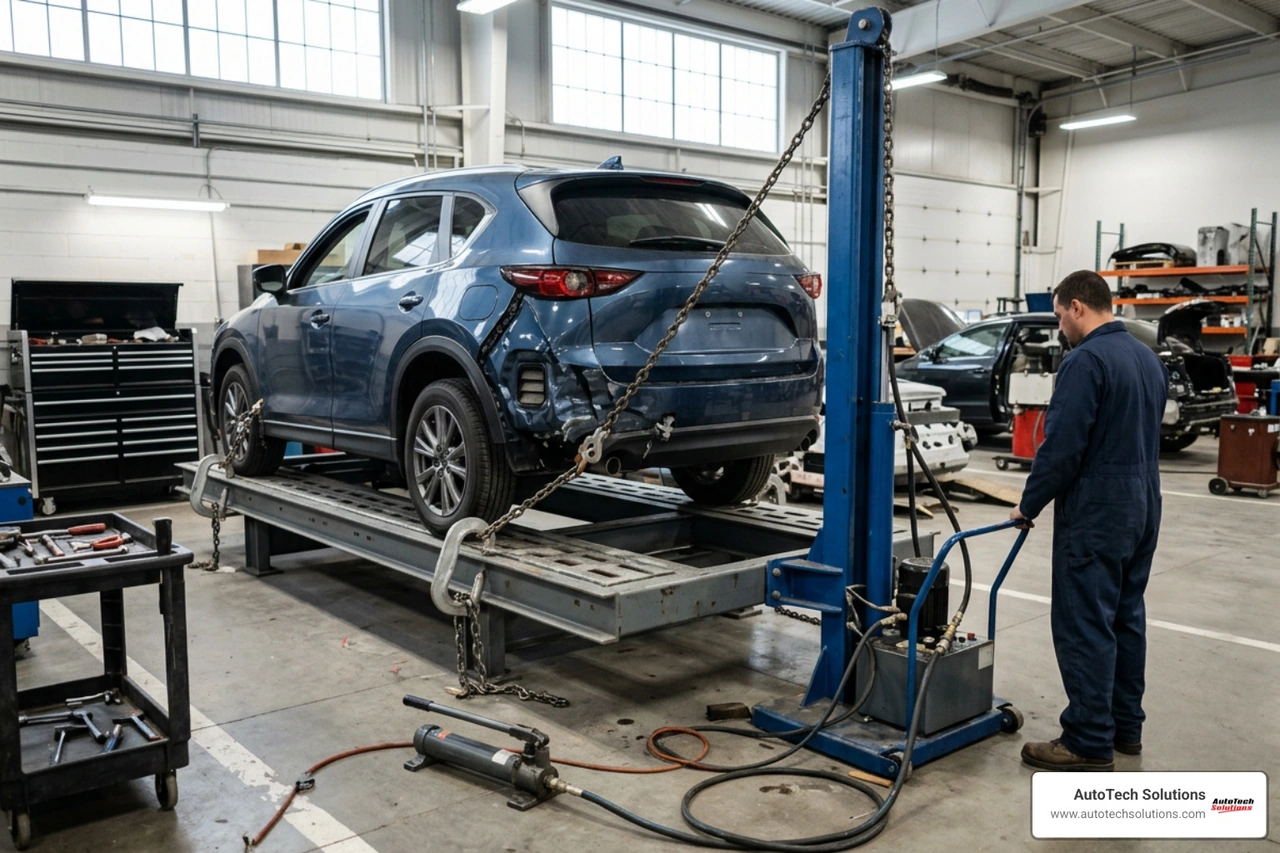
Modern frame machines feature multi-point automated clamping assemblies that lock securely onto the platform structure. Hydraulic towers roll effortlessly around the perimeter track of the rack, allowing multi-vector pulling forces to be applied simultaneously. Applying controlled force along exact vector angles allows technicians to relieve internal metal stress incrementally without causing secondary distortion in adjacent intact structural members.
Step-by-Step Professional Frame Restoration Process
Executing safe, efficient frame repairs requires a standardized step-by-step production line process. Having a clear workflow minimizes shop downtime and ensures every vehicle leaving the structural bay satisfies rigorous quality checks.
Professional Shop Workflows for Vehicle Frame Straightening
- Initial Teardown & Clean-up: Damaged mechanical components, exterior panels, and interior trim are cleared away to expose structural tie-ins and reference points.
- Platform Mounting & Anchoring: The chassis is elevated via integrated rack lifts and secured using heavy-duty anchoring clamps to isolate the vehicle body from tower pulling motion.
- Target Placement & Initial Laser Scan: Target markers are attached to factory locating holes to map out baseline 3D spatial coordinates against OEM dimension charts.
- Controlled Multi-Stage Pulling: Technicians set up pulling chains and hydraulic towers along precise vector angles, applying hydraulic pressure in slow, incremental stages while monitoring continuous digital feedback.
- Stress Relieving: During hydraulic tension cycles, technicians carefully relieve residual stress in the worked structural areas to stabilize the metal structure.
- Final Re-measurement & Documentation: Once all measuring points report inside factory tolerances (0-1mm variance), a final digital report is logged for quality records and shop files. Facilities maintaining top-tier equipment utilize specialized Auto Collision Repair Tools to execute these workflows cleanly.
Frame Straightening vs. Section Replacement Criteria
Not every damaged structural member can or should be pulled. Commercial shops must follow OEM repair guidelines to evaluate whether a bent structural frame component can be safely straightened or if it mandates sectioning or complete component replacement.
- Conventional Mild Steel: Highly ductile; responds well to controlled hydraulic pulling and stress relieving.
- High-Strength Steel (HSS): Higher tensile strength; requires strict thermal limits and careful force application to avoid cracking.
- Ultra-High-Strength Steel (UHSS) & Boron Steel: Designed to resist deformation during severe impacts. Automakers frequently prohibit pulling or heating UHSS members, requiring structural section replacement at designated factory joint locations.
- Structural Aluminum Alloys: Requires specialized, dedicated pulling workstations and controlled heating tools to prevent galvanic cross-contamination and stress fracturing.
Modern Shop Infrastructure, Safety, and OEM Compliance
Operating a high-capacity collision center requires continuous adherence to safety standards and manufacturer certifications. Proper shop layout and infrastructure planning ensure that heavy frame machines operate safely without posing hazards to shop technicians or nearby bays.
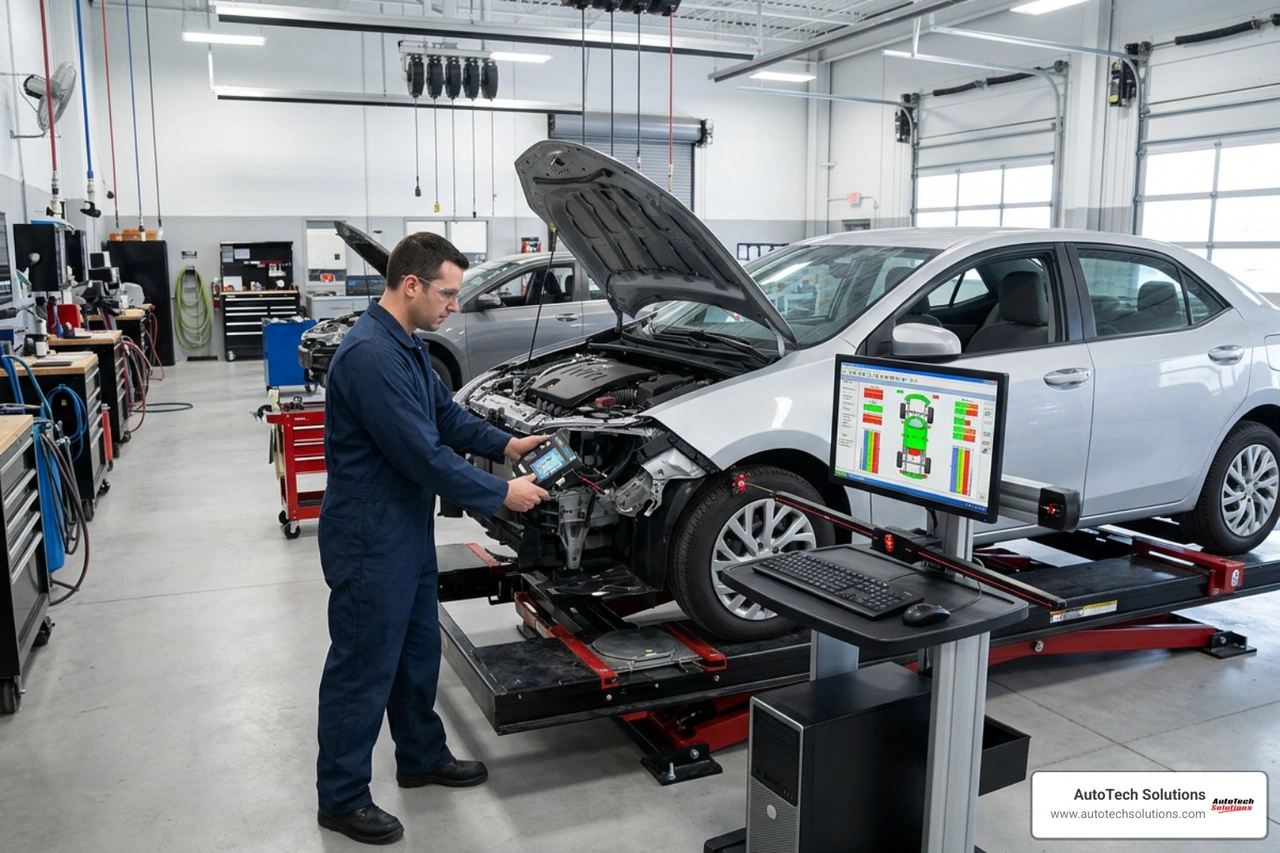
At AutoTech Solutions, our installation teams specialize in full shop layout design, concrete floor evaluation, utility drop placement, and heavy commercial equipment setups. When planning a facility upgrade or expansion in regions like Novi, MI or Charlotte, NC, shop owners can consult our comprehensive Collision Center Equipment Install Guide to ensure full compliance with occupational safety codes and structural floor load specifications.
Key infrastructure and compliance considerations for modern frame bays include:
- Floor Load Capacity: Concrete slabs must meet thickness and PSI requirements to support anchored rack loads during high-tonnage pulls.
- Exhaust & Ventilation Drops: Drive-on frame bays require integrated, accessible exhaust extraction systems to clear vehicle fumes safely during diagnostic positioning.
- I-CAR & OEM Certifications: Maintaining I-CAR Gold Class status requires technicians to stay trained on evolving chassis metallurgy and OEM-mandated structural repair procedures.
- ADAS Calibration Integration: Post-repair frame alignment must restore the chassis to its 3D mechanical centerline; failure to do so prevents precise front camera, radar, and blind-spot sensor calibration.
Frequently Asked Questions About Commercial Frame Repair
How long does a professional frame straightening procedure typically take?
A typical commercial vehicle frame straightening repair takes between 1 and 3 working days, depending on the damage severity and vehicle construction type. Minor sway or unibody rail adjustments using fast-setup platform racks can be completed in 4 to 8 hours, whereas severe multi-directional pulls requiring extensive panel teardown, subframe removal, and 3D laser mapping can take several days to execute safely.
Why is computerized 3D measuring essential for structural alignment?
Computerized 3D measuring provides absolute, objective accuracy down to the millimeter by comparing real-time spatial target data against OEM structural blueprints. Visual estimations or manual measuring tapes cannot detect subtle twist or cross-diagonal sag across complex unibody structures. Precise alignment is vital for proper wheel alignment, door and panel fitment, airbag sensor geometry, and ADAS camera and radar calibration.
Can severe frame distortion always be straightened back to factory standards?
No. While modern multi-tower hydraulic machines can apply tremendous pulling force, structural metals have precise material strain limits. If high-strength steel or structural aluminum frame rails suffer severe tearing, deep creasing, micro-fracturing, or extreme metallurgic fatigue, pulling may compromise structural integrity. In such cases, OEM repair procedures dictate cutting out damaged structural sections at approved locations and installing factory replacement components.
Conclusion
Mastering vehicle frame straightening in a modern commercial collision center requires a balance of advanced technology, rigorous OEM compliance, and reliable shop infrastructure. Investing in top-tier heavy-duty frame machines, 3D laser measuring systems, and proper facility installation ensures your shop delivers safe structural repairs while maximizing throughput and labor efficiency.
At AutoTech Solutions, we are dedicated to minimizing shop downtime through expert equipment sales, professional car lift installation, preventative maintenance, and fast repair service across Michigan and the Carolinas. Whether you are building out a new collision bay in Raleigh, NC, upgrading frame racks in Charlotte, NC, or servicing shop equipment in Novi, MI, our team delivers complete support for your operational needs.
Explore our comprehensive resources in our Automotive Shop Equipment Complete Guide or contact our technical sales team today to learn more about our tailored Collision Center Solutions.