Choose the Right Air Compressor Filtration System for Your Shop
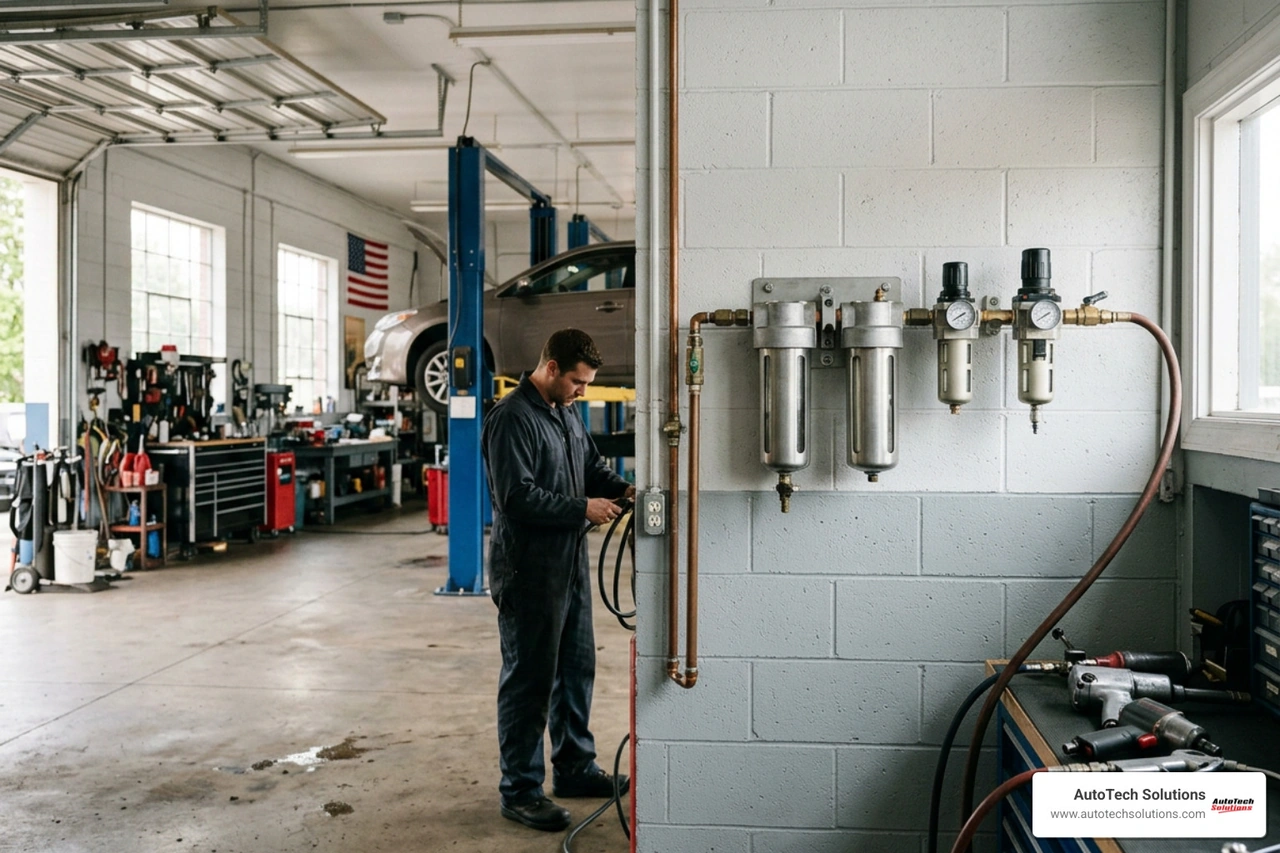
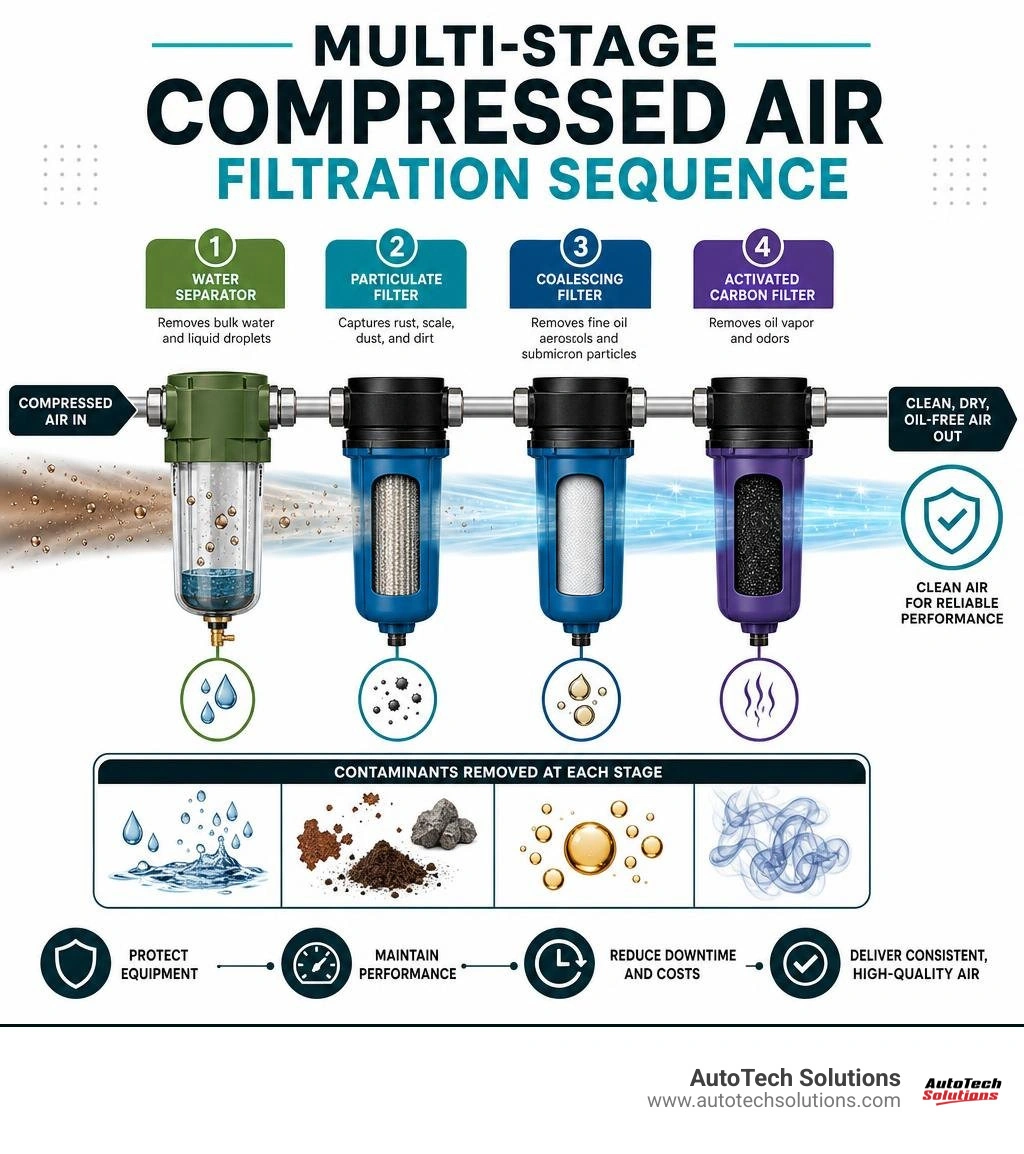
A air compressor filtration system removes the water, oil, vapor, and debris that can disrupt professional shop operations. For most automotive service and collision facilities, the right setup uses staged filtration: bulk moisture removal first, then fine particulate and oil-aerosol control, with activated carbon added where vapor-free air is required.
| Shop air need | Typical filtration approach |
|---|---|
| General pneumatic tools and shop equipment | Water separator plus general-purpose particulate filter |
| Sensitive controls, automation, and production equipment | Water separator, dryer, and fine coalescing filter |
| Paint preparation and finish work | Multi-stage filtration with water separation, coalescing, and carbon vapor removal |
| Critical point-of-use air drops | Modular filtration installed near the equipment |
Compressed air is not clean just because the compressor has an inlet filter. Humidity condenses after compression, lubricated compressors can introduce oil aerosols, and aging pipework can add rust and scale. These contaminants can cause corrosion, poor tool performance, finish defects, and unplanned downtime.
Sizing also matters. A filter must handle the shop's required SCFM, operating pressure, temperature, and target air-quality level without creating excessive pressure drop. Even a 10 PSI pressure drop can raise compressed-air energy cost by about 5%.
The following roundup explains the commercial filtration system options that help automotive shops protect equipment, support consistent work, and manage operating costs.
Prepared by AutoTech Solutions Staff, with a focus on dependable compressed-air infrastructure for commercial automotive shops.
Know your air compressor filtration system terms:
Why Your Commercial Shop Needs an Air Compressor Filtration System
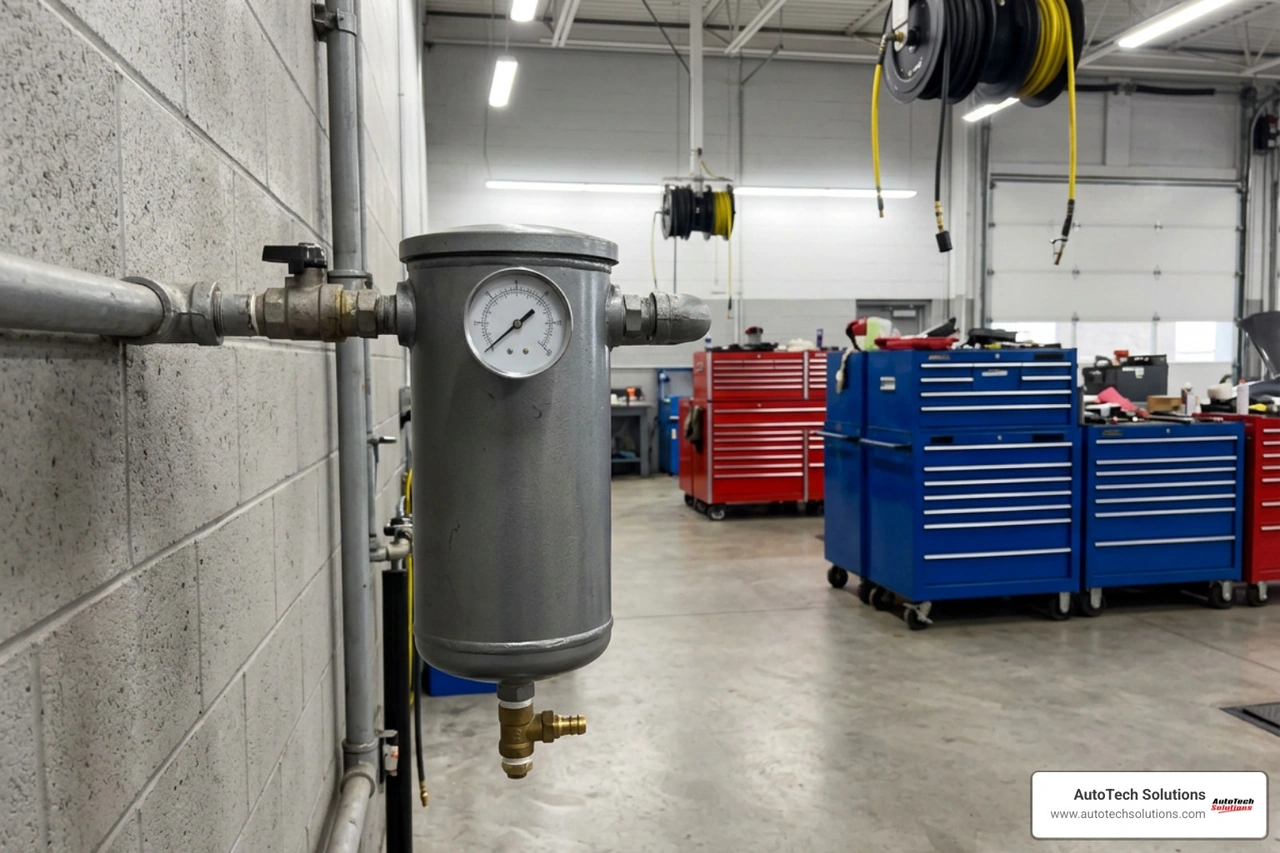
In any commercial automotive service, heavy-duty repair, or collision center, clean compressed air is just as vital as electrical power. Atmospheric air drawn into your compressor inlet contains microscopic ambient dust, airborne hydrocarbons, and humidity. Once compressed to standard working pressures (such as 125 to 175 PSIG), these impurities become highly concentrated. Without a properly engineered air compressor filtration system, this aggressive mix travels directly into your distribution piping, pneumatic equipment, and paint spray guns.
Beyond physical contamination, poor air treatment places an immense financial drain on shop operations. Over a typical 10-year lifespan of a commercial compressor package, the cost of electrical energy to run the system far outweighs the original capital investment of purchasing the equipment. Operating with clogged or poorly configured line filters directly drives up these utility costs.
Specifically, a 10 PSI pressure drop across saturated filter elements represents a 5% increase in total energy costs because the compressor must work significantly harder to maintain required line pressures. Investing in low-differential-pressure filtration and adhering to timely maintenance protects both your equipment and your bottom line.
For comprehensive details on setting up robust piping headers and distribution layouts, explore our detailed guide on Shop Air Systems.
Contaminant Types in Compressed Air
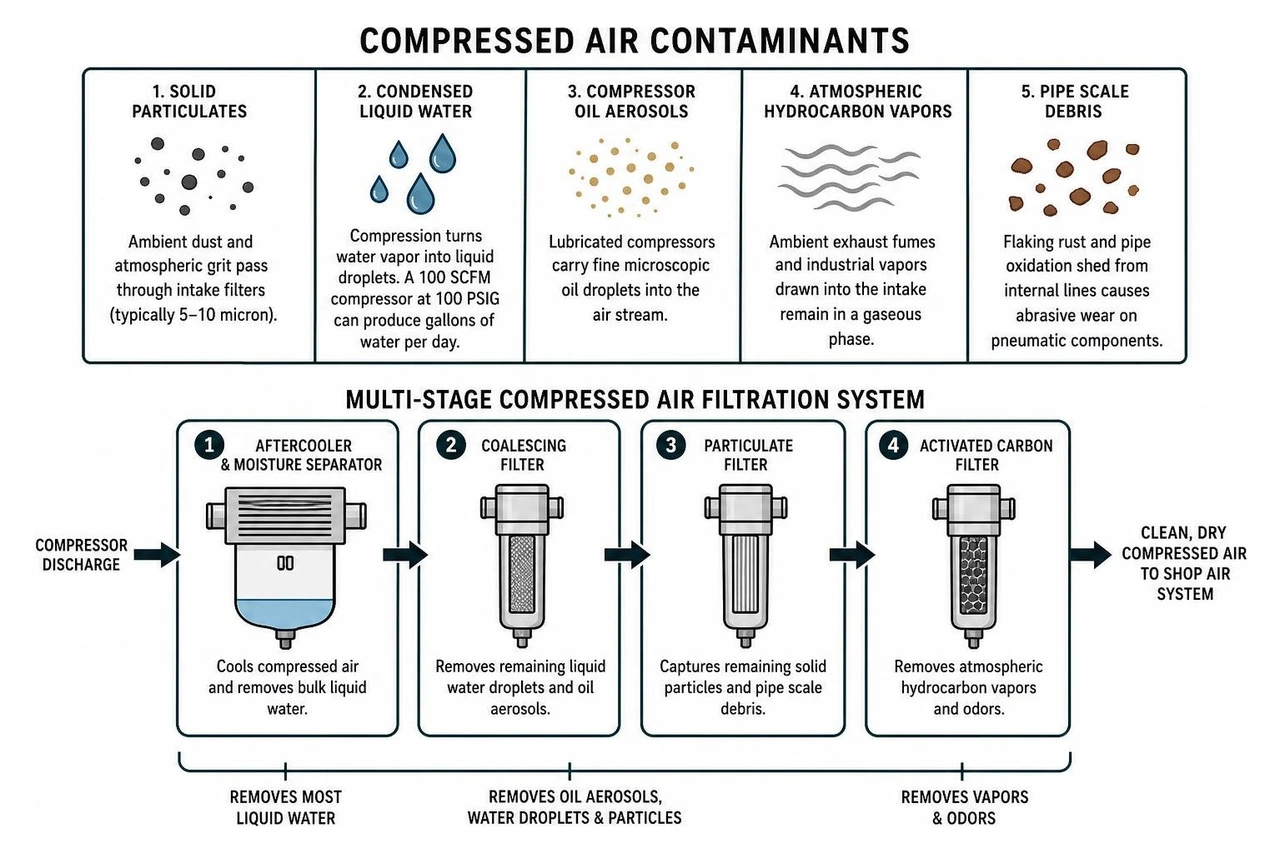
To choose the right treatment train, you must understand the five primary contaminants circulating inside an untreated air line:
- Solid Particulates: Ambient dust and atmospheric grit pass right through standard intake air filters, which typically capture particles only down to 5 or 10 microns.
- Condensed Liquid Water: Compression squeezes atmospheric water vapor into liquid droplets. A 100 SCFM compressor running at 100 PSIG in humid weather can produce gallons of liquid water per day.
- Compressor Oil Aerosols: Lubricated rotary screw and reciprocating compressors carry over fine microscopic droplets of compressor oil into the air stream.
- Atmospheric Hydrocarbon Vapors: Ambient exhaust fumes and industrial vapors drawn into the intake remain in a gaseous phase through mechanical filtration stages.
- Pipe Scale Debris: Flaking rust and pipe oxidation shed from internal metal distribution lines cause abrasive wear on pneumatic seals and valves downstream.
Impact of Temperature on Moisture Removal
Understanding the relationship between compressed air temperature and liquid condensation is critical when designing a filtration system. Warm air holds vastly more water vapor than cool air. When hot air leaves the compressor pump, water exists almost entirely as an invisible gas (vapor).
Mechanical water separators and inline coalescing filters are engineered to remove liquid water droplets and oil droplets—they cannot strip out gas-phase moisture vapor. If warm air enters a filter housing at 150°F, water vapor passes straight through the filter media without being trapped.
As the air travels downstream through your distribution main and cools down to ambient shop temperature, that vapor condenses into liquid inside your air drops. This is why proper cooling—achieved via aftercoolers, heat exchangers, or extended piping runs with drop legs—must occur upstream so moisture can drop out of the vapor phase into liquid condensate before reaching mechanical filters.
Core Components of a Complete Commercial Filtration Setup
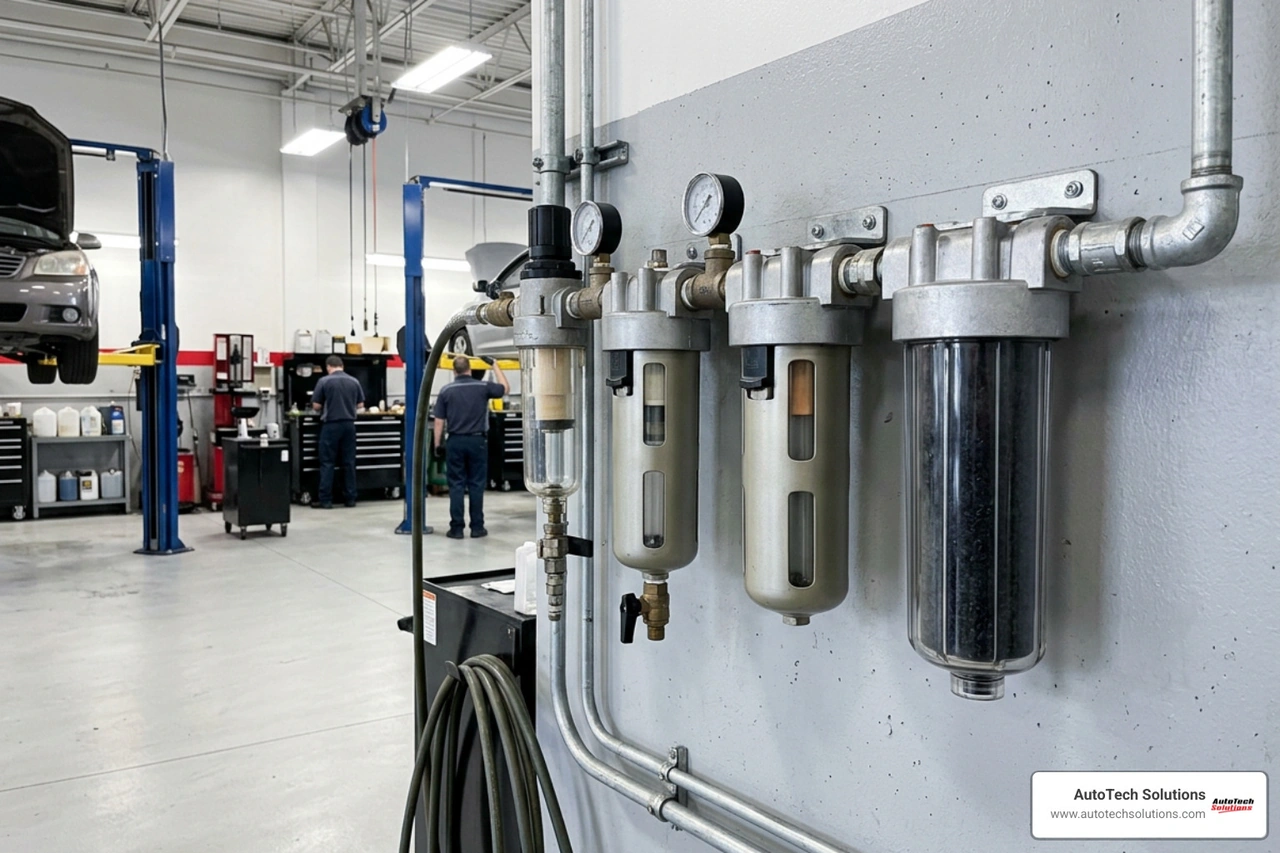
Achieving pristine air quality in commercial operations requires a multi-stage approach. No single filter element can strip out liquid water, sub-micron oil aerosols, solid grit, and vapor odors simultaneously without becoming rapidly clogged or destroyed.
Integrating a full air treatment layout ensures every component performs its intended task efficiently. To learn how main line filtration connects with header layouts, review our breakdown on the Compressed Air Ring Main.
Water Separator vs Coalescing Filter vs Activated Carbon Air Compressor Filtration System
Each filtration technology relies on distinct mechanical principles to isolate specific contaminants:
- Water Separators (Centrifugal Bulk Removal): Positioned immediately downstream of aftercoolers or wet receiver tanks, water separators use internal directional vanes to force incoming air into a high-speed cyclone. Centrifugal force throws heavy liquid droplets and large rust particles against the housing wall, where they drain into a bottom collection sump. Leading models, like centrifugal water separators from Walker Filtration or the nano-purification solutions GF Series, remove 93% to 99% of bulk liquid water without requiring filter element replacements.
- Coalescing Filters (Sub-Micron Aerosol Capture): Coalescing elements are dense, multi-layered microfiber matrices designed to capture microscopic liquid oil mists and fine water aerosols. Air flows from the inside of the element outward. Tiny liquid particles hit the microfibers, combine (coalesce) into larger drops, and migrate down to the outer drainage layer. High-efficiency coalescers, such as the Quincy QCF Series or Atlas Copco UD+ Filter, remove oil droplets down to 0.01 micron with 99.9% mass efficiency.
- Activated Carbon Absorbers (Vapor Removal): When compressed air is used for high-end paint spraying or process applications, gaseous oil odors and hydrocarbon vapors must be removed. Activated carbon beds utilize deep adsorption media to trap oil molecules chemically. Units like the BEKO CLEARPOINT or Hankison HF Series reduce remaining oil vapors down to a stringent 0.003 PPM (mg/m³), achieving ISO 8573-1 Class 1 oil purity standards.
Particulate Line Filters and Desiccant Protection
Particulate line filters rely on mechanical interception, inertial impaction, and diffusion to strip dry solids from the air stream. A standard 1-micron pre-filter protects refrigerated dryers and fine coalescers from heavy dust accumulation.
When ultra-low pressure dew points down to -40°F are needed, shops deploy point-of-use desiccant dryers, such as the Super-Dry D-Series. In these configurations, a 1-micron dry particulate filter must be installed immediately downstream of the desiccant tower. This post-filter captures desiccant bead dust (fine abrasive particles) that naturally sheds from the drying bed, preventing it from migrating into your shop tools or pneumatic machinery.
Establishing a routine inspection schedule for these elements is vital; learn how in our Air Compressor Preventative Maintenance Guide.
How to Choose the Right Commercial Air Treatment Hardware
Selecting the proper commercial hardware requires balancing airflow requirements, operating pressure ratings, and target air purity levels defined by ISO 8573 standards.
| Filter Type | Primary Function | Typical Micron Rating | Efficiency / Oil Carryover | Max Operating Limits |
|---|---|---|---|---|
| Water Separator | Bulk liquid condensate removal | 10 to 25 micron bulk separation | 93% – 99% bulk water removal | Up to 250–300 PSIG |
| General Particulate Filter | Solid particle & dust pre-filtration | 1.0 micron | Captures solids > 1 micron | Up to 232–250 PSIG |
| Fine Coalescing Filter | Oil aerosol & liquid mist removal | 0.01 micron | 99.9% mass efficiency / <0.01 mg/m³ | Up to 232–250 PSIG |
| Activated Carbon Filter | Hydrocarbon vapor & odor adsorption | N/A (Vapor phase) | <0.003 PPM (mg/m³) residual oil | Up to 175–232 PSIG |
When matching commercial hardware to your facility, never select a filter housing based strictly on your pipe connection size. A 1-inch line in a high-demand shop might carry 150 SCFM at 125 PSIG, or 300 SCFM at 175 PSIG. Sizing must always be calculated using your actual peak flow rate (SCFM) modified by pressure correction factors.
If a filter is undersized, air velocity through the media becomes too fast, causing high initial differential pressure, element tearing, and oil carryover. High-flow industrial filters, like the Kaeser F-Series Flanged Filters, accommodate flow rates from 1,250 to over 11,875 SCFM while maintaining initial pressure losses under 0.8 PSI dry.
To explore full system integrations and equipment specs, consult our Compressed Air Systems Ultimate Guide 2026.
Proper Filter Sequence and Installation Order
Installing filters in the correct physical sequence prevents pre-mature filter clogging and maximizes air purity. The industry-standard installation sequences depend on your dryer equipment:
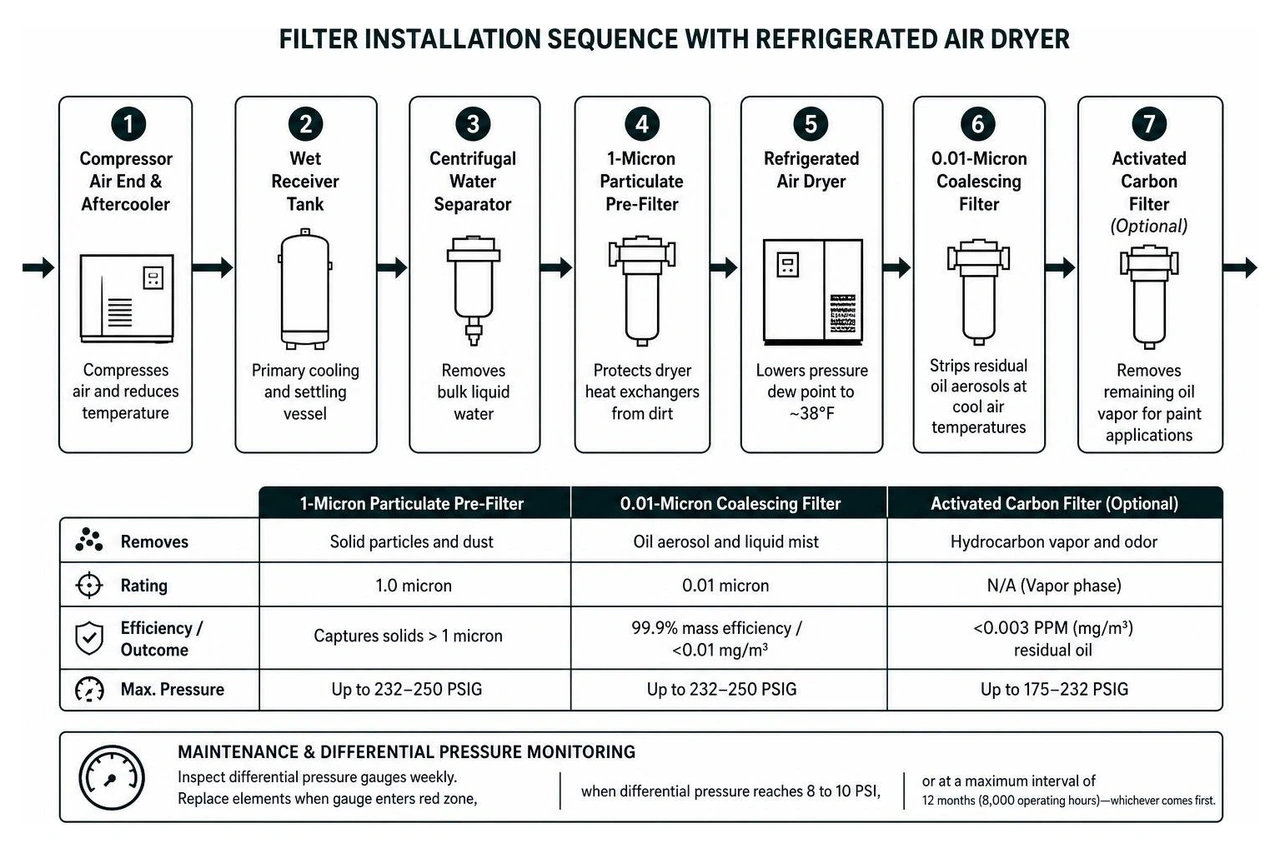
Sequence with a Refrigerated Air Dryer:
- Compressor Air End & Aftercooler
- Wet Receiver Tank (acts as a primary cooling/settling vessel)
- Centrifugal Water Separator (removes bulk liquid)
- 1-Micron Particulate Pre-Filter (protects dryer heat exchangers from dirt)
- Refrigerated Air Dryer (lowers pressure dew point to ~38°F)
- 0.01-Micron Coalescing Filter (strips residual oil aerosols at cool air temperatures)
- Activated Carbon Filter (optional: removes remaining oil vapor for paint applications)
Sequence with a Desiccant Air Dryer (-40°F Dew Point):
- Compressor & Water Separator
- 1-Micron Pre-Filter
- 0.01-Micron Coalescing Filter (crucial: liquid oil coats desiccant beads and ruins them)
- Desiccant Air Dryer
- 1-Micron Particulate After-Filter (captures shedding desiccant dust)
Maintenance Schedules and Differential Pressure Monitoring
Filter elements are consumable items. Over time, trapped dirt creates a physical restriction to airflow, causing differential pressure (pressure drop) across the filter head.
To maintain peak energy efficiency, inspect differential pressure gauges weekly. Elements should be changed whenever the gauge enters the red zone, when differential pressure reaches 8 to 10 PSI, or at a maximum interval of 12 months (8,000 operating hours)—whichever comes first.
Additionally, liquid collected in filter bowls must be reliably discharged. Manual drains are often forgotten, leading to flooded filter bowls and liquid re-entrainment into the air line. Upgrading to level-actuated electronic drains or zero-loss pneumatic drains ensures automatic condensate removal without venting valuable compressed air.
For professional service support, explore our options for Air Compressor Repair and Maintenance for Automotive Shops.
Modular Point-of-Use vs Centralized Air Compressor Filtration System Drops
While centralized filtration at the compressor room protects your main distribution trunk, many high-demand shop applications require dedicated protection right at the workstation drop. Modular point-of-use filtration systems offer customized air treatment without the expense of over-treating air used for basic tasks like shop tire inflation or lift operation.
For instance, an automotive collision shop operating paint spray booths, CNC plasma tables, or sensitive automated equipment benefits immensely from localized treatment headers. Heavy-duty modular units, such as the Tsunami 120 Series Filter, Tsunami 225 Series Filter, and Tsunami 300 Series Filter, utilize precision-machined, anodized 6061 aircraft-grade aluminum housings.
These modular assemblies let you bolt water separation, coalescing, and carbon vapor elements directly together at the drop. Mounting modular filters 20 to 50 feet downstream from the receiver tank gives the air adequate distance to cool, ensuring that condensed moisture and scale formed inside aging main lines are trapped right before air enters paint guns or pneumatic machinery.
Frequently Asked Questions About Compressed Air Treatment
How often should air compressor filter elements be replaced?
Air compressor filter elements should be replaced every 12 months or 8,000 operating hours, whichever comes first. However, if your filter housing is equipped with a differential pressure indicator and the gauge reads in the red zone (typically indicating an 8 to 10 PSI pressure drop across the element), the filter should be replaced immediately. Operating saturated elements forces your compressor to work harder, increasing energy costs by roughly 5% for every 10 PSI of pressure drop.
What sequence should compressed air filters follow relative to the air dryer?
For a standard setup with a refrigerated air dryer, the recommended order is:
- Centrifugal Water Separator
- 1-Micron Particulate Pre-Filter
- Refrigerated Air Dryer
- 0.01-Micron High-Efficiency Coalescing Filter
- Activated Carbon Vapor Filter (for paint booths).
Placing a pre-filter before the dryer protects internal heat exchanger passages from dirt fouling, while placing the fine coalescing filter after the dryer allows it to remove oil aerosols far more effectively at cooler air temperatures.
Why does hot air from the compressor bypass mechanical moisture filters?
Mechanical moisture filters and water separators can only trap physical liquid water droplets—they cannot remove gaseous water vapor. Air discharged directly from a compressor pump is extremely hot (often 150°F to 200°F) and holds moisture as an invisible vapor. If hot air enters a mechanical filter, the vapor passes right through the media without being stopped. The air must be cooled—using aftercoolers or by flowing through 20 to 50 feet of metal distribution piping equipped with drop legs—so the water vapor condenses into liquid droplets that filters can physically catch.
Conclusion
A well-designed air compressor filtration system is an investment in your commercial shop's daily uptime, output quality, and long-term energy efficiency. From initial bulk liquid removal down to 0.003 PPM vapor adsorption, matching the right filter sequence to your specific air demands eliminates finish defects, prevents premature tool wear, and protects expensive pneumatic machinery.
At AutoTech Solutions, our experienced team provides comprehensive commercial shop equipment sales, professional car lift installation, distribution layout design, expert installations, and preventative maintenance programs tailored to facilities across Michigan and North Carolina. Whether you operate a busy collision center in Charlotte, NC, an auto repair facility in Raleigh, NC, or a commercial fleet shop in Novi, MI, we keep your air systems running at peak performance.
Ready to optimize your shop's compressed air quality and reduce operating costs? Connect with our team today for a custom evaluation and professional Air Compressor Installation for Automotive Shop.