
The Role of Compressed Air Systems in Professional Automotive Shops
Compressed air systems are one of the most critical infrastructure investments a commercial automotive shop can make.
Here's a quick overview of what they are and why they matter:
- What they are: A network of equipment that compresses atmospheric air, stores it under pressure, treats it for quality, and delivers it to pneumatic tools and equipment throughout a facility.
- Key components: Air compressor, receiver tank, dryer, filters, piping distribution network, and condensate management.
- Common shop uses: Powering pneumatic tools, operating vehicle lifts, running paint spray equipment, actuating automated systems, and inflating tires.
- Most common types: Rotary screw (continuous duty), reciprocating piston (intermittent use), and rotary vane (quiet, compact).
- Why it matters: A poorly designed or undersized system causes pressure drops, tool failures, increased energy costs, and technician downtime.
Compressed air is often called the "fourth utility" — right alongside electricity, water, and natural gas. In a busy automotive service or collision facility, it powers nearly every corner of the shop floor.
But here's the problem most shop managers face: compressed air is invisible. Leaks go undetected. Systems get undersized. Energy costs quietly climb. And when something fails, the whole shop feels it.
This guide covers everything you need to know — from selecting the right compressor type to installation, piping design, air treatment, and ongoing maintenance — so your shop runs at full productivity without unnecessary downtime or waste.
Understanding Compressed Air Systems and How They Work
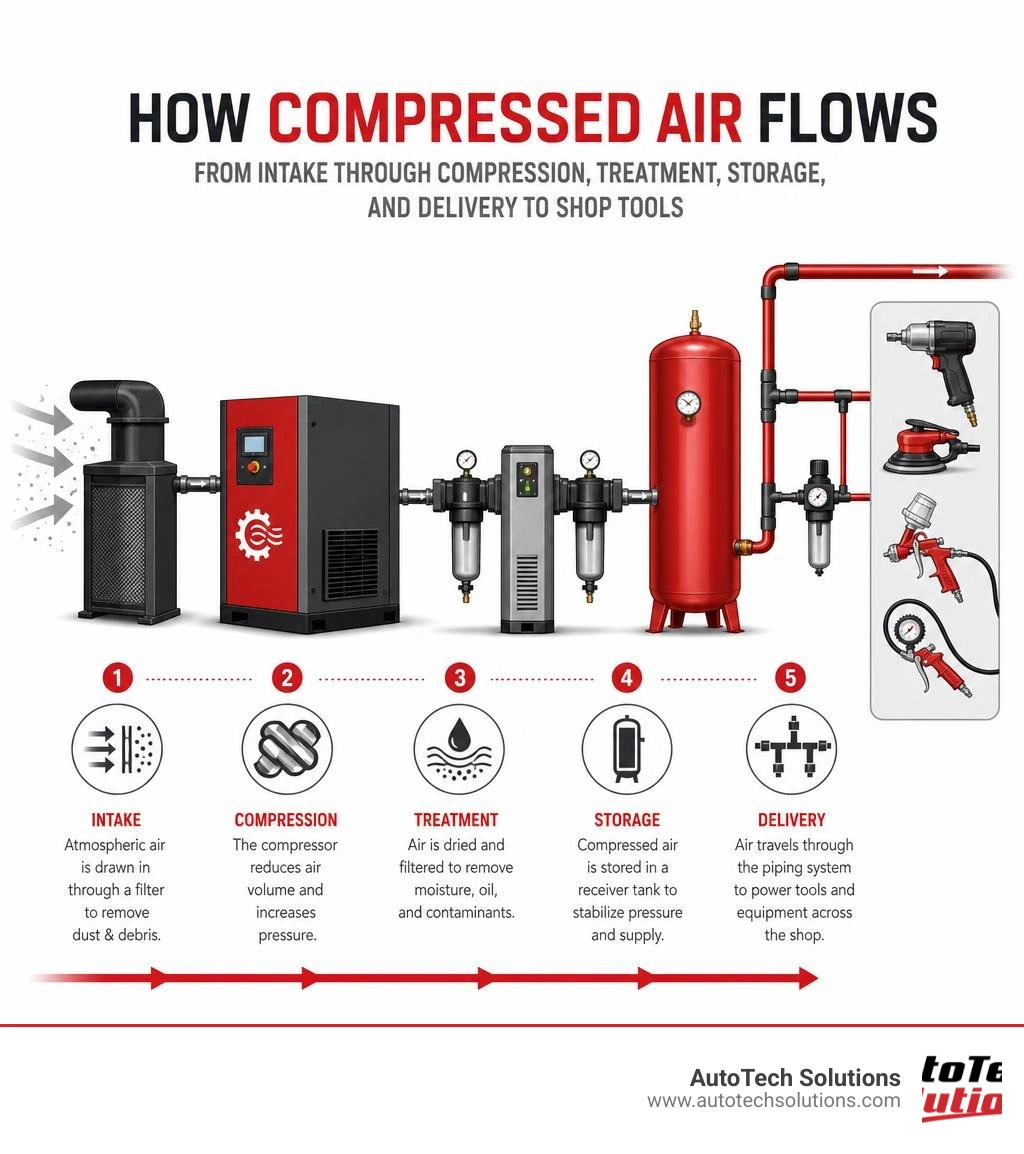
At its most basic level, a compressed air system is a mechanical setup that takes ambient atmospheric air, squeezes it into a much smaller space, and stores it as potential energy. When that squeezed air is released, it converts back into kinetic energy to power heavy-duty shop equipment.
The compression cycle begins at the intake valve, where atmospheric air is drawn in through a filter to remove dust and debris. The compressor pump then uses mechanical force—such as a reciprocating piston or rotating screws—to reduce the volume of the air. Because compressing air generates a massive amount of heat, the air must be cooled and treated before it enters the distribution network.
To understand how these systems perform, we rely on three key metrics:
- PSI (Pounds per Square Inch): This measures the pressure or "force" of the air. Most professional automotive shop tools require between 90 and 120 PSI to operate correctly.
- CFM (Cubic Feet per Minute): This measures the volume of air flow. CFM is the most critical metric for sizing because if your tools consume more air volume than your compressor can produce, system pressure will plummet.
- HP (Horsepower): This represents the mechanical power of the motor driving the compressor. While HP is important, you should always size your system based on CFM and PSI rather than horsepower alone.
Core Components of Industrial Compressed Air Systems
A complete industrial compressed air system is much more than just the compressor pump. To deliver clean, reliable pneumatic power, several specialized components must work in harmony:
- The Air Receiver Tank: Often called a wet or dry tank depending on its placement, the receiver stores compressed air, cushions pressure pulses from the compressor, and acts as a primary moisture separator as the air cools.
- The Aftercooler: This heat exchanger cools the hot discharged air immediately after compression, causing up to 70% of the suspended water vapor to condense into liquid water so it can be drained away.
- The Moisture Separator: Located downstream from the aftercooler, this mechanical device removes bulk water droplets from the air stream before they reach your piping.
- System Controls: Modern commercial systems rely on advanced control panels or master controllers to coordinate multiple units, match air supply with fluctuating shop demand, and protect the motor from short-cycling.
- Engineering Standards for Distribution: Delivering air efficiently requires high-integrity piping designed to withstand maximum system pressure while minimizing friction and pressure drop.
Types of Industrial Air Compressors
Different shop environments require different compression technologies. The three primary types of industrial air compressors are:
- Rotary Screw Compressors: These units use two counter-rotating helical screws to continuously compress air. They are designed for 100% continuous duty, meaning they can run 24/7 without needing rest. They are incredibly reliable, quiet, and highly efficient for commercial shops with constant air demand.
- Reciprocating Piston Compressors: Operating much like a commercial engine, these use pistons, cylinders, and valves to compress air. They are ideal for intermittent use (typically a 60% to 70% duty cycle) and are highly durable, though they produce more noise and vibration than rotary screw models.
- Rotary Vane Compressors: These feature a rotor with sliding blades offset within a cylindrical housing. As the rotor turns, the blades sweep air into smaller pockets. They are known for their compact footprint, exceptionally quiet operation, and longevity.
Here is a quick comparison of the two most common types found in professional shops:
| Feature | Rotary Screw Compressor | Reciprocating Piston Compressor |
|---|---|---|
| Duty Cycle | 100% (Continuous Duty) | 60% - 70% (Intermittent Duty) |
| Noise Level | Low (60–70 dBA) | High (80–90+ dBA) |
| Oil Carryover | Very Low | Moderate to High |
| Best Suited For | High-volume, multi-bay commercial shops | Small to mid-sized shops with fluctuating demand |
| Initial Cost | Higher | Lower |
Sizing and Selecting the Right Compressor for Commercial Shops
Sizing a compressor incorrectly is a recipe for operational headaches. If it is too small, your tools will starve for air, and your compressor will run hot, leading to premature failure. If it is too large, you will waste thousands of dollars in energy costs and equipment overhead.
To size your system correctly, follow these three steps:
- Calculate Total CFM Demand: List every pneumatic tool and automated system in your shop. Write down their individual CFM requirements at their operating PSI. Identify which tools will run simultaneously during your busiest hour. Add their CFM ratings together.
- Establish PSI Requirements: Identify the tool with the highest operating pressure requirement. Your compressor must be rated to deliver at least 15 to 20 PSI above this highest tool requirement to account for natural pressure drops across your piping and filtration system.
- Apply a Safety Buffer and Duty Cycle Factor: Never run a compressor at its absolute limit. For rotary screw systems, add a 20% safety buffer to your total CFM calculation. For reciprocating piston systems, double your CFM calculation to ensure the compressor has enough idle time to cool down (matching its 50% to 60% duty cycle limit).
Oil-Injected vs. Oil-Free Compressors
When selecting a compressor, you must choose between oil-injected (lubricated) and oil-free designs.
- Oil-Injected Compressors: These use specialized compressor oil to lubricate, seal, and cool the compression chamber. They are the industry standard for general automotive service because they have a longer lifespan, run cooler, and are highly cost-effective. However, they introduce tiny amounts of oil aerosols into the air stream, which must be filtered out.
- Oil-Free Compressors: These use self-lubricating materials (like Teflon) and sealed bearings. They are essential for environments where even a single molecule of oil contamination can ruin a process—such as in pharmaceutical manufacturing or advanced food packaging.
For commercial automotive shops, oil-injected compressors are almost always preferred due to their lower maintenance costs and superior durability. To achieve the extreme air purity required for high-end automotive paint booths, we simply pair an oil-injected compressor with advanced inline filtration and refrigerated dryers.
Fixed-Speed vs. Variable Speed Drive (VSD) Efficiency
Historically, air compressors ran at a single, fixed speed. When your shop needed less air, the compressor would either unload (run idle while still consuming significant power) or stop and start repeatedly, putting heavy wear on the motor.
Variable Speed Drive (VSD) compressors solve this problem by using an inverter to adjust the motor's speed in real-time to match your exact air consumption.
- Fluctuating Demand: If only one technician is using an air tool, the VSD motor spins slowly. If ten bays open up simultaneously, the motor instantly ramps up.
- Permanent Magnet Motors: High-efficiency VSD models utilize interior permanent magnet (iPM) motors, which offer unmatched electrical efficiency.
- Utility Incentives: Because VSD systems drastically reduce peak electrical demand, local energy companies often offer substantial financial incentives and rebates to offset the initial purchase cost.
Professional Installation and Piping Design
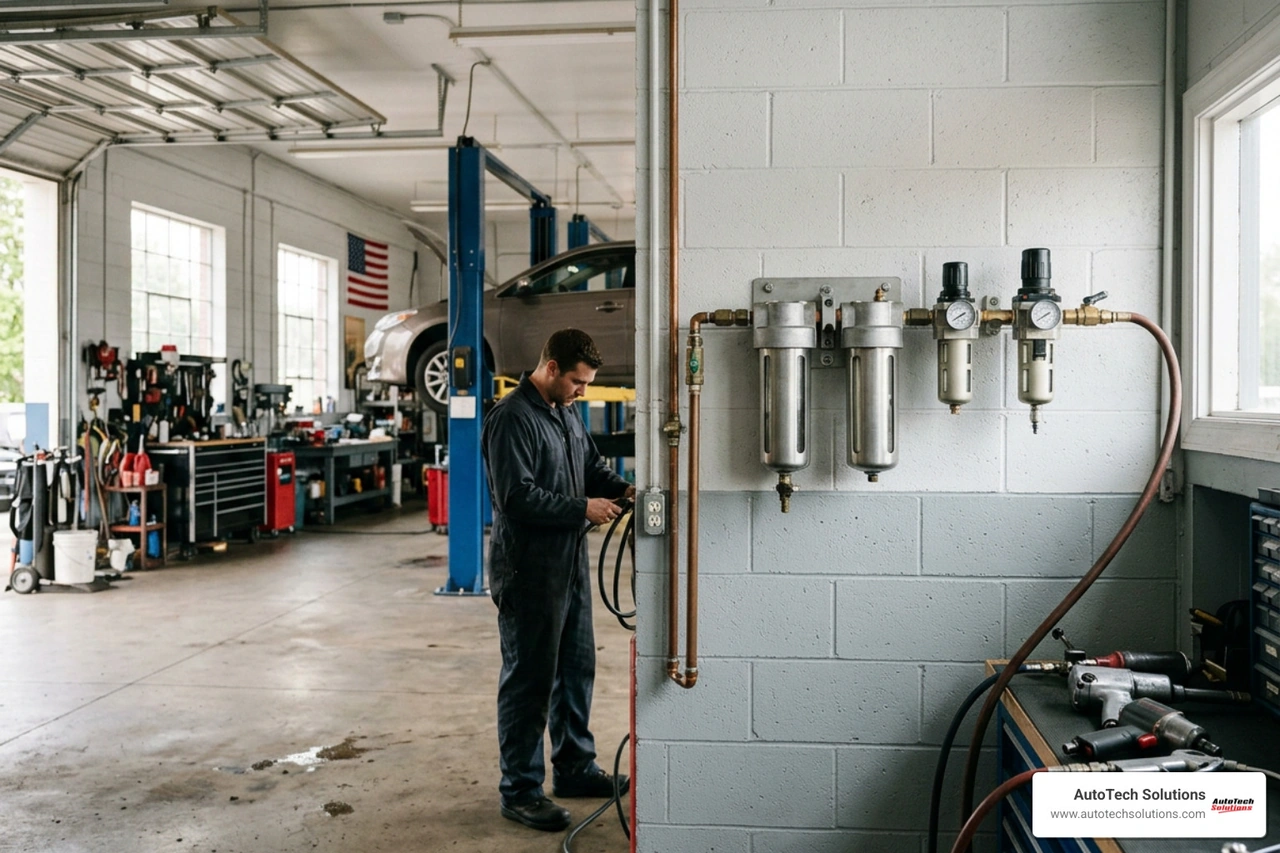
A world-class air compressor is useless if the air is choked by poorly designed piping. Poor piping design creates a massive pressure drop—the loss of air pressure between the compressor discharge and the tool on the shop floor. Every 2 PSI of pressure drop forces the compressor to work harder, increasing your energy bill by roughly 1%.
To maintain clean, laminar flow (smooth, non-turbulent airflow), you must avoid sharp 90-degree elbows, undersized pipes, and restrictive fittings. A professional setup ensures that air flows freely, moisture is trapped before reaching tools, and pressure remains stable across all service bays. To learn more about setting up your shop's system correctly, check out our guide on Air Compressor Installation.
Ventilation and Environmental Layout Requirements
Where and how you install your compressor matters just as much as how you pipe it. Compressors generate an incredible amount of heat. In fact, 100% of the electrical energy consumed by an industrial compressor is converted into heat.
To keep your system running safely:
- Provide Ample Ventilation: Use thermostatically controlled louvers and exhaust fans to keep the compressor room within its optimal operating temperature range (ideally below 104°F).
- Incorporate Heat Recovery: Since up to 96% of compressor waste heat can be recovered, you can duct this hot air into your shop floor to offset heating costs during cold Michigan winters.
- Ensure Proper Service Clearance: Always leave at least 24 to 36 inches of clear space around the compressor cabinet so technicians can safely perform routine maintenance and repairs.
Piping Layouts for Commercial Compressed Air Systems
The layout of your distribution piping dictates how well pressure is maintained across your shop. The most efficient layout for a commercial facility is a loop system, often referred to as a ring main.
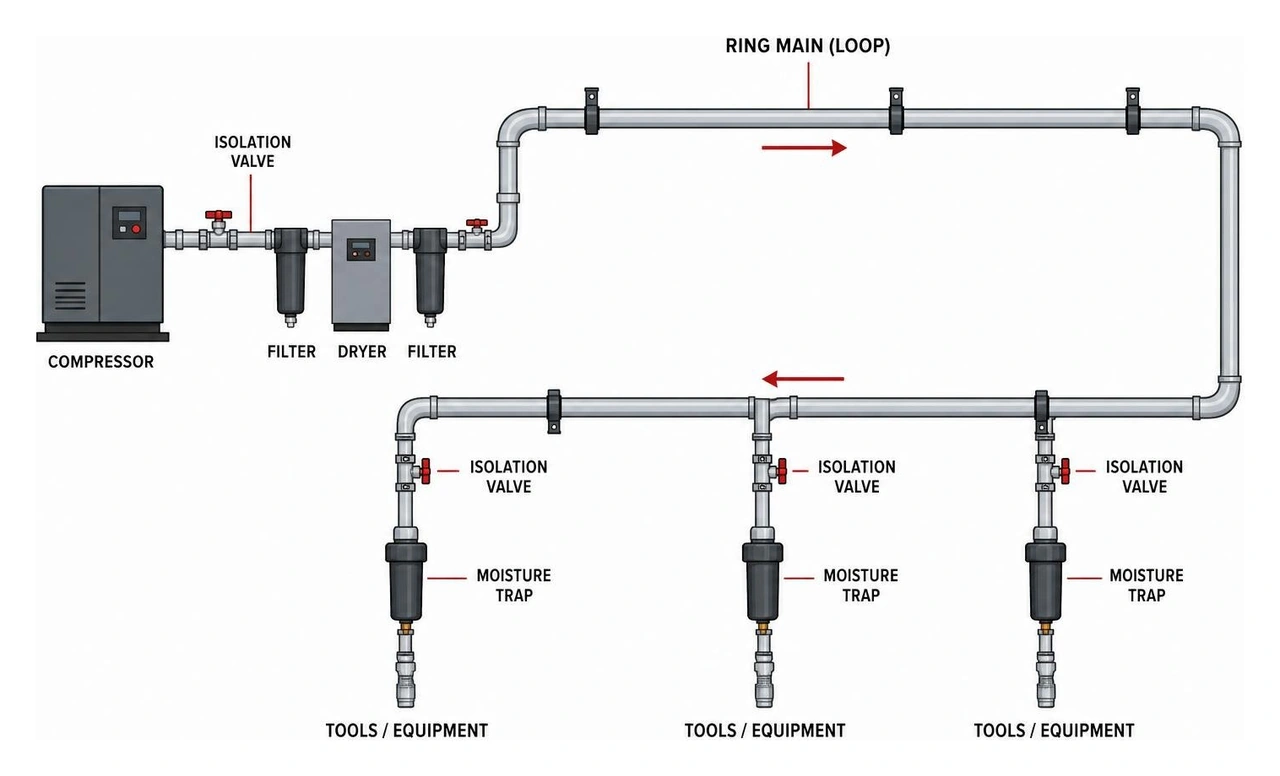
A Compressed Air Ring Main allows air to flow in multiple directions to reach a single tool, effectively cutting the velocity of the air in half and drastically reducing pressure drop.
When selecting piping materials, steer clear of black iron pipe, which rusts internally when exposed to moisture, shedding scale that ruins pneumatic tools. Instead, we highly recommend modern modular aluminum piping. Aluminum has an incredibly low friction coefficient, will never rust or corrode, and features push-to-connect fittings that eliminate the need for threading or gluing, making future shop expansions incredibly simple.
Maintenance and Energy Optimization Strategies
The total cost of owning a compressed air system over ten years is dominated by electricity—nearly 70% of the lifecycle cost is energy, while the initial purchase price is only about 10%. This means that keeping your system optimized is the easiest way to put money back into your business.
To keep operating costs low, we recommend:
- Ultrasonic Leak Detection: In an average shop, up to 30% of all compressed air is lost to silent leaks around fittings, hoses, and quick-connects. Regular leak audits can save thousands of dollars annually.
- System Pressure Optimization: Don't run your system at 125 PSI if your tools only require 90 PSI. Lowering your system pressure by just 2 PSI reduces energy consumption by 1%.
- Professional Assessments: Partnering with experts for regular system audits ensures your layout is fully optimized. For more details on keeping your shop's equipment in peak condition, explore our resource on Air Compressor Repair and Maintenance for Automotive Shops.
Air Treatment and Condensate Management
When air is compressed, the moisture suspended in the atmosphere is squeezed out like a wet sponge. If this water gets into your distribution lines, it will wash away tool lubricants, cause internal corrosion, and ruin paint jobs.
Effective air treatment requires a multi-stage approach:
- Refrigerated Dryers: These cool the compressed air to approximately 35°F to 39°F, causing vaporized moisture to condense into liquid water so it can be automatically discharged.
- Desiccant Dryers: For specialized applications requiring ultra-dry air, desiccant dryers use chemical beads to absorb moisture, achieving dew points as low as -40°F.
- Oil-Water Separators: The water drained from your compressor system contains trace amounts of compressor oil. Dumping this untreated condensate down the drain violates environmental laws. An oil-water separator filters out the oil, allowing you to discharge clean, compliant water safely.
Preventative Maintenance for System Longevity
The best way to prevent unexpected shop downtime is to stick to a strict preventative maintenance schedule. Neglecting simple tasks will destroy your compressor's efficiency and lead to catastrophic motor or pump failure.
Key preventative maintenance tasks include:
- Filter Replacements: Clogged air intake and inline filters force your compressor to work harder, causing a severe drop in system pressure and efficiency.
- Regular Oil Analysis: Just like a car engine, your compressor's oil must be changed regularly to protect moving parts and prevent overheating.
- Belt Tension and Alignment: Inspect drive belts for cracking and ensure proper tension to prevent slipping and power loss.
For a complete, step-by-step checklist to keep your system running flawlessly, refer to our comprehensive Air Compressor Preventative Maintenance Guide.
Frequently Asked Questions about Shop Compressors
How do I calculate the CFM and PSI requirements for my shop?
To calculate your shop’s requirements, list every tool that will run at the same time. Add their individual CFM ratings together. For example, if you have two impact wrenches (5 CFM each) and a tire changer (4 CFM) running simultaneously, your target is 14 CFM. Identify the highest required operating pressure (usually 90 to 120 PSI) and select a compressor that delivers at least 125 to 150 PSI to provide a safe operating buffer and account for piping pressure drops.
What is the difference between a wet receiver and a dry receiver tank?
A wet receiver tank is installed before the air dryer. It provides extra cooling and allows bulk water and oil aerosols to drop out of the air stream, protecting the dryer from liquid overloading. A dry receiver tank is installed after the air dryer. It stores fully treated, dry air, preventing sudden surges in demand from pulling wet air through the dryer. Using both in tandem is the gold standard for large commercial shops.
How often should compressed air filters and oil separators be replaced?
Typically, inlet air filters should be inspected monthly and replaced every 1,000 to 2,000 operating hours. Inline coalescing filters and oil separators should be replaced annually or whenever the pressure drop across the filter exceeds 3 to 5 PSI. Always follow your manufacturer’s guidelines, as dusty shop environments (like collision repair dust) will require more frequent filter changes.
Conclusion
A well-designed, professionally installed compressed air system is the backbone of any successful commercial automotive facility. From selecting the right rotary screw or VSD compressor to engineering a leak-free aluminum ring main, every decision you make directly impacts your shop's daily productivity and utility bills.
At AutoTech Solutions, we are committed to keeping your shop running at peak performance. As a premier one-stop-shop for automotive equipment sales, professional installation, and rapid-response service across Michigan and the Carolinas—including our dedicated teams in Novi, MI, Charlotte, NC, Raleigh, NC, and Wade, NC—we specialize in minimizing your downtime.
Whether you need a brand-new system engineered from the ground up or a reliable preventative maintenance plan to protect your investment, we have you covered. For expert assistance in planning your next upgrade, read our Air Compressor Installation Guide Michigan or contact us today to schedule your professional Air Compressor Installation for Automotive Shop.