Why Every Commercial Shop Should Care About Car Lift Installation Service
A professional car lift installation service is one of the most critical investments a shop manager can make for long-term operational efficiency and technician safety.
Here's what you need to know quickly:
- What it is: A professional service that handles site assessment, lift selection, anchoring, hydraulic and electrical connections, and final safety testing for commercial-grade vehicle lifts.
- Who needs it: Automotive service shops, collision centers, dealerships, and industrial facilities adding or replacing lift equipment.
- Why it matters: Improper installation leads to equipment failure, technician injury, voided warranties, and costly compliance violations.
- How long it takes: Most standard commercial lift installations complete in 4 to 8 hours per bay.
- Key requirement: Floors must meet a minimum of 4 inches of reinforced concrete rated at 3,000 PSI.
- What to look for: ALI-certified technicians, factory-authorized installation, and full post-installation safety testing.
Getting a lift installed correctly the first time isn't just about convenience. It directly affects your shop's uptime, your team's safety, and your bottom line.
A poorly installed lift can pull your best bay out of service for days. A properly installed one — anchored, leveled, tested, and compliant — keeps your technicians productive and your facility running without interruption.
At AutoTech Solutions, we work with commercial shop operators who need more than just equipment delivered. They need a complete, professional installation that meets code, protects their investment, and gets their bays operational fast.
This guide walks through everything you need to know: lift types, facility requirements, the installation process, costs, permits, and ongoing maintenance.
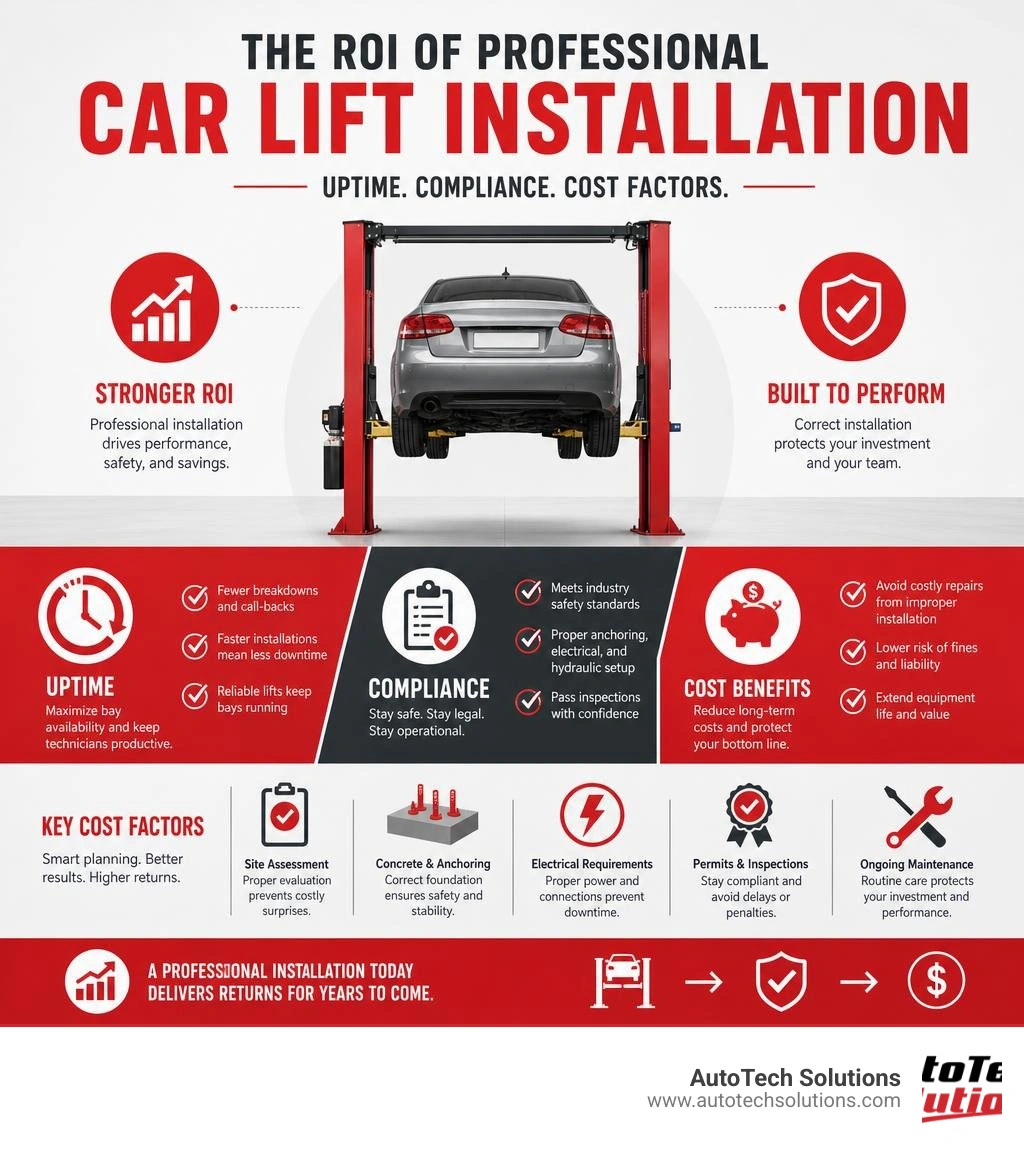
Car lift installation service word guide:
Why Your Shop Needs a Professional Car Lift Installation Service
When running a commercial fleet facility or auto repair shop in Novi, MI, or across the Carolinas, your bays are your revenue engines. Attempting to cut corners on equipment setup is a recipe for operational disaster. Professional installation ensures your shop complies with all local regulations and maintains a safe workspace.
Commercial garages operate under strict safety standards. Standardizing your shop layout requires specialized engineering knowledge. A certified installer understands the structural demands of heavy-duty machinery, ensuring your equipment performs reliably under maximum load.
Working with a certified team also reduces your business's liability. If a lift fails due to poor uncertified installation, your insurance company may deny coverage, leaving you with massive out-of-pocket costs and potential legal issues. For more background on what proper setup entails, read More info about professional automotive lift installation.
Choosing a qualified partner is the first step toward safeguarding your workforce. If you are ready to upgrade your facility, explore the Professional lift services from AutoTech Solutions to see how we handle complex fleet and commercial configurations.
Key Benefits of a Certified Car Lift Installation Service
Investing in factory-authorized technicians protects your capital equipment. Here is why certified installation pays off:
- Equipment Longevity: Properly aligned columns and tensioned cables prevent uneven wear on hydraulic cylinders, bearings, and carriages, extending the life of your lift by years.
- Warranty Protection: Most industrial lift manufacturers require professional, factory-authorized installation to honor their product warranties. If a component fails early, you are covered.
- OSHA and ALI Compliance: Professional installers ensure your equipment aligns with the safety expectations of OSHA and the Automotive Lift Institute, helping your shop reduce compliance risk and avoid expensive safety fines.
To learn more about selecting the right professionals for your facility, check out our Complete guide to car lift installers.
Minimizing Operational Downtime
Every hour a service bay sits empty represents lost revenue. Professional installers optimize your bay layout before the equipment even arrives, ensuring smooth integration with existing shop systems like exhaust extraction and fluid delivery lines.
Precision alignment during setup prevents premature cable stretching and hydraulic seal failures, meaning you won't have to take the bay offline for emergency repairs next month. By trusting experts with the heavy lifting, your team can focus on servicing fleet vehicles and maintaining shop productivity.
Selecting the Right Commercial Lift and Preparing Your Facility
Choosing the wrong lift type can choke your shop's workflow. Before purchasing, you must evaluate the types of vehicles your facility services and plan your floor layout accordingly. Working with a partner who understands CAD planning ensures that columns, runways, and overhead bars do not interfere with other equipment.
Let's compare the three most common commercial lift designs:
| Lift Type | Typical Weight Capacity | Primary Commercial Use Case | Space Efficiency |
|---|---|---|---|
| Two-Post Lift | 9,000 to 20,000 lbs | General repair, wheel service, brakes, and suspension | Excellent (minimal floor footprint) |
| Four-Post Lift | 9,000 to 60,000+ lbs | Wheel alignment, heavy-duty fleet trucks, long-term storage | Moderate (requires wider bays) |
| Scissor Lift | up to 16,000 lbs | Quick-lube services, detailing, and wheel alignment | High (low profile, flush-mount options) |
For a deeper dive into outfitting your service bays, read our guide on Commercial Automotive Lifts and Shop Equipment.
Two-Post Lifts for High-Volume Service Bays
Two-post lifts are the workhorses of high-volume commercial repair facilities. They provide maximum under-car access, allowing technicians to work on wheels, brakes, and exhaust systems with ease.
- Symmetrical Arms: These lifts position the vehicle evenly between the columns, which is ideal for heavier trucks and SUVs requiring balanced weight distribution.
- Asymmetrical Arms: These lifts angle the columns slightly and use unequal arm lengths, allowing the technician to open vehicle doors wider for interior or under-dash work.
- Frame-Engaging Design: By lifting the vehicle by its frame rails, these systems keep the suspension unloaded, which is necessary for comprehensive steering and suspension repairs.
If you are considering a floorplate model for a space with specific overhead limitations, consult our Guide to 2-post floor plate car lifts.
Four-Post and Scissor Lifts for Heavy-Duty and Alignment Work
For heavy-duty fleet service or precision wheel alignment, four-post and scissor lifts are the industry standards.
Four-post lifts feature drive-on runways, making them incredibly fast to load. This makes them ideal for commercial quick-lube lanes or alignment racks where time-to-lift is a key performance metric. They also support massive weight capacities, which is necessary for medium-duty delivery vans and heavy commercial trucks.
Scissor lifts offer a compact footprint. When flush-mounted into the concrete floor, they leave the bay completely flat when lowered, maximizing usable shop space. For a detailed breakdown of these configurations, see Car and truck lift installation options.
To ensure your shop gets the highest quality equipment, we recommend sourcing systems from authorized distributors who can secure durable, industry-proven machinery.
Technical Requirements and Site Preparation
You cannot simply bolt a commercial lift to any concrete floor. The structural integrity of your facility's foundation is the most critical safety factor during installation.
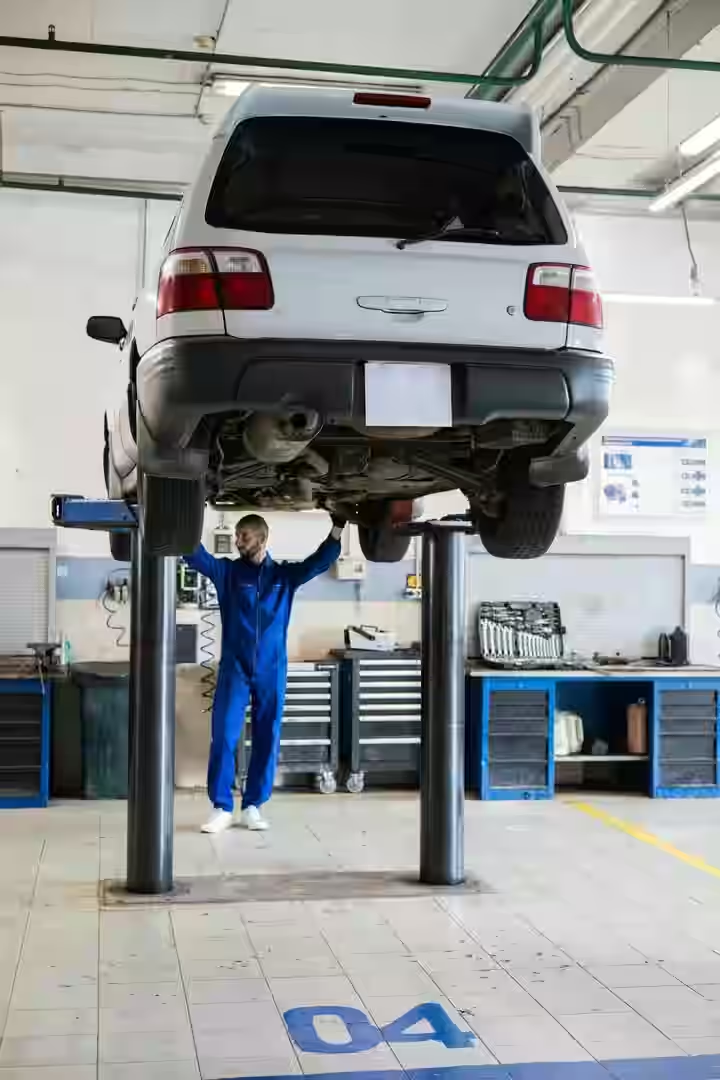
Before scheduling a car lift installation service, our team conducts a thorough site survey to verify that your space meets the following technical requirements:
- Concrete Thickness and Strength: Most standard commercial lifts require a minimum of 4 inches of steel-reinforced concrete rated at 3,000 PSI. Heavy-duty lifts (capacities over 15,000 lbs) often require 6 to 8 inches of concrete.
- Ceiling Clearance: You must have enough vertical space for both the height of the lift columns and the tallest vehicle you plan to raise, plus a safety margin of at least 12 inches.
- Electrical Specifications: Commercial lifts typically require 208-230V single-phase or 460V three-phase power. Running these dedicated lines must be coordinated before the installation team arrives.
To make sure your shop is fully prepared, review our detailed Automotive lift installation guide.
Preparing Your Facility for a Car Lift Installation Service
A successful installation starts with rigorous site preparation. Our factory-trained technicians inspect the proposed installation area for floor cracks, slope issues, and overhead obstructions like heater ducts, light fixtures, or structural beams.
We use specialized tools to verify concrete depth and strength. If the concrete is insufficient, we can coordinate slab reinforcement or recommend alternative lift designs. We also map out the exact placement of anchor bolts to avoid tension points in the concrete. To see how we manage these complex structural requirements, explore our services for Facility buildouts and installations by AutoTech Solutions.
Navigating Local Permits and Structural Regulations
Commercial facilities must comply with local building codes, electrical permits, and environmental regulations. In areas like Charlotte, NC, Raleigh, NC, and Novi, MI, code enforcement officers require engineering approvals for structural modifications and electrical upfits.
Working with a professional installation service ensures that your project is fully permitted and compliant with municipal standards, preventing costly stop-work orders or post-installation code violations.
The Professional Installation Process, Timeline, and Costs
A professional installation is a highly synchronized process designed to minimize operational disruption.
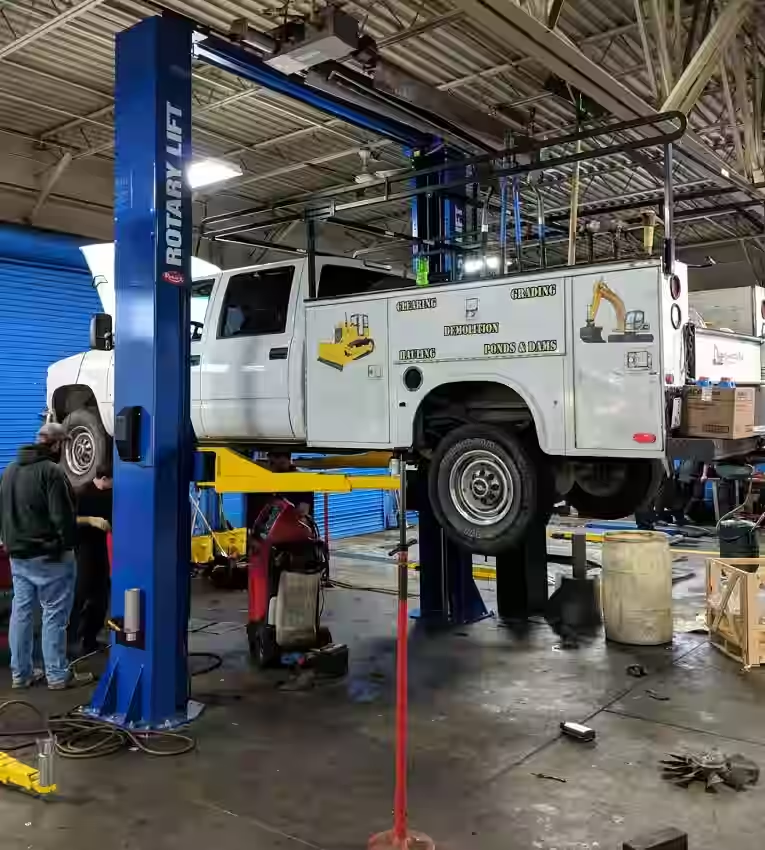
A standard commercial lift installation typically takes 4 to 8 hours per bay, though complex alignment systems or heavy-duty in-ground lifts can take multiple days.
The standard mechanical installation process includes:
- Unloading and Staging: Transporting heavy columns and runways into the bay using specialized flatbed crane trucks.
- Layout and Drilling: Measuring and marking anchor points, then drilling holes using industrial rotary hammers.
- Plumb and Level: Erecting columns and using precision shims to ensure they are perfectly vertical and level.
- Anchoring: Driving heavy-duty wedge anchors into the concrete and torqueing them to exact manufacturer specifications.
- Hydraulic and Mechanical Assembly: Installing carriages, cables, cylinders, and routing hydraulic hoses.
- Electrical and Testing: Connecting the power unit, bleeding the hydraulic system, and performing a dry cycle test.
For a complete look at how we manage these logistics, read about Automotive equipment installation and service.
Step-by-Step Execution and Safety Testing
Once mechanical assembly is complete, our technicians perform rigorous safety testing before handing over the keys to your bay. This includes verifying that the safety locks engage smoothly on both columns, checking cable tension, and inspecting all hydraulic fittings for micro-leaks.
We also perform load testing with calibrated weights to ensure the lift operates perfectly under pressure. Regular calibration keeps your shop safe and compliant. To learn more about maintaining this equipment post-install, check out our options for Automotive lift repair and calibration.
Common Installation Mistakes to Avoid
Non-professional or uncertified installations often lead to severe operational issues. Here are the most common mistakes we see when repairing poorly installed lifts:
- Poor Anchoring: Using incorrect anchor bolts or failing to torque them to manufacturer specs can cause columns to shift or pull out of the concrete under load.
- Incorrect Column Spacing: Even a minor measurement error can prevent lift arms from reaching vehicle lifting points safely, or cause binding in the carriages.
- Electrical Mismatch: Wiring a 3-phase motor to a single-phase supply without a proper converter will quickly burn out the power unit.
- Unlevel Columns: If columns are not perfectly plumb, the lift will experience uneven wear, leading to premature cable failure and dangerous weight distribution.
Post-Installation Maintenance, Inspections, and Third-Party Equipment
The installation is just the beginning of your lift's lifecycle. To maintain OSHA compliance and protect your technicians, your facility must schedule annual lift inspections conducted by an ALI-certified inspector.
Preventative maintenance is the best way to avoid unexpected downtime. This includes lubricating chains and cables, checking hydraulic fluid levels, and inspecting safety latches daily. For a complete guide to maintaining your shop's infrastructure, read our Automotive shop equipment complete guide.
Many shop owners ask if they can hire us to install a lift they purchased from another vendor. The answer is yes! While we sell top-tier equipment, we are happy to install third-party lifts. However, be aware of the potential risks:
- Warranty Complexity: If a component is damaged upon arrival, you must coordinate replacement parts with your external vendor, which can delay the installation.
- Part Discrepancies: Third-party shipments sometimes lack necessary anchoring hardware or specialized fittings, requiring extra time to source.
Whether you need installation or ongoing service, working with established regional partners ensures your operations run smoothly and your equipment remains fully compliant.
Frequently Asked Questions About Commercial Car Lifts
How thick does the concrete floor need to be for a commercial lift?
For most commercial two-post and four-post lifts with capacities up to 12,000 lbs, you need a minimum of 4 inches of reinforced concrete rated at 3,000 PSI. Heavy-duty lifts or truck lifts with capacities over 15,000 lbs generally require 6 to 8 inches of concrete.
Never install a commercial lift on asphalt, outdoor dirt, or cracked, unreinforced light-duty slabs. For precise engineering requirements, refer to our Car hoist installation specifications.
Can you install a car lift in a garage with a low ceiling?
Yes, but you must select the right equipment. If your commercial facility has low overhead clearance, we recommend installing low-rise or mid-rise scissor lifts, or specialized floorplate two-post lifts that do not feature an overhead crossbar.
However, keep in mind that floorplate models can raise vehicles above the column height, meaning technicians must remain highly vigilant of ceiling clearance. For more space-saving layout strategies, see our guide on Installing a car lift in a commercial garage.
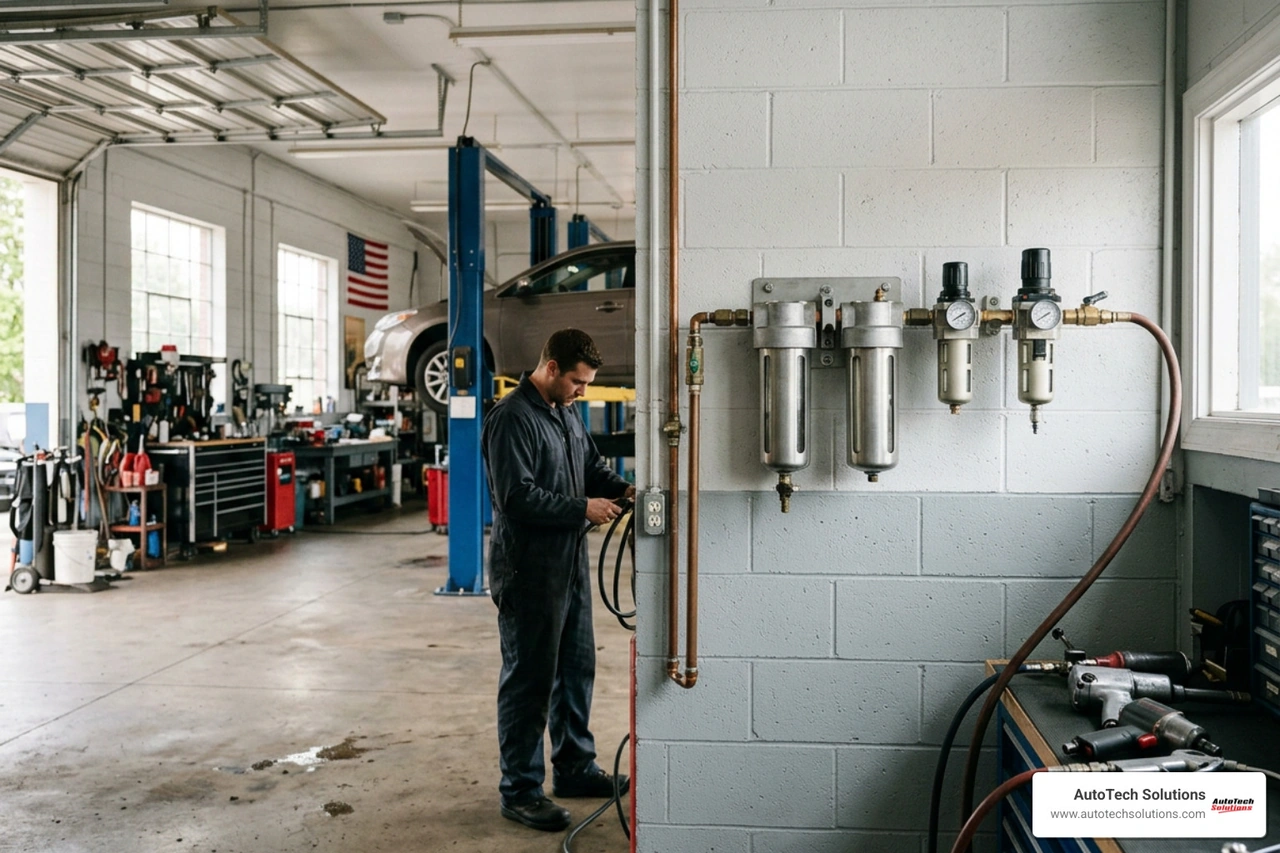
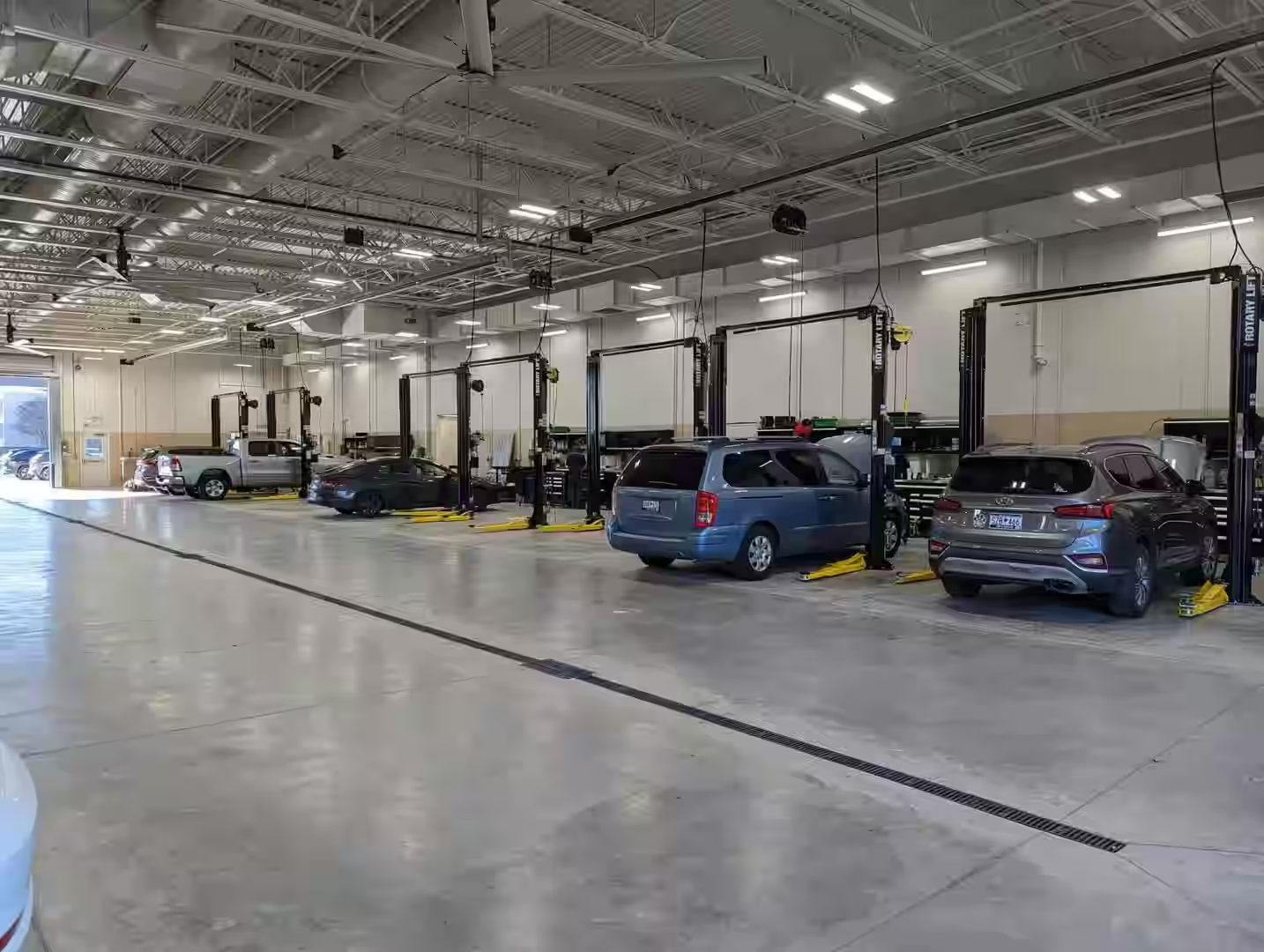
Commercial shops require heavy-duty, industrial-grade systems engineered for continuous daily use to handle heavy workloads safely.
How long does a typical commercial lift installation take?
A standard commercial two-post or four-post lift installation typically takes 4 to 8 hours. If you are outfitting a multi-bay facility, we can coordinate staggered installations to ensure that some of your bays remain open, keeping your shop's downtime to an absolute minimum.
For more details on scheduling and multi-bay coordination, read Automotive Lifts & Car Lift Installation.
Partner with the Experts for Your Shop's Infrastructure
At AutoTech Solutions, we understand that your shop equipment is the backbone of your business. We are a one-stop-shop for automotive equipment sales, professional installation, certified inspections, and preventative maintenance across Michigan and the Carolinas.
With physical locations in Charlotte, NC, Raleigh, NC, Wade, NC, and Novi, MI, our factory-trained technicians are always nearby to support your operations. Our ultimate goal is to minimize your shop's downtime with rapid repair response times and expert installation that gets your service bays operational on day one.
Do not risk your team's safety or your shop's productivity on uncertified work. Let our professional team handle your next equipment upgrade with precision and care.
Schedule your equipment service and repair support with AutoTech Solutions today, and let us help you build a safer, more efficient workshop.