When a Lift Goes Down, Your Whole Shop Stops
Effective downtime reduction in lift repair starts with these core actions:
- Shift from reactive to condition-based maintenance — service lifts based on actual usage and wear signals, not just the calendar
- Pre-stock critical spare parts — have high-risk components on hand to cut repair time from days to hours
- Track key metrics — monitor MTBF, MTTR, and first-time fix rate to spot patterns before failures escalate
- Inspect environmental conditions — control moisture, heat, and power quality in bays and machine areas
- Know when to modernize — repeat call-outs on aging equipment often cost more than a planned upgrade
A single lift out of service doesn't just slow one technician. It backs up your entire bay schedule, delays customer vehicles, and pushes your team into costly improvisation.
The numbers back this up. Elevators and commercial lifts worldwide break down an average of four times per year, contributing to an estimated 272 million hours of lost service annually. For a busy automotive service or collision shop, even one unexpected outage during peak hours can ripple through the whole day's workflow.
What makes this harder is that most lift failures don't come out of nowhere. They build quietly — a worn door roller here, a minor controller fault there — until something finally gives. By then, the damage to your schedule and your margins is already done.
The good news: most of that downtime is preventable. And that's exactly what this guide is designed to help you address.
AutoTech Solutions' equipment specialists have compiled this guide based on hands-on experience supporting commercial automotive shops from Michigan to the Carolinas — so you can keep your bays moving and your technicians productive.

Root Causes of Commercial Lift Failures
Understanding why heavy-duty automotive lifts fail is the first step toward preventing outages. In commercial environments, lift failures are rarely the result of a single, sudden mechanical catastrophe. Instead, they are almost always the culmination of smaller, unaddressed issues that snowball over time.
We can categorize the primary root causes of commercial lift failures into four distinct areas:
- Preventable Wear and Tear: High-use components such as synchronization cables, carriage rollers, slide blocks, and hydraulic seals bear the brunt of daily operations. Over time, friction and physical stress degrade these parts. Without regular adjustments, a minor misalignment in a two-post lift's synchronization cables can lead to uneven carriage travel, accelerated structural wear, and eventually, a complete system shutdown.
- Hydraulic and Electrical Faults: Hydraulic systems are vulnerable to fluid contamination, pressure drops, and seal degradation. Even tiny microscopic debris in a hydraulic valve can prevent a lift from lowering smoothly or holding pressure safely. On the electrical side, microswitch failures, worn contactors, and control box malfunctions frequently halt operations.
- Environmental Factors: Commercial automotive bays are harsh environments. Concrete floor moisture, temperature fluctuations, airborne dust, and chemical overspray directly impact lift reliability. For example, high humidity in coastal Carolinas facilities can accelerate corrosion on exposed pistons and electrical terminals, while winter temperature swings in Novi, Michigan can affect hydraulic fluid viscosity and cause premature seal shrinkage.
- User Error and Load Mismanagement: Operating a lift beyond its rated capacity or failing to balance the load correctly places immense stress on the structural columns and hydraulic cylinders. Ignoring basic loading guidelines can warp carriages and damage safety locks, rendering the lift unsafe and inoperable.
Academic and industrial research confirms these patterns. According to a scientific study on lift fault causes, mechanical systems (specifically doors and locking mechanisms) account for over 26.34% of all lift-related stranding faults, while human-caused operational errors make up 22.84%. Furthermore, environmental factors such as water ingress, extreme temperatures, and power fluctuations trigger approximately 12.13% of unexpected failures.
By analyzing these root causes, we can design targeted maintenance strategies that address the most vulnerable points of your equipment. For a deeper look at what keeps your shop's lifting systems offline, review our detailed guide on the common causes of automotive lift downtime.
Implementing a Downtime Reduction Lift Repair Strategy
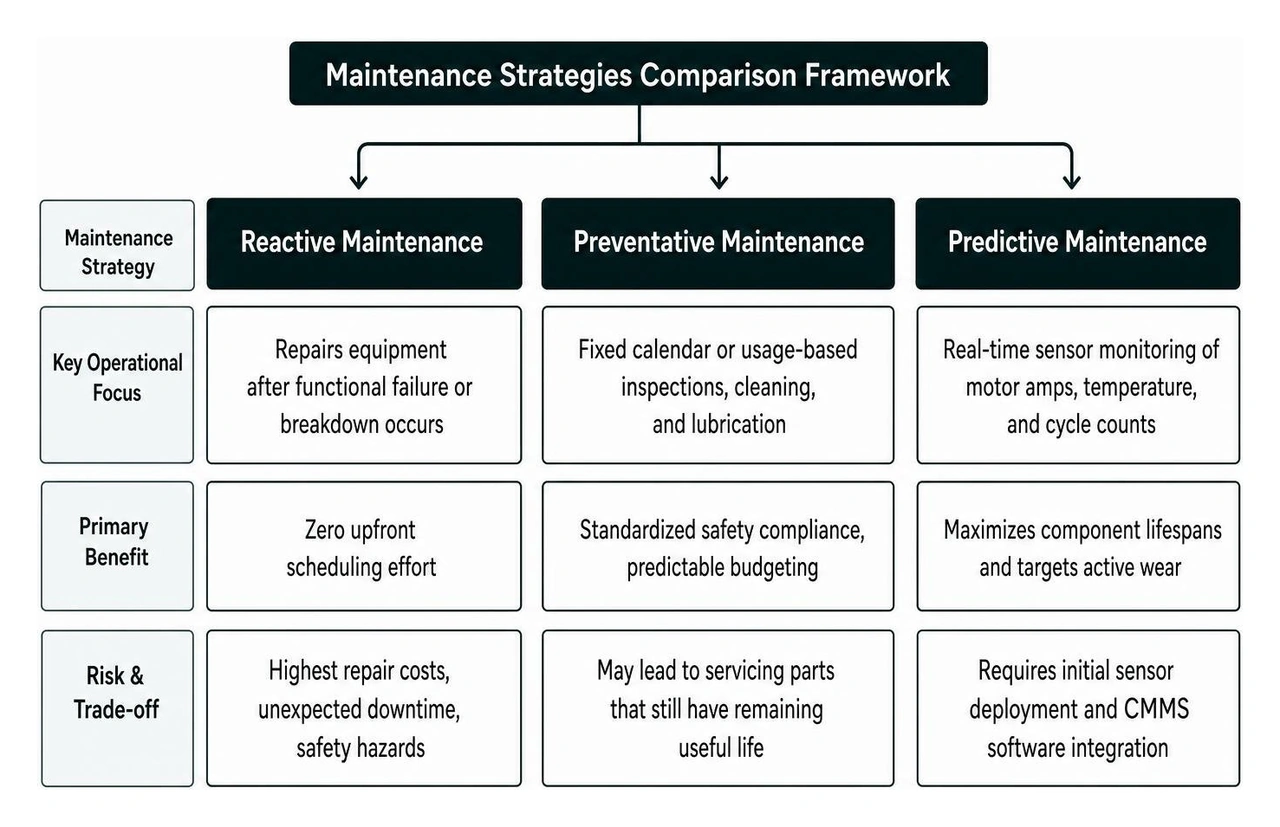
To transition from a chaotic, reactive repair model to a highly efficient, proactive operation, shop managers must implement a structured downtime reduction in lift repair strategy. Relying on "break-fix" maintenance is a recipe for high costs and unpredictable schedules. When a lift breaks, you don't just pay for the repair technician; you lose the revenue that the bay would have generated during the hours—or days—it remains offline.

A modern downtime reduction strategy focuses on optimizing two key metrics:
- Mean Time Between Failures (MTBF): Maximizing the operational time between equipment breakdowns.
- Mean Time to Repair (MTTR): Minimizing the time it takes to get a failed lift back into service.
To achieve this, we must look at how maintenance is scheduled and executed. Traditional, paper-heavy workflows often slow down response times and lower technician efficiency. In fact, research on technician productivity and manual workflow bottlenecks shows that field technicians in compliance-driven industries lose 1 to 2 hours daily to paperwork and administrative coordination. This represents a 30% to 50% "productivity black hole" during an average shift.
By eliminating manual paperwork and equipping technicians with digital access to service histories and real-time parts availability, service operations can boost technician utilization rates from the industry average of 60% to over 75%. For your shop, this translates directly to faster response times, highly accurate diagnostics, and a much higher first-time fix rate (FTFR).
If you are ready to stop reacting to emergencies and start controlling your equipment availability, explore our comprehensive guide on how to reduce equipment downtime in an automotive shop.
Transitioning to Condition-Based Downtime Reduction Lift Repair
For decades, the standard approach to lift servicing was calendar-based maintenance—checking the equipment every six months or once a year regardless of actual usage. While this approach keeps you compliant with basic safety regulations, it often leads to over-servicing low-use lifts while dangerously under-servicing high-traffic bays.
A condition-based maintenance strategy replaces rigid calendar schedules with dynamic, usage-driven servicing. By monitoring actual runtime triggers, cycle counts, and early wear indicators, we can schedule maintenance exactly when it is needed.
For example, a busy commercial service center in Charlotte, NC, might operate a two-post lift through dozens of cycles a day, while a specialized alignment lift in Novi, MI, might only see a fraction of that volume. Under a condition-based model, the high-use lift receives more frequent inspections, lubrication, and cable adjustments, preventing premature wear before it leads to a breakdown.
Advanced facilities are now integrating IoT-enabled condition monitoring tools, such as:
- Vibration Beacons: Placed on hydraulic power units to detect subtle changes in motor vibration, predicting bearing or pump wear before a loud noise or failure occurs.
- Load-Cell Sensors: Installed on carriages to monitor structural loading profiles and flag minor alignment drags before they strain the motor.
- Fluid Quality Sensors: To continuously monitor hydraulic fluid for moisture content and particulate contamination.
By combining these modern tools with regular, hands-on wear-point inspections, we ensure that your equipment remains safe, reliable, and compliant. Learn more about protecting your assets with our guide on car lift maintenance.
Spare Parts Planning for Rapid Downtime Reduction Lift Repair
Even the most sophisticated predictive maintenance system cannot prevent every mechanical failure. When a component inevitably wears out, the speed of your recovery depends entirely on your spare parts strategy.
Waiting for a critical replacement part to ship can extend a simple repair from a two-hour job into a multi-day operational nightmare. This is why strategic spare parts planning is a cornerstone of any effective downtime reduction in lift repair program.
According to research on how manufacturers reduce equipment downtime through spare parts availability, having readily accessible, pre-stocked parts is the single most effective way to slash MTTR. Rather than ordering parts reactively, shop managers should work with their service partners to maintain an on-site inventory of high-risk, high-wear components. These typically include:
- Replacement hydraulic seals and O-rings
- Carriage slide blocks and rollers
- Safety lock solenoids and microswitches
- Equalizer cables and pulley sheaves
- Common hydraulic valves and contactors
To make repairs even faster, we recommend using "kitted spares." Instead of searching for individual washers, fittings, or seals during an emergency, technicians can grab a pre-packaged repair kit tailored to a specific lift model and failure mode. This minimizes diagnostic confusion and ensures that the repair is completed correctly on the first visit.
For shop owners operating two-post configurations, keeping these critical elements on hand is vital. Read our practical advice on two-post lift repair to understand which components fail most frequently and how to stock them effectively.
The Financial Impact of Unplanned Shop Downtime
To justify the investment in proactive maintenance and spare parts planning, it is essential to look at the financial reality of unplanned equipment outages. Many shop owners view maintenance as an annoying expense, but the true cost of leaving a lift broken is far higher than the cost of keeping it serviced.
When a lift goes offline, the financial impact ripples through several areas of your business:
- Lost Contribution Margin: If a bay normally generates $150 to $200 per hour in labor revenue, a lift that remains down for two days (16 operational hours) represents a direct loss of up to $3,200 in revenue, not including lost parts margins.
- Technician Idle Time: You still have to pay your certified technicians even if they are standing around waiting for a bay to open up or working inefficiently out of a non-optimized space.
- Bottleneck Overtime: To make up for lost production time, shops often have to pay technicians overtime once the lift is finally repaired, driving labor costs up and eroding service margins.
- Customer Dissatisfaction: Delayed repairs lead to missed delivery times, damaged customer trust, and lost repeat business.
In commercial environments, we measure these losses using Overall Equipment Effectiveness (OEE) metrics. Unplanned downtime directly reduces your shop's "Availability" score. While best-in-class service operations maintain an unplanned downtime rate of 2% to 5%, reactive shops often experience downtime rates of 10% to 15%, representing a massive drag on annual profitability.
To see how these costs accumulate in dealership environments, read our detailed analysis on the cost of downtime in dealership service departments.
The table below compares the long-term financial outcomes of a reactive "break-fix" approach versus a proactive, condition-based maintenance program over a typical lift operational cycle:
| Operational Metric | Reactive "Break-Fix" Approach | Proactive Maintenance Program |
|---|---|---|
| Annual Maintenance Cost | Low ($0 - $500 baseline) | Moderate ($1,500 - $3,000) |
| Emergency Repair Frequency | High (Avg. 3-4 times per year) | Very Low (Less than 1 per year) |
| Average Emergency Repair Cost | High ($1,200 - $2,500 per event) | Low ($200 - $500 minor adjustments) |
| Average MTTR (Repair Time) | 2 to 5 days (waiting for parts/techs) | 2 to 4 hours (pre-stocked parts) |
| Estimated Annual Revenue Loss | $6,000 - $12,000 per bay | Under $1,000 per bay |
| Overall 20-Year Lifecycle Cost | 100% (Baseline) | 30% to 40% Less than Reactive |
When to Modernize vs. Continue Reactive Repairs
Every piece of shop equipment eventually reaches a point where continuing to repair it is no longer financially viable. For commercial automotive lifts, this decision point typically arrives after 15 to 20 years of heavy service, or when the frequency of minor breakdowns begins to skyrocket.

When deciding whether to keep patching up an old lift or invest in a modern replacement, ask yourself the following questions:
- Are replacement parts becoming obsolete? If sourcing basic hydraulic seals or control boards requires searching secondary markets or waiting weeks for custom fabrication, the extended downtime will quickly wipe out any savings from avoiding a replacement.
- How frequent are the breakdowns? If a lift requires professional repair attention more than three times a year, you are dealing with systemic wear. The cumulative cost of those emergency service calls will soon exceed the cost of a new machine.
- Is the lift still safety compliant? Safety standards evolve. Older lifts may lack modern automatic structural locking systems or velocity fuses in the hydraulic cylinders. Ensuring your shop complies with OSHA regulations and maintaining up-to-date ANSI/ALI certifications is critical for protecting your team and shielding your business from liability claims.
According to research on reducing downtime with custom lift systems, modern lifting systems are engineered with high-strength materials and protective features—such as inverted hydraulic cylinders that shield the chrome piston rod from abrasive shop dust—that dramatically reduce long-term maintenance requirements. Upgrading to modern, wireless mobile column lifts or high-efficiency two-post systems can also reduce vehicle setup times by up to 30%, boosting overall shop throughput.
If you are evaluating your current fleet and trying to decide your next move, check out our ultimate automotive lifts guide 2026 for expert advice on choosing the right replacement systems.
Frequently Asked Questions About Lift Maintenance
How often should a commercial auto lift undergo professional inspection?
In accordance with OSHA regulations and the Automotive Lift Institute (ALI) guidelines, commercial automotive lifts must undergo a comprehensive professional safety inspection at least once every 12 months.
These annual inspections must be performed by a qualified lift inspector—ideally an ALI Certified Inspector—who will thoroughly test all structural, mechanical, hydraulic, and electrical safety systems. In addition to the mandatory annual inspection, shop operators should perform monthly operational checks of safety locks, synchronization cables, and hydraulic fluid levels to ensure continuous safe operation.
For a complete breakdown of compliance requirements and setup procedures, review our professional automotive lift installation guide.
What are the primary warning signs of an impending lift failure?
Lifts rarely fail without warning. Technicians should keep an eye out for these common red flags:
- Slow or Jerky Ascent: This often indicates hydraulic fluid contamination, a failing pump, or air trapped within the hydraulic cylinders.
- Fluid Discoloration or Leaks: Milky or dark hydraulic fluid signals water entry or thermal breakdown, while visible puddles around the base of the columns point to failing cylinder seals.
- Unusual Noises: Squealing, grinding, or popping sounds during operation usually point to unlubricated carriage tracks, worn slide blocks, or dry pulley sheaves.
- Safety Lock Misalignment: If the safety locks do not click in perfect synchronization on both columns, the equalizer cables are stretched or misaligned, creating a serious safety hazard.
Catching these signs early allows you to schedule a repair during a planned slow period rather than dealing with an emergency breakdown. For detailed troubleshooting steps, refer to our auto lift repair guide 2026.
How does digital workflow management improve lift repair response times?
Transitioning from paper-based service sheets to digital workflow management completely changes how repairs are handled. When a technician can log a fault digitally:
- The service coordinator receives immediate notification of the exact error code, lift model, and service history.
- The dispatch system automatically matches the job to the nearest technician who has the right tools and replacement parts on their truck.
- The technician arrives on-site with full visibility into the machine's historical breakdown patterns, leading to faster, highly accurate diagnostics.
- This digital communication eliminates administrative delays, helping service teams achieve high first-time fix rates (FTFR) and reducing the time your bay remains offline.
Conclusion
Minimizing lift downtime is not about reacting faster to emergencies; it is about building a proactive operational strategy that prevents failures from happening in the first place. By shifting to condition-based maintenance, pre-stocking critical spare parts, tracking key reliability metrics, and knowing when to modernize aging equipment, you can keep your bays running smoothly and protect your bottom line.
At AutoTech Solutions, we are dedicated to helping automotive service, collision, and heavy-duty shops maximize their equipment uptime. As a comprehensive provider of automotive equipment sales, professional car lift installation, rapid repair, and preventative maintenance, we serve as your single point of contact for operational reliability.
Our unique value is simple: we minimize your downtime with expert technical support and rapid repair response times across our entire service area—from Novi, Michigan, down to Charlotte, Raleigh, and Wade, North Carolina.
Whether you need to schedule an annual safety compliance inspection, optimize your preventative maintenance schedule, or rapidly resolve an emergency breakdown, our team of factory-trained specialists is ready to support you.
To learn more about how we can help you keep your shop moving, visit our professional equipment support services page and schedule a comprehensive equipment assessment today.