
Why Choosing the Right Automotive Lifts Defines Your Shop's Productivity
Automotive lifts are the backbone of any productive commercial service bay. The wrong lift — or a poorly maintained one — creates bottlenecks, increases technician downtime, and puts your shop's compliance at risk.
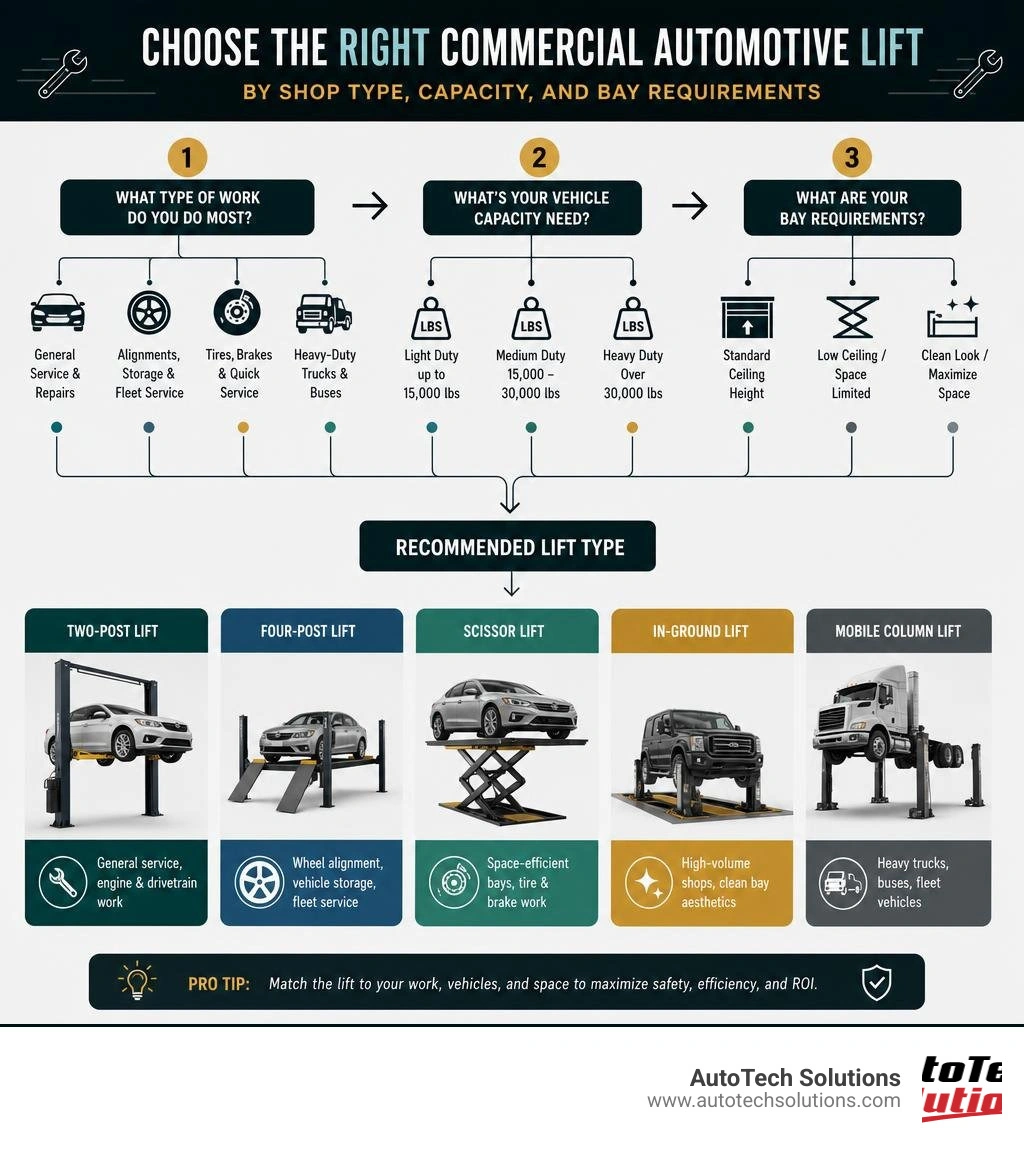
Quick answer: What are the main types of commercial automotive lifts?
| Lift Type | Best For | Typical Capacity Range |
|---|---|---|
| Two-post lift | General service, engine and drivetrain work | 7,000 – 20,000 lbs |
| Four-post lift | Wheel alignment, vehicle storage, fleet service | 9,000 – 30,000 lbs |
| Scissor lift | Space-efficient bays, tire and brake work | 8,000 – 15,000 lbs |
| In-ground lift | High-volume shops, clean bay aesthetics | 10,000 – 72,000 lbs |
| Mobile column lift | Heavy trucks, buses, fleet vehicles | 14,000 – 120,000 lbs |
Every shop is different. A high-volume dealership servicing light passenger vehicles has very different needs from a fleet maintenance facility running medium-duty trucks and vans.
This guide covers everything your operation needs to know — from lift types and arm configurations to safety certifications, facility requirements, and keeping your equipment running with minimal downtime.
Key Types of Commercial Automotive Lifts
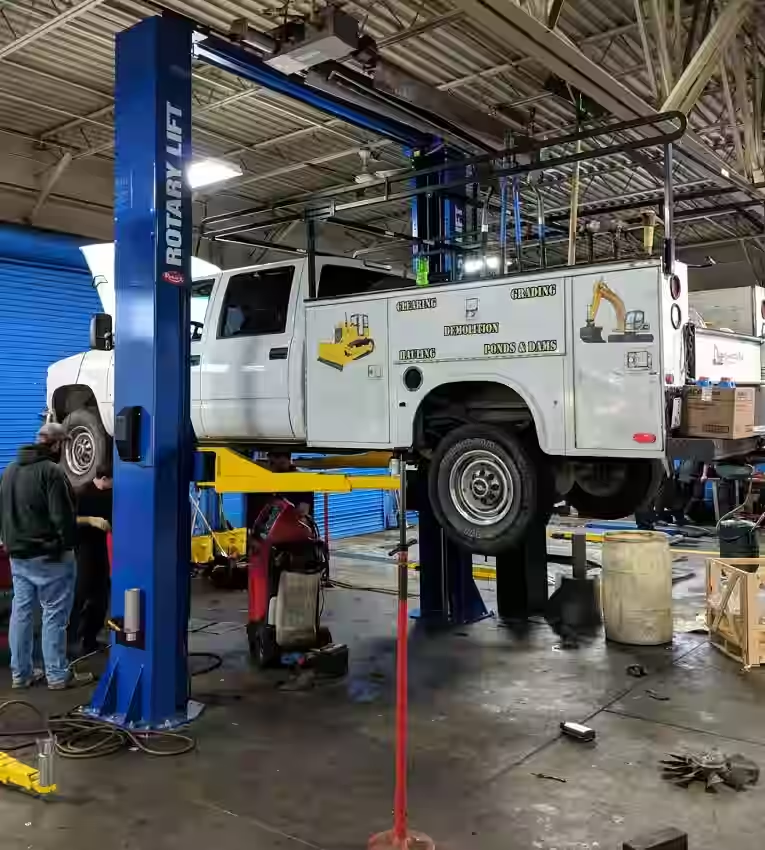
Selecting the right vehicle lift involves matching your bay layout, vehicle mix, and service specialties to the appropriate structural design. For heavy commercial fleets, municipal vehicles, and transit buses, Heavy-duty vehicle lifts are essential for maintaining safety and throughput.
Two-Post Lifts for General Service
Two-post automotive lifts are the industry standard for general repair, brake service, and under-car diagnostics. By lifting a vehicle from its frame, they leave the wheels suspended and the undercarriage completely accessible.
Lifting capacities for two-post models generally range from 7,000 lbs to 20,000 lbs. For standard passenger cars and light SUVs, a 9,000-lb or 10,000-lb lift is highly versatile. However, commercial shops frequently opting for a heavy-duty 2 Post Floor Plate Car Lift can accommodate larger delivery vans, ambulances, and dual-rear-wheel service trucks. If your technicians regularly work on heavy-duty vehicles, upgrading to a high-capacity model like the BendPak 16AP 16,000-lbs. Capacity - Clearfloor - High-Rise - 168" O.A. Height -5175608 ensures that your fleet is supported safely and efficiently.
Four-Post Lifts for Alignment and Storage
Four-post lifts utilize solid runways that support the vehicle by its tires. This design makes loading vehicles exceptionally fast and simple, as there is no need for technicians to bend down and position swing arms under the frame.
Four-post lifts are the gold standard for wheel alignment services. When configured with integrated slip plates and turn plates, they allow the suspension to settle naturally for precise measurements. Beyond alignments, commercial garages utilize heavy-duty four-post systems for quick inspections and fluid changes. If you are looking to expand your shop's capabilities, exploring commercial Car Lift Sales Near Me can help you source four-post models equipped with internal airlines and rolling bridge jacks for wheel-free service.
Specialty In-Ground and Scissor Lifts
For shops where space is at a premium or clean bay aesthetics are a priority, specialty lifts offer excellent alternatives.
- Scissor Lifts: These lifts feature a pantograph-style lifting mechanism beneath the runways. They are highly valued for tire, brake, and bodywork because they eliminate the side columns of two-post and four-post lifts, allowing technicians full access around the perimeter of the vehicle.
- In-Ground Lifts: Modern in-ground hydraulic lifts house their assemblies inside sealed, environmentally safe containment sleeves beneath the shop floor. When lowered, they sit completely flush, allowing other vehicles to drive over them unimpeded. This maximizes bay flexibility and is highly favored by high-volume dealerships.
Two-Post Lift Configurations and Arm Designs
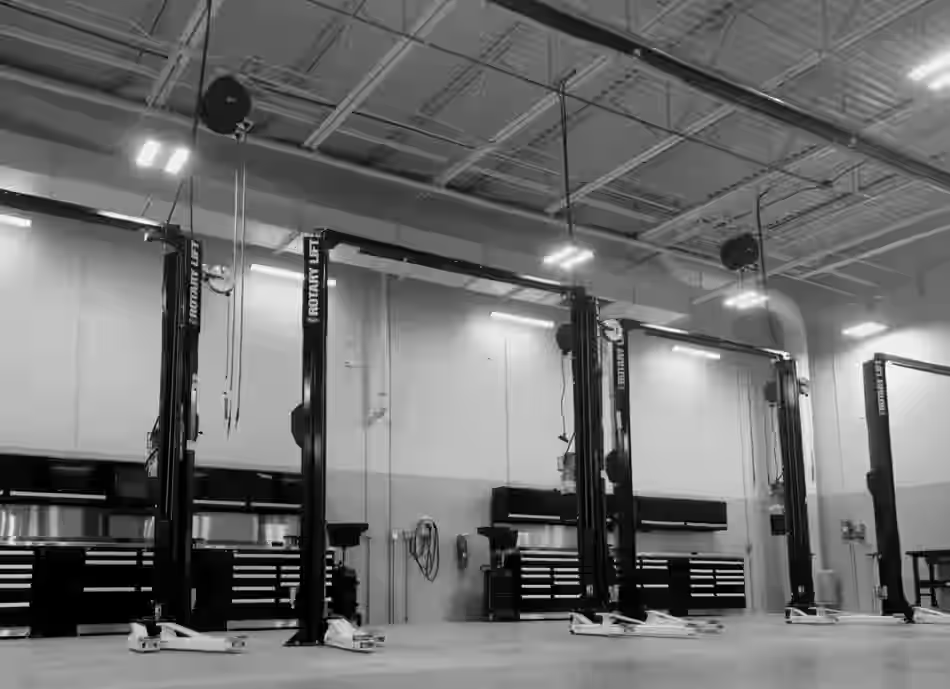
When selecting a two-post lift, the physical layout of the columns and the design of the swing arms will dictate which vehicles your technicians can service and how easily they can access the cabin.
Overhead vs. Floorplate Two-Post Automotive Lifts
Two-post lifts are divided into two structural categories:
- Overhead (Clearfloor) Lifts: These models feature a steel structural beam and hydraulic equalization lines running across the top of the columns. This leaves the floor completely flat, allowing technicians to easily roll toolboxes, oil drains, and transmission jacks directly under the vehicle. However, they require higher ceiling clearance to accommodate the overhead bar.
- Floorplate Lifts: These lifts feature a low-profile steel plate running across the floor between the columns to protect the hydraulic lines and cables. This design is highly beneficial for shops with ceiling height limitations or those servicing tall commercial vehicles like high-roof cargo vans, as there is no overhead bar to restrict upward travel.
Symmetric, Asymmetric, and Bi-Metric Arm Designs
The way a lift's arms swing out to reach a vehicle's lifting points determines weight distribution and door access:
- Symmetric Lifts: These lifts position the columns directly opposite each other. The front and rear swing arms are of equal length, centering the vehicle's weight directly between the columns. While highly stable for heavy trucks, this configuration places the vehicle's front doors directly next to the columns, making it difficult for technicians to open doors and access the interior.
- Asymmetric Lifts: In this design, the columns are rotated slightly outward (often 30 degrees), and the front arms are shorter than the rear arms. This pulls the vehicle forward, shifting the door opening area behind the columns. This allows technicians to open vehicle doors fully while elevated, making interior diagnostic and electrical work much easier.
- Bi-Metric (Adaptable) Lifts: These highly versatile lifts combine the benefits of both designs. By utilizing telescoping arms and adjustable column configurations, bi-metric lifts allow technicians to lift vehicles either symmetrically or asymmetrically depending on the vehicle's wheelbase and center of gravity.
Engineering and Safety Standards for Commercial Lifts
In a busy commercial shop, safety is non-negotiable. Elevating a multi-ton vehicle requires robust engineering, reliable redundant safety mechanisms, and strict adherence to manufacturing standards.
| Safety Feature | Primary Function | Why It Matters for Commercial Shops |
|---|---|---|
| Mechanical Safety Locks | Automatically engage as the lift rises to hold the load mechanically. | Prevents sudden descent in the event of hydraulic pressure loss. |
| Velocity Fuses / Flow Restrictors | Restricts hydraulic fluid flow if a high-pressure hose ruptures. | Ensures the lift descends at a controlled, safe speed during a hydraulic failure. |
| Overload Protection Valve | Prevents the hydraulic system from operating if the load exceeds capacity. | Protects the lift structure from catastrophic structural failure. |
| Slack-Cable Sensor | Shuts down power if a synchronization cable loses tension. | Prevents the vehicle from tilting or falling off the lift due to uneven lifting. |
Safety Standards and Certifications for Automotive Lifts
When purchasing automotive lifts, verifying industry-recognized certifications is crucial for protecting your technicians and complying with local safety regulations. The most important certification in North America is from the Automotive Lift Institute (ALI).
An ALI-certified lift has undergone rigorous independent testing to meet the ANSI/ALI ALCTV standards. This certification guarantees that the lift's structural integrity, hydraulic components, and electrical systems have been thoroughly vetted for commercial use. Non-certified lifts may seem cost-effective initially, but they often lack independent testing, which can lead to compliance issues with OSHA and potential insurance claim denials in the event of an accident.
Installation and Facility Requirements
A commercial lift is only as reliable as the foundation it is anchored to. Proper facility planning and professional installation are required to guarantee safe operation and long-term durability. If you are preparing your shop for new equipment, consulting an Automotive Lift Installation Guide is the best way to ensure your space meets all requirements.
Ceiling Height and Bay Space Planning
Before selecting a lift, you must carefully evaluate your bay's physical dimensions. To prevent vehicle-to-ceiling contact, the minimum ceiling height must account for the maximum rise of the lift, the height of the tallest vehicle you intend to service, and a safety margin for overhead lighting and structural beams.
Additionally, you must plan for adequate bay width and length to allow technicians to work comfortably around the vehicle. For a standard 10,000-lb two-post lift, a minimum bay size of 12 feet wide by 24 feet deep is generally recommended. For larger commercial vehicles, heavy-duty bays may require significantly larger footprints. Working with certified professionals for your Car Hoist Installation guarantees that your equipment is positioned for optimal workflow and safety.
Concrete and Anchoring Specifications
The foundation of a two-post lift bears immense concentrated loads. Most manufacturers require a minimum concrete thickness of 4 inches to 6 inches, with a compressive strength rating of at least 3,000 to 3,500 PSI.
For heavy-duty lifts, the concrete requirements are even stricter, often requiring reinforced concrete with a minimum thickness of 6 to 8 inches. If your facility is located in a seismically active zone, additional anchoring specifications and structural calculations may be required. When you prepare for Installing a car lift in a commercial garage, our team at AutoTech Solutions ensures that your concrete is thoroughly inspected and that heavy-duty anchor bolts are torqued to exact manufacturer specifications.
Maintenance, Repairs, and Minimizing Downtime
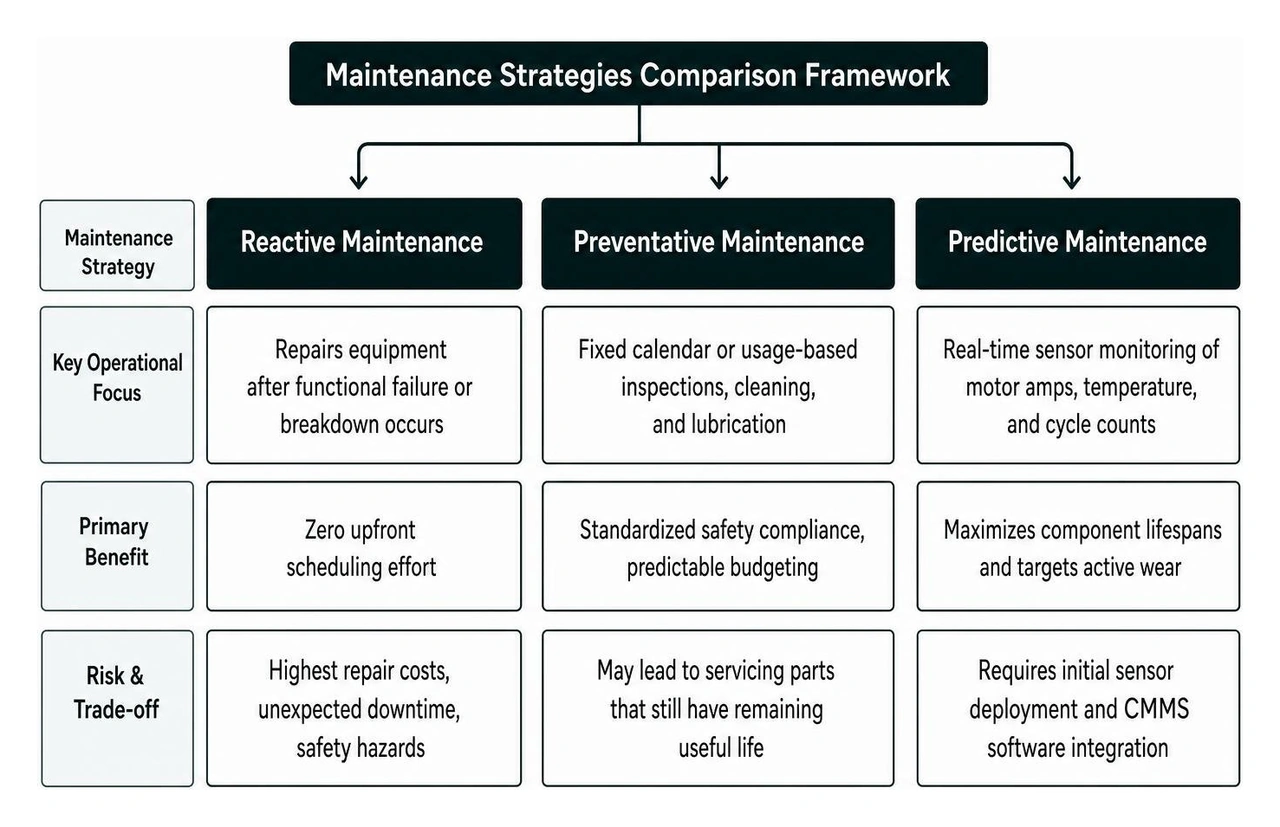
Every hour a lift is out of service, your shop loses revenue. Implementing a strict preventative maintenance schedule is the most effective way to prevent unexpected breakdowns and extend the lifespan of your investment. For comprehensive facility planning, refer to our Car Lift Installers Complete Guide.
Common Causes of Lift Failure
Understanding why lifts fail allows your team to catch minor issues before they escalate into major disruptions:
- Hydraulic Seal Leaks: Over time, cylinder seals wear down, leading to fluid leaks, slow lifting speeds, or drifting carriages.
- Cable Wear and Tension Imbalance: Synchronization cables stretch with regular use. If they are not adjusted periodically, the lift carriages will rise unevenly, placing undue stress on the structure.
- Electrical Component Failure: Limit switches, contactors, and control buttons can fail due to dust, moisture, and high-volume usage.
- Lack of Lubrication: Failing to lubricate the lift's columns, pulleys, and arm pins leads to premature wear and jerky operation.
To learn more about keeping your equipment in top shape, check out our guide on the Common Causes of Automotive Lift Downtime.
Professional Repair and Parts Sourcing
While daily visual inspections can be performed by your shop technicians, structural repairs and hydraulic maintenance should always be handled by certified professionals. Attempting uncertified repairs on commercial lifting equipment can void manufacturer warranties and compromise shop safety.
At AutoTech Solutions, we understand that lift downtime directly impacts your bottom line. We provide rapid Two Post Lift Repair services to get your bays back up and running quickly. We stock a wide inventory of high-quality Car Lift Parts for Sale and offer reliable After Hours Automotive Lift Repair across Michigan and the Carolinas to minimize your operational disruptions.
Frequently Asked Questions about Commercial Lifts
What is the difference between ALI certified and non-certified lifts?
An ALI-certified lift has been independently tested and proven to meet strict national safety and performance standards (ANSI/ALI ALCTV). Non-certified lifts do not undergo this rigorous third-party verification. Using non-certified lifts in a commercial shop can lead to OSHA citations, increased liability, and potential insurance policy exclusions.
How often do commercial vehicle lifts require safety inspections?
According to ANSI standards and OSHA regulations, commercial vehicle lifts must receive a professional safety inspection at least once a year. These inspections must be performed by a qualified lift inspector. Additionally, shop technicians should perform basic daily safety checks of the locks, cables, and hydraulics before operating the equipment.
What concrete specifications are required for a 10,000-lb two-post lift?
For most 10,000-lb two-post lifts, manufacturers require a concrete slab with a minimum thickness of 4 to 6 inches, a compressive strength of at least 3,000 to 3,500 PSI, and a minimum cure time of 28 days before anchoring. Always consult the specific manufacturer's manual, as some high-capacity or clearfloor models may require thicker foundations.
Partner with AutoTech Solutions for Seamless Shop Operations
Investing in the right automotive lifts is only the first step; keeping them running safely and efficiently requires a dedicated service partner.
At AutoTech Solutions, we are a true one-stop-shop for automotive equipment sales, professional installation, certified service, and preventative maintenance. We serve light duty, heavy duty, and collision repair shops across Michigan to the Carolinas, with physical locations in:
- Novi, MI
- Charlotte, NC
- Raleigh, NC
- Wade, NC
Our team provides unmatched sales and service coverage throughout these regions. Whether you are looking to purchase heavy-duty equipment or require local installation expertise, we have you covered with factory-certified technicians and top-tier equipment brands.
Our ultimate mission is to minimize your shop's downtime. From initial bay layout planning to rapid emergency repairs, our factory-trained technicians are always ready to help. To learn more about our investment in industry-leading service capabilities, read about AutoTech Solutions - Harvey & Company LLC.
Ready to upgrade your shop's lifting capabilities or schedule your annual safety inspection? Contact us today for Professional automotive lift installation and service that keeps your business moving.