Why the Right Vehicle Lift System Defines Your Shop's Productivity
A 4 post vehicle lift is a drive-on hydraulic lifting system that raises an entire vehicle via four vertical columns and two parallel runways — giving shops a stable, high-capacity platform for both vehicle storage and undercarriage service.
Quick answer — what you need to know:
| Feature | 4-Post Lift |
|---|---|
| How it works | Vehicle drives onto runways; hydraulic cylinder raises all four posts simultaneously |
| Primary use | Vehicle storage, fleet maintenance, heavy-duty undercarriage work |
| Typical capacity | 8,500 lbs to 12,000 lbs (commercial models) |
| Power requirement | 110V single-phase or 220V; dedicated 20–30 amp circuit |
| Floor requirement | 3,000 PSI concrete, minimum 4–6.5 inches thick |
| Key advantage over 2-post | Full vehicle stability, drive-on speed, vertical stacking capability |
| Who it's for | Commercial automotive shops, fleet maintenance facilities, collision centers |
For facility managers running a busy service operation, choosing the wrong lift system means slower throughput, technician bottlenecks, and unnecessary downtime. The difference between a 2-post and a 4-post system isn't just a matter of columns — it's a fundamental difference in what work gets done, how fast, and how safely.
Shops servicing commercial fleets, full-size trucks, or high-volume bays face a specific challenge: standard lifts often lack the capacity, stability, or clearance to handle the job efficiently. A mismatch between equipment and operational demands is one of the most common — and costly — mistakes in shop buildouts.
At AutoTech Solutions, our team works directly with automotive service facilities to match the right lift systems to their specific bay layouts, vehicle mix, and throughput goals — and this guide covers everything you need to make that decision with confidence.
Discover more about 4 post vehicle lift:
Comparing 2-Post vs 4 Post Vehicle Lift Systems for Commercial Facilities
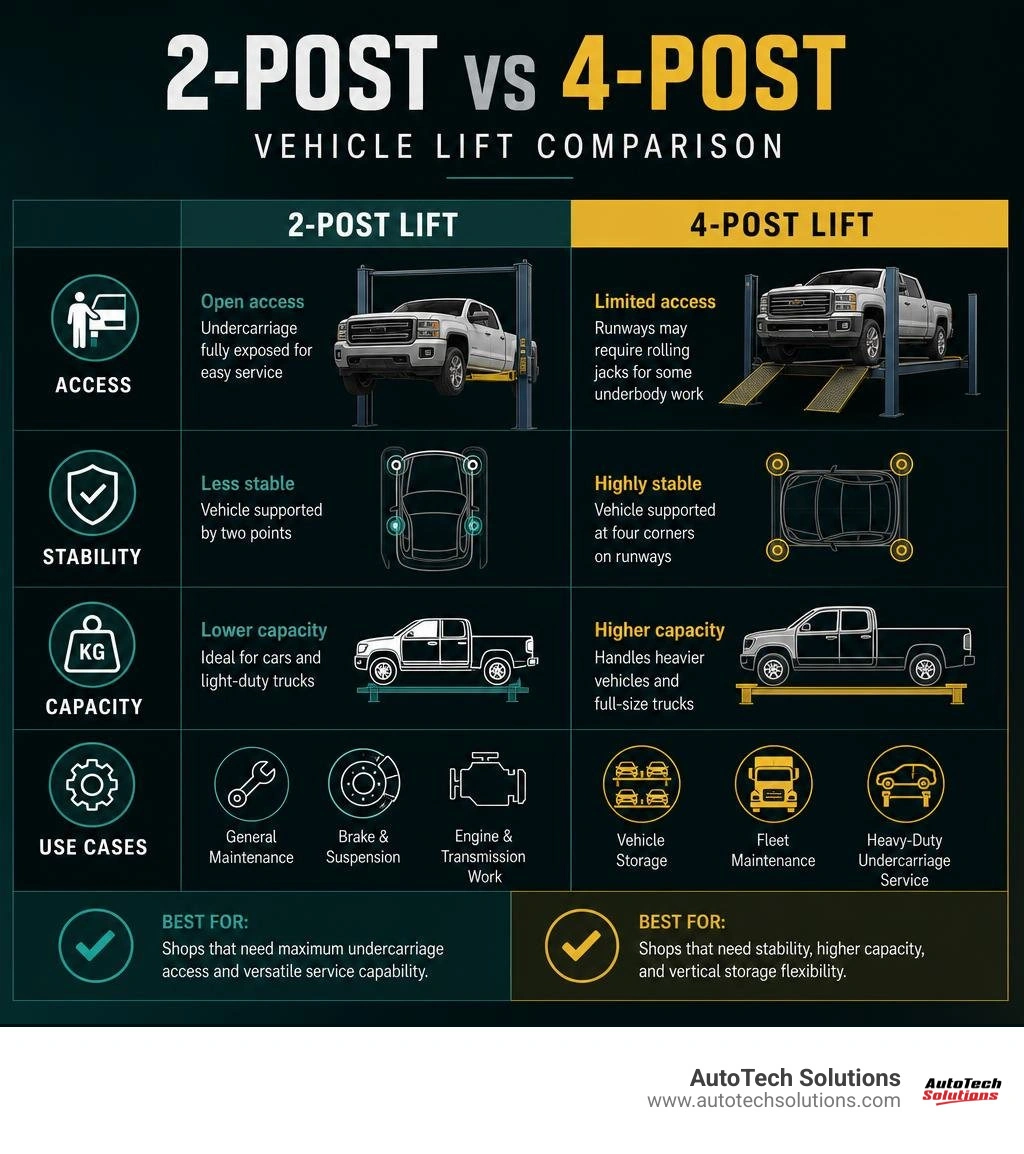
When evaluating vehicle lifts for commercial service bays, understanding the structural and operational contrasts between two-post and four-post equipment is crucial. While both systems utilize heavy-duty hydraulic power units and mechanical safety locks, their interaction with the vehicle frame and shop floor creates distinct advantages for different automotive repair procedures.
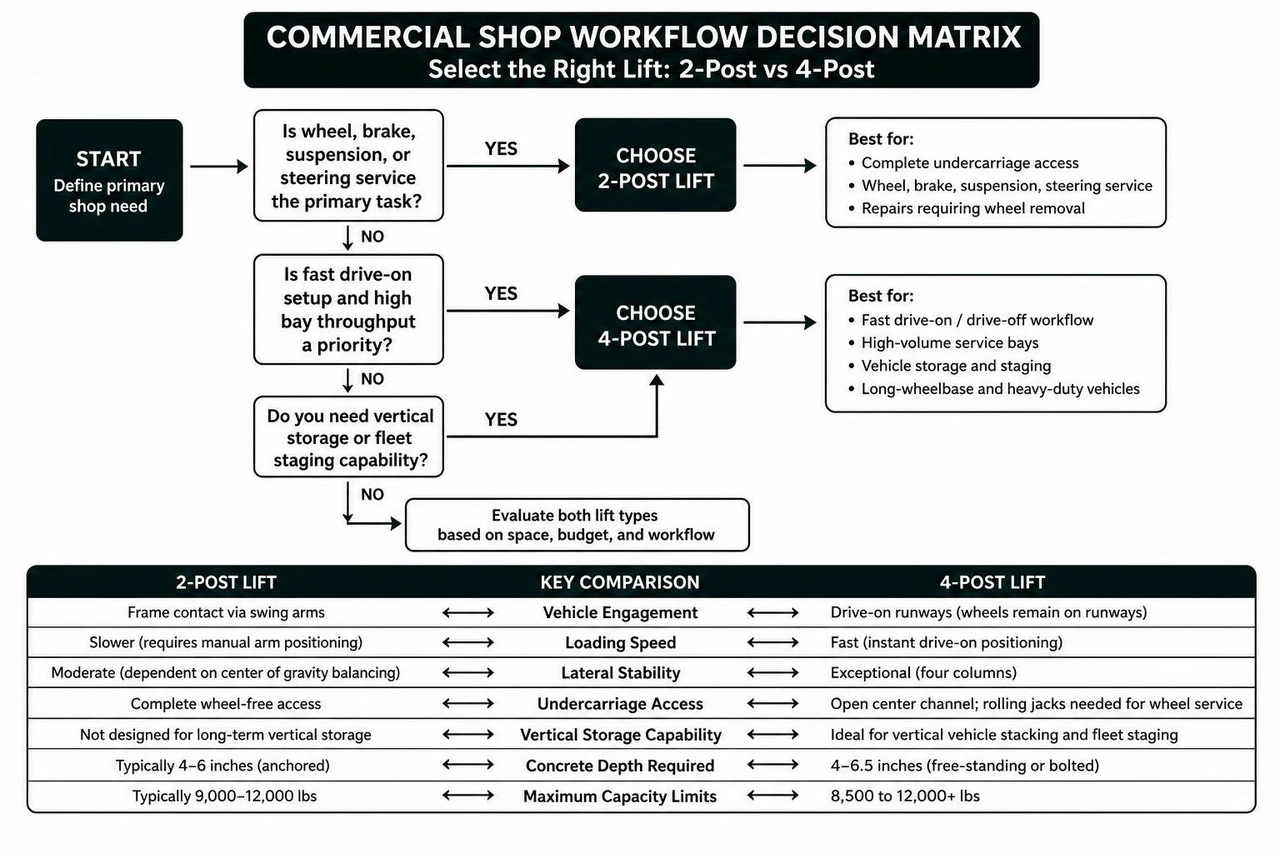
| Operational Criteria | 2-Post Lift System | 4-Post Lift System |
|---|---|---|
| Vehicle Engagement | Frame contact via swing arms | Drive-on runways (wheels remain on runways) |
| Loading Speed | Slower (requires manual arm positioning) | Fast (instant drive-on positioning) |
| Lateral Stability | Moderate (dependent on center of gravity balancing) | Exceptional (four anchored or balanced columns) |
| Undercarriage Access | Complete wheel-free access for suspension/brakes | Open center channel; requires rolling jacks for wheel service |
| Vertical Storage Capability | Not designed for long-term vertical storage | Ideal for vertical vehicle stacking and fleet staging |
| Concrete Depth Required | Typically 4–6 inches (anchored) | 4–6.5 inches (can function free-standing or bolted) |
| Maximum Capacity Limits | Typically 9,000–12,000 lbs in standard shop bays | 8,500 to 12,000+ lbs for commercial fleet chassis |
Mechanics of Two-Post Automotive Lifts
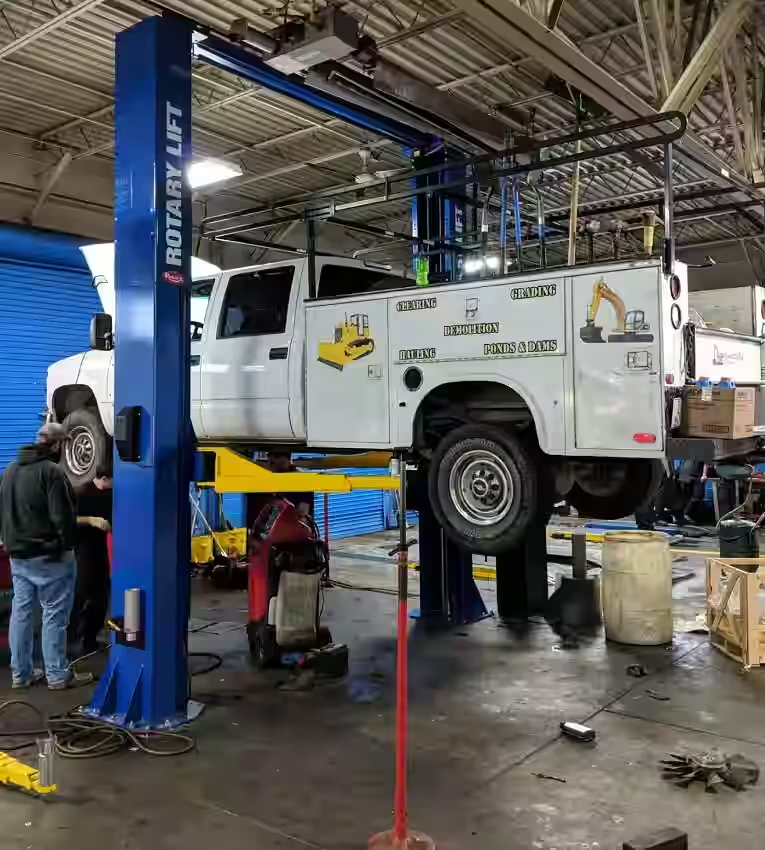
Two-post automotive lifts utilize dual vertical columns anchored directly to the concrete slab, connected by an overhead bar or floor plate. Hydraulic cylinders drive internal carriage assemblies that raise symmetrical or asymmetrical swing arms. Technicians position these mechanical arms under specific OEM vehicle frame contact points or unibody pinch welds before elevating the chassis.
This frame-engaging design leaves all four wheels hanging free. As detailed in our Two Post Lift Complete Guide, this makes two-post lifts exceptionally suited for wheel, tire, brake, steering, and suspension servicing. However, improper balancing on a two-post lift can create safety risks with long-wheelbase commercial vans or unevenly loaded work trucks.
Operating Advantages of a 4 Post Vehicle Lift in Busy Bays
By contrast, a 4 post vehicle lift supports the vehicle by its tires along two heavy-gauge steel drive-on runways. This drive-on design eliminates the labor-intensive step of technician kneeling and manual frame arm adjustment. Service writers and shop technicians can drive a commercial truck directly onto the runways, set the parking brake, and engage the hydraulic control valve instantly.
In high-volume fleet maintenance facilities and collision centers across Michigan and the Carolinas, drive-on speed drastically reduces rack setup times. Furthermore, the four-column geometry distributes weight across a larger footprint, providing maximum lateral stability when servicing wide-body commercial vans, heavy utility trucks, or dually pickups.
Beyond vehicle repair, commercial facilities utilize 4-post lifts as vertical storage systems. Stacking inactive fleet vehicles, long-term repair projects, or seasonal equipment vertically doubles usable floor space inside tight bay envelopes.
Commercial Applications, Capabilities, and Weight Capacities
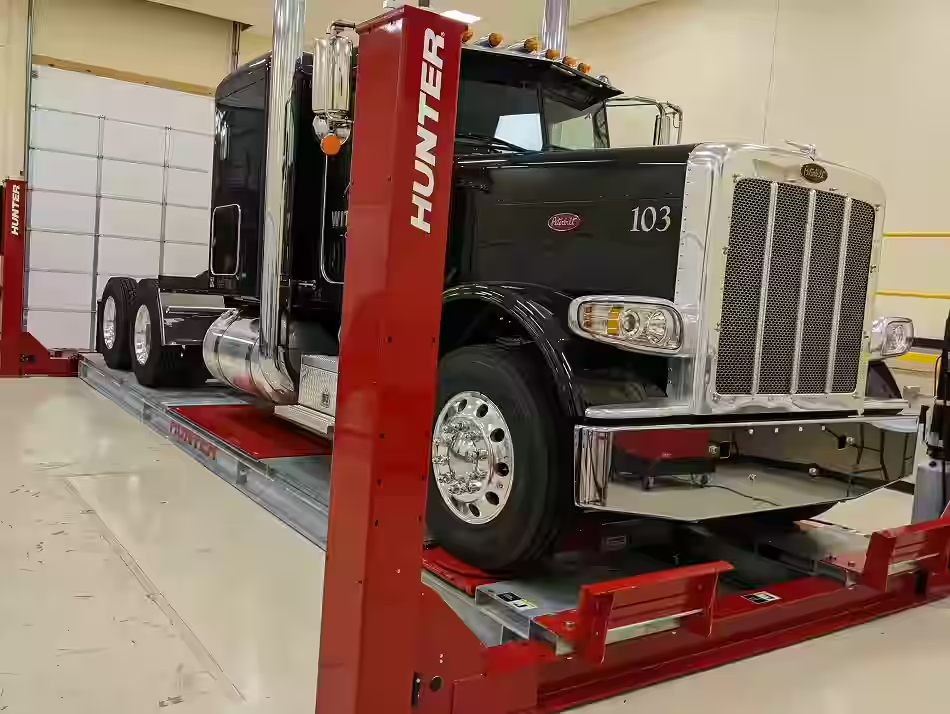
Commercial fleet servicing demands precision load-rating calculations. Overloading a vehicle lift or selecting an undersized unit leads to premature hydraulic seal wear, column flexing, structural fatigue, and dangerous mechanical failure.
Sizing 4 Post Vehicle Lift Capacity for Fleet and Heavy Duty Trucks
Selecting the correct lift capacity depends on the heaviest vehicles entering your service bays. Commercial 4-post lifts are generally segmented into standard, pro, and heavy-duty capacity classes:
- 8,500 lbs to 9,000 lbs Capacity: Tailored for standard commercial fleets, passenger sedans, light crossovers, and compact utility vehicles. For instance, lifts rated at 8,500 lbs provide a compact footprint (often around 83.6 inches column height) suitable for lower ceiling heights, while 9,000 lb models offer drive-through widths designed for everyday commercial service.
- 10,000 lbs Capacity: The standard workhorse for modern commercial shops. A 10,000 lb 4 post vehicle lift comfortably handles half-ton and three-quarter-ton pickups, full-size cargo vans, and commercial SUVs. Models in this range typically feature extra-wide runway spacing and heavy-duty steel pulleys.
- 12,000 lbs Capacity: Engineered specifically for heavy work trucks, dual-rear-wheel (dually) chassis, service utility vehicles, and long-wheelbase commercial vans. If your facility handles commercial work trucks, explore our inventory of 4 Post Truck Lift For Sale to match high-capacity requirements.
Duty Classifications: Standard, Pro, and Heavy-Duty Commercial Models
To withstand continuous multi-shift usage in commercial environments, lift engineering extends beyond pure hydraulic pulling force. Upgrading from standard commercial units to Pro or Heavy-Duty models introduces significant structural enhancements:
- Column Construction: Standard units may utilize formed C-channel steel posts. Pro and commercial-grade heavy-duty models utilize 5x5-inch square posts or heavy boxed structural steel columns that eliminate vertical deflection under maximum load.
- Crossbeam Mounting: Commercial-duty lifts implement wrap-around cross-beam mounts that encapsulate the square column, providing rigid multi-directional stability during heavy mechanical wrenching or component extraction.
- Runway Specifications: Pro-tier lifts increase runway widths up to 23 inches, providing plenty of clearance for wide commercial tire assemblies, dually rear axles, and extended track widths.
- High-Clearance Geometry: High-profile models offer underneath clearances up to 82 inches (6 feet 10 inches) or more beneath the runways, allowing technicians to walk upright comfortably without stooping during exhaust, transmission, or differential overhauls.
Key Safety Features and Structural Engineering Standards
Commercial lift operations governed by OSHA guidelines and shop safety protocols require redundant, heavy-duty mechanical locking systems. A reliable 4 post vehicle lift never relies solely on hydraulic pressure to hold an elevated vehicle in place.
Mechanical Lock Systems and Cable Safety
Commercial-grade 4-post vehicle lifts incorporate multi-tiered safety hardware designed to protect technicians working under multi-ton loads:
- Primary Mechanical Safety Locks: High-tensile steel ladder locks mounted inside or along each of the four posts automatically engage as the carriage rises. Quality lifts feature between 10 and 12 distinct locking positions spaced at precise 4.5-inch to 4.7-inch intervals along the post height.
- Single-Point Lock Release: Rather than requiring technicians to disengage mechanical locks manually at four separate corners, single-point manual air or mechanical lever releases allow immediate disengagement of all four safety locks from the main operator control console.
- Cable Slack Locks (Secondary Safety): In the event of primary steel aircraft cable tension loss or slack, secondary safety lock latches trigger instantly to freeze the crossbeams on the columns, preventing platform tipping.
- Proof Load Testing: Commercial lifts undergo rigorous structural load testing, including dynamic overload tests (typically 115% of rated capacity) and static load tests (up to 150% of rated capacity) to verify weld integrity, cylinder seal safety, and structural yield thresholds.
Essential Accessories: Rolling Jacks, Drip Trays, and Decking
While a drive-on 4-post lift keeps vehicle wheels resting firmly on its runways, commercial repair work frequently requires wheel-free access for brake jobs, tire rotations, and suspension maintenance. Commercial accessories transform a standard drive-on platform into a complete repair bay:
- Pneumatic/Hydraulic Rolling Bridge Jacks: Mounted on inner runway tracks, rolling bridge jacks lift the front or rear axle of the vehicle off the runways while elevated. Utilizing 4,500 lb to 6,000 lb capacity rolling jacks gives a 4-post lift complete wheel-free service capabilities similar to a 2-post system.
- Impact-Resistant Drip Trays: Polypropylene or steel drip trays slide between the runways to catch oil, transmission fluid, or coolant drips during underbody teardowns, protecting vehicles or equipment parked beneath the platform.
- Jack Trays: Cross-runway steel jack trays provide a mobile platform for placing auxiliary jacks or support stands, providing secondary lifting support directly on the rack.
- Approach Ramp Extensions: Lightweight aluminum or heavy-duty extended steel approach ramps reduce the drive-on angle for low-clearance commercial service vehicles, sports cars, or specialized fleet vans.
Facility Requirements and Professional Lift Installation
Installing a commercial 4 post vehicle lift requires thorough pre-installation site auditing. Concrete slab structural strength, vertical ceiling clearances, and electrical supply infrastructure must comply with exact engineering specifications.
Concrete Slab, Ceiling Clearance, and Electrical Specifications
Failure to verify facility foundation and ceiling parameters before delivery causes costly operational delays and structural hazards.
- Concrete Depth and Strength: While portable or light-duty 4-post lifts can operate free-standing on sound concrete, commercial operations require a flat, level concrete pad with a minimum depth of 4.0 to 6.5 inches and a minimum compressive strength of 3,000 PSI. If bolting high-capacity heavy-duty models to achieve maximum stability, concrete integrity is paramount for wedge anchor expansion.
- Ceiling Height Calculation: To calculate required overhead clearance, add the maximum vehicle height to the maximum runway lifting height (e.g., 83.5 inches to top of runway) plus an additional 6 to 12 inches of safety buffer for lock disengagement travel. Standard commercial bays usually require at least 10 to 12 feet of clear overhead room.
- Electrical Power Units: Standard 110V single-phase power units operate effectively on dedicated 20-amp or 30-amp circuits equipped with 10-gauge wiring. However, high-volume commercial bays often opt for 220V single-phase or three-phase power units. A 220V motor cuts lifting cycle times from ~140 seconds down to roughly 55–70 seconds, significantly increasing vehicle throughput per shift.
Professional Assembly and Certified Inspection Protocols
Commercial lift assembly involves aligning multi-hundred-pound crossbeams, stringing high-tensile steel cables over sealed ball-bearing pulleys, leveling runways, bleeding hydraulic lines, and setting mechanical lock timing.
At AutoTech Solutions, we provide turn-key Car Lift Installation Service across Michigan, North Carolina, and surrounding regional hubs (including Charlotte, Raleigh, Wade, NC, and Novi, MI). Our factory-trained technicians ensure full compliance with strict safety standards.
For facilities completing layout checks, review our complete Automotive Lift Installation Guide. Following installation, routine preventative maintenance schedules keep equipment operating smoothly. Schedule annual ANSI/ALI certified inspections using our Lift Inspection Services Guide 2026, and back your shop with scheduled Car Lift Maintenance to protect your capital investment.
Frequently Asked Questions About Commercial Vehicle Lifts
What concrete depth is required to install a commercial 4-post lift?
Most commercial 4-post vehicle lifts require a level concrete slab with a minimum thickness between 4.0 and 6.5 inches and a compressive strength rating of at least 3,000 PSI. While 4-post lifts distribute weight over four bases—making floor tension less concentrated than with 2-post lifts—a solid, non-cracked concrete foundation is essential for anchoring and dynamic safety.
What is the difference in lifting speed between 110V and 220V power units?
A standard 110V motor (typically 2HP to 3HP on a dedicated 20A–30A circuit) takes between 71 and 143 seconds to reach maximum lifting height under full load. Upgrading to a 220V power unit cuts lifting cycle times down to approximately 50 to 70 seconds. For high-volume service bays, a 220V system significantly improves daily bay efficiency.
How often should commercial shop vehicle lifts undergo safety inspections?
OSHA and the Automotive Lift Institute (ALI) recommend that all commercial automotive lifts undergo a thorough visual inspection daily by trained operators, along with a documented, comprehensive annual inspection by a certified lift inspector. Annual inspections check cable tension, pulley wear, hydraulic cylinder seals, mechanical safety lock engagement, and anchor bolt torque.
Conclusion
Investing in high-performance service equipment directly impacts shop profitability, technician performance, and operational safety. A heavy-duty 4 post vehicle lift gives busy commercial bays the perfect blend of high weight capacity, drive-on setup speed, vertical storage versatility, and solid vehicle stability.
At AutoTech Solutions, we help commercial service facilities, fleet managers, and body shops optimize their operational floor plans with premium equipment, rapid repair response, and complete maintenance coverage across Michigan and the Carolinas.
Whether upgrading existing bays or building a modern facility from the ground up, explore our specialized commercial systems at AutoTech Solutions Collision Center Solutions or call our equipment specialists today to maximize your shop's productivity.