
Why Industrial Motor Repair Directly Affects Your Shop's Bottom Line
Industrial motor repair is one of the most critical — and most overlooked — maintenance priorities for any commercial automotive, collision, or manufacturing facility.
When a motor fails, everything stops. Lifts won't raise. Compressors go silent. Production lines halt. Every minute of downtime has a direct cost.
Here's a quick overview of what reliable industrial motor repair involves:
What to know about industrial motor repair:
- What it is: The process of diagnosing, rewinding, rebuilding, or reconditioning electric motors to restore or exceed original performance
- Who needs it: Commercial shops, manufacturing plants, and industrial facilities that rely on motor-driven equipment
- Key services: Motor rewinding, bearing replacement, dynamic balancing, vibration analysis, insulation testing, and core loss testing
- Repair vs. replace: Repair typically costs 30–60% of a new motor; replacement lead times can stretch up to 25 weeks
- How to choose a shop: Look for EASA accreditation, UL certification, written quality standards, and documented testing procedures
- Turnaround time: Standard repairs run 3–7 business days; emergency/rush service is often available within 24 hours
The scale of this industry is significant. In the United States alone, more motor horsepower is repaired each year than is sold new. Yet research shows that only one-third of motor repair shops use any written quality assurance standards — meaning the quality of repair work varies widely from shop to shop.
For facility managers running automotive or collision operations, that inconsistency carries real risk. A poorly repaired motor doesn't just fail sooner — it can quietly degrade energy efficiency, increase operating costs, and put technician productivity at risk every day it runs.
This guide is designed to help you identify the right repair partner, understand what quality motor service actually looks like, and make smarter decisions about repair versus replacement.

Handy industrial motor repair terms:
Key Indicators of High-Quality Industrial Motor Repair Services
Finding a motor repair shop that actually knows its way around a heavy-duty stator is harder than it sounds. Historically, the motor repair industry has been highly fragmented. In the United States, there are approximately 4,100 motor repair shops generating billions in annual revenue, but three-quarters of these operations have ten or fewer employees.
While small shops can offer personalized service, many lack the capital to invest in high-end diagnostic gear or structured quality management programs. In fact, historically, only one-third of all shops used written quality assurance standards of any type.
When evaluating potential service providers for your commercial shop, look for these key indicators of high-quality operations:
- Documented Quality Procedures: A premium shop will have written, repeatable processes for every stage of disassembly, cleaning, repair, and testing.
- In-House Machining Capabilities: Shops that can perform shaft reconstruction, end bell sleeving, and custom machining in-house maintain total quality control and offer significantly faster turnaround times.
- Comprehensive Service Reports: You shouldn't just get a repaired motor back; you should receive a detailed multi-page diagnostic and run-test report documenting exactly what was fixed and how it performed on the test stand.
For a deeper dive into what standard mechanical repairs should look like, read our comprehensive electrical machine repair guide 2026.
The Value of EASA Accreditation and UL Certification in Industrial Motor Repair
If you want to bypass the guesswork entirely, look for certifications. The gold standard in this industry is accreditation by the Electrical Apparatus Service Association (EASA).
An EASA-accredited facility must adhere strictly to the EASA AR100 standard for the repair of rotating electrical apparatus. This standard governs everything from mechanical tolerances to electrical testing limits, ensuring that the motor is returned to you matching or exceeding original equipment manufacturer (OEM) performance.
Equally important is UL (Underwriters Laboratories) certification. If your shop operates specialized equipment—such as paint booths requiring explosion-proof motors—working with a UL-certified facility is non-negotiable. A UL-certified shop is authorized to repair explosion-proof units without compromising their safety ratings, keeping your facility compliant with local fire codes and OSHA regulations.
Standard Quality Assurance and OEM Specifications
A quality repair process is obsessed with returning a motor to its exact original design specifications. This is incredibly difficult because of physical and material limitations.
For example, studies have shown that 42% of repair shops report problems rewinding motors with the original size wire due to insufficient room in the stator slots or the simple unavailability of the correct wire gauge. To make matters worse, 81% of shops admit to changing winding configurations (such as converting concentric windings to lap windings) simply because of equipment limitations or shop preference.
These shortcuts can drastically alter the motor's operating characteristics, leading to increased heat, reduced torque, and premature failure. High-quality shops invest in proper wire stocks and advanced winding equipment to ensure the original winding pattern and wire volume are maintained. To keep your shop's electrical systems operating reliably, you must pair quality motor repairs with routine electrical machine maintenance protocols.
Advanced Testing and Diagnostic Procedures for Commercial Shop Motors
You can't fix what you can't measure. A reliable motor service provider doesn't just look at a dead motor, smell burnt copper, and call it a day. They utilize advanced electrical and physical diagnostics to pinpoint the exact root cause of failure.
When diagnosing complex shop machinery—like the large hydraulic power units running heavy-duty vehicle lifts—relying on a structured automotive shop equipment repair guide is critical to differentiating electrical motor issues from hydraulic system failures.
Predictive Maintenance and On-Site Diagnostics
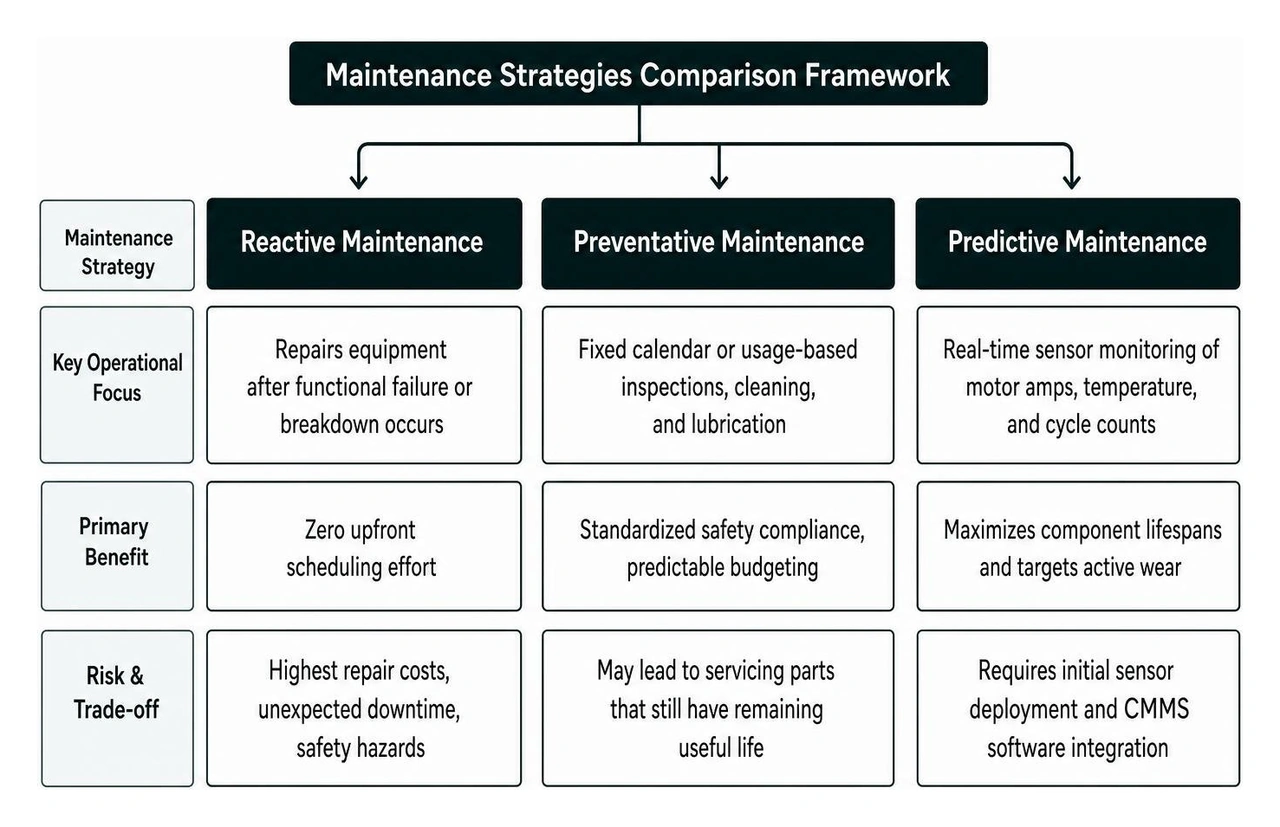
Up to 80% of electric motor failures are preventable with early diagnostics. Rather than waiting for a motor to catastrophically fail in the middle of a busy shift, commercial shops should utilize on-site predictive maintenance services. These proactive steps are detailed in our preventative maintenance service guide and include:
- Vibration Analysis: Using advanced sensors (like the Emerson CSI 2140) to detect unbalance, mechanical looseness, or bearing wear before they cause physical damage.
- Infrared Thermography: Scanning the motor, connections, and control panels to find "hot spots" caused by high resistance or phase imbalances.
- Laser Alignment: Aligning the motor shaft with the driven equipment (such as a compressor pump) to within thousandths of an inch, preventing premature bearing wear.
- Dynamic Balancing: Balancing rotors and fans up to thousands of pounds to eliminate vibration and mechanical stress during operation.
Core Loss and Surge Testing in Industrial Motor Repair
Before a motor is rewound, it must undergo a stator core loss test. The stator core is made of thin, insulated steel laminations. If these laminations are shorted together, the motor will experience massive energy losses, overheat, and fail rapidly. Core loss testing verifies that the magnetic core is still healthy enough to justify a rewind.
Once wound, the motor should face rigorous electrical testing:
- Insulation Resistance (MegOhm) Testing: Measures the integrity of the winding insulation relative to ground.
- Surge Testing: Applies high-voltage pulses to detect shorted turns within the same winding phase—a fault that standard resistance meters completely miss.
- High-Potential (HiPOT) Testing: Verifies that the insulation can withstand voltages well above its operating limit without breaking down.
The Economics of Motor Maintenance: Repair vs. Replace Decisions
Every facility manager eventually faces the ultimate question: Do I repair this broken motor, or do I throw it in the scrap bin and buy a new one?
This decision isn't just about the immediate price tag. It requires balancing upfront capital expenses, lead times, and long-term energy costs. For example, if your shop's central air compressor goes down, you must weigh the speed of repair against the long-term energy savings of a brand-new, ultra-efficient unit. Understanding air compressor repair and maintenance for automotive shops can help you navigate this specific trade-off.
To guide your decision-making, we use a simple framework:
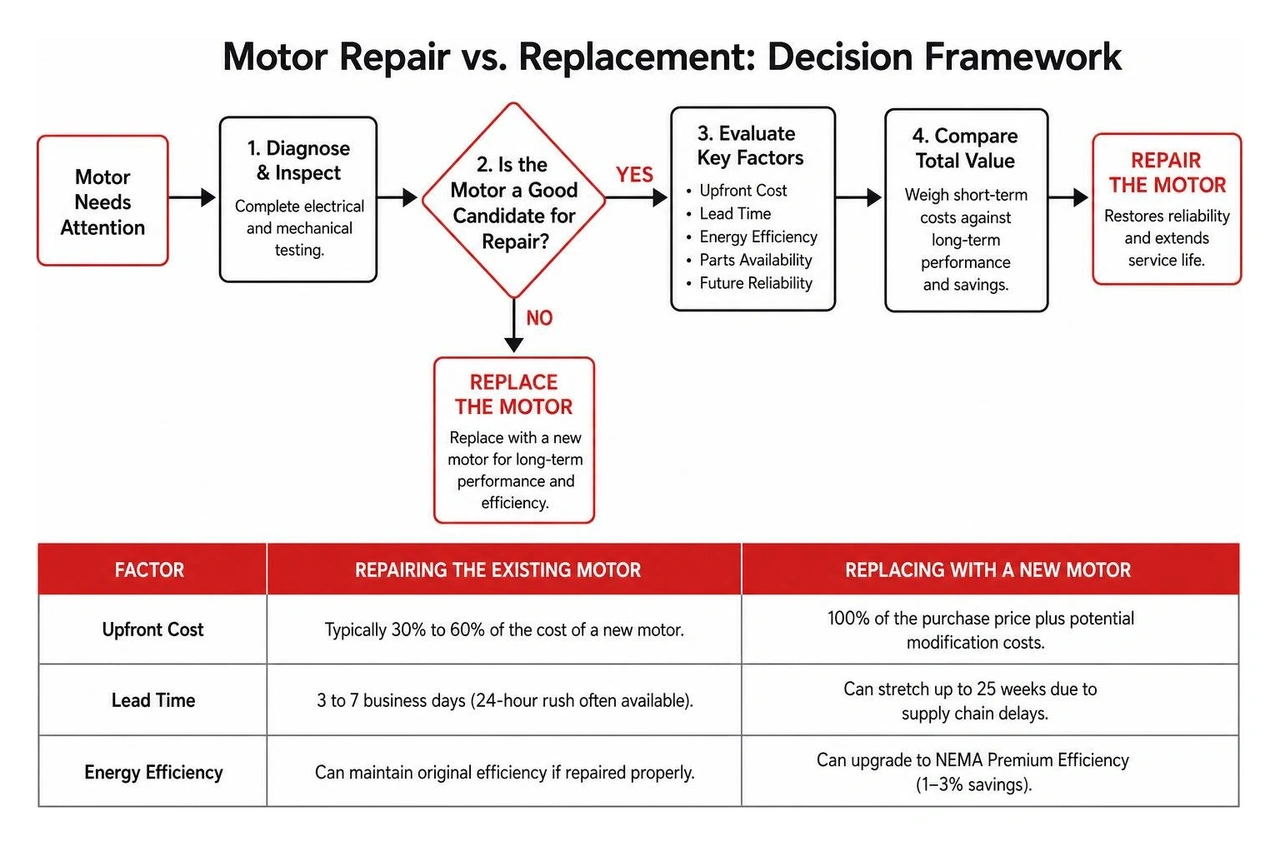
| Factor | Repairing the Existing Motor | Replacing with a New Motor |
|---|---|---|
| Upfront Cost | Typically 30% to 60% of the cost of a new motor. | 100% of the purchase price plus potential modification costs. |
| Lead Time | 3 to 7 business days (24-hour rush often available). | Can stretch up to 25 weeks due to supply chain delays. |
| Energy Efficiency | Can maintain original efficiency if repaired properly. | Can upgrade to NEMA Premium Efficiency (1–3% savings). |
| Warranty | Typically 12 months on the repaired components. | Full manufacturer warranty (usually 1 to 5 years). |
| Specialized Equipment | Ideal for custom, obsolete, or highly integrated motors. | May require expensive modifications to fit existing mounts. |
Generally, the 100 HP threshold is a great rule of thumb. For standard, off-the-shelf motors under 100 horsepower, replacement is often more economical than a full rewind, unless the motor is highly specialized or custom-mounted. For motors over 100 HP, a high-quality repair is almost always the most cost-effective path.
Energy Efficiency Losses and Rewinding Best Practices
Historically, it was assumed that rewinding a motor inevitably decreased its efficiency by 1 to 2 percentage points. Today, we know that is a myth. An efficiency drop is not an inevitable consequence of repair—it is the consequence of bad repair.
The primary culprit behind efficiency loss during a rewind is the burn-out oven. To remove old, damaged copper windings, the stator is placed in an oven to burn away the insulating resins. If the oven temperature exceeds 700°F to 750°F, the insulation between the stator's steel laminations degrades, causing permanent core damage and a permanent efficiency drop of up to 5%.
To prevent this, high-quality shops:
- Calibrate oven temperature controls regularly and use water-suppression systems to prevent thermal runaway.
- Utilize premium Class F or Class H high-temperature insulation materials during the rewind.
- Use original copper wire sizes to maintain low winding resistance.
Utility Rebates and Long-Term Cost Analysis
When evaluating replacement, don't ignore local utility rebate programs. Many energy providers across Michigan and the Carolinas offer substantial financial incentives for facilities that upgrade to NEMA Premium Efficient motors. These rebates can offset a significant portion of the replacement cost, making a new unit much more competitive when compared to a complex repair.
Over a motor's operating life, energy consumption accounts for roughly 95% of its total cost—the purchase price is a drop in the bucket. A 1% to 2% increase in efficiency can save thousands of dollars in operating costs over a few years of constant use.
Minimizing Commercial Shop Downtime Through Spare Motor Storage
In a busy commercial shop, waiting 3 to 5 days for a motor repair is sometimes out of the question. If your main exhaust extraction fan or heavy-duty vehicle lift motor goes down on a Monday morning, you are losing money by the hour.
The ultimate defense against this downtime is a structured spare motor storage program. By keeping critical replacement motors on hand, you can swap out a failed unit in hours rather than days. For shops undergoing upgrades or setting up spare storage areas, coordinating with professionals for industrial wiring installation ensures your backup systems are wired safely and efficiently.
Proper Storage and 90-Day Maintenance Rotations
Simply throwing a spare motor on a dusty shelf in the back of your shop is a recipe for disaster. Over time, environmental factors will degrade an idle motor just as fast as active use. Moisture will settle in the windings, causing corrosion, and gravity will pull the grease out of the bearings, leading to flat spots and rapid failure upon startup.
A professional spare motor storage program includes:
- Climate-Controlled Storage: Keeping motors in a clean, dry, temperature-controlled environment to prevent moisture ingress.
- 90-Day Rotation Schedules: Manually rotating the motor shaft 10 to 15 times every 90 days to redistribute grease within the bearings and prevent flat spots.
- Regular Insulation Testing: Performing periodic MegOhm tests to ensure the windings remain dry and ready for immediate service.
Modern Challenges in the Motor Repair Industry
The motor repair industry is facing unprecedented headwinds. Supply chain delays have made sourcing specialized replacement parts—like metric bearings or proprietary OEM winding data—extremely difficult. Lead times for new motors can stretch past six months, putting immense pressure on repair shops to deliver fast turnarounds.
Furthermore, a critical shortage of skilled manual winders and machinists means that smaller, unaccredited shops often struggle to maintain quality. By partnering with a robust, well-capitalized service provider, you ensure your facility is protected from these industry-wide bottlenecks.
Frequently Asked Questions About Industrial Motor Services
How does improper rewinding affect motor efficiency?
Improper rewinding practices—most notably burning out old windings at temperatures exceeding 700°F—damage the stator's micro-thin lamination insulation. This increases core losses, causing the motor to run hotter and consume more electricity. Additionally, using smaller wire sizes or altering the original winding configuration increases electrical resistance, dropping overall efficiency by up to 5%.
What is the standard turnaround time for an industrial motor rebuild?
A standard industrial motor rebuild typically takes 3 to 7 business days, depending on parts availability and shop workload. However, for critical equipment failures, premium shops offer 24/7 emergency rush services that can complete a standard bearing replacement or emergency rewind within 24 hours.
Where is the make and model information located on a commercial shop lift?
When coordinating repairs for a commercial vehicle lift, many shop owners mistakenly look at the motor nameplate for lift identification. However, the lift's make, model, and serial number are actually located on an identification tag mounted directly on the motor-side vertical post or column of the lift structure itself. Providing this lift tag information, rather than just the motor nameplate details, ensures technicians bring the correct structural and mechanical parts.
Conclusion
At AutoTech Solutions, we understand that in the B2B automotive and collision industry, downtime is the enemy of profitability. Your shop relies on heavy-duty infrastructure—from high-capacity vehicle lifts to massive air compressors—to keep your technicians working and your bays turning over.
When an industrial motor fails, you don't just need a quick patch; you need an expert partner that can diagnose the root cause, restore the equipment to exact OEM specifications, and get your facility back to full capacity.
We are a one-stop-shop for commercial automotive equipment sales, professional car lift installation, service, and preventative maintenance. Our primary mission is to minimize your operational downtime with rapid-response repair support and expert technical service across our footprint from Michigan to the Carolinas. Whether you are running a high-volume collision center in Charlotte, NC, a heavy-duty fleet shop in Novi, MI, or a busy commercial garage in Raleigh or Wade, NC, we have the regional reach and technical expertise to support your operation.
Don't wait for a critical motor failure to grind your shop to a halt. Contact us today to establish a proactive preventative maintenance plan or to schedule immediate service for your shop's critical motor-driven systems.
For expert equipment support and rapid repair dispatch, visit the AutoTech Solutions Service and Repair Support portal.