Commercial Advantages of Adding Nitrogen Service to Your Bay
A nitrogen tire inflation system can be a practical addition for commercial service bays when it supports a documented fleet-maintenance process, adequate compressed-air capacity, and a clear service workflow. When modern commercial facilities evaluate equipment additions, the decision comes down to throughput, labor efficiency, and customer fleet retention. Standard shop air consists of approximately 78% nitrogen, 21% oxygen, and 1% trace gases, including water vapor. Because an oxygen molecule is roughly one-quarter the size of a nitrogen molecule, oxygen permeates through rubber tire structures significantly faster. Normal ambient air fills can lose 1 to 3 PSI every month solely through permeation.

By deploying a dedicated on-site nitrogen generation station, service departments offer commercial fleet clients measurable uptime benefits:
- Sustained Pressure Retention: Maintaining proper operational pressure reduces uneven tread wear across heavy-use delivery and transport fleets. Consistent pressure also helps commercial vehicles maintain predictable handling and braking response during loaded routes, which reduces the frequency of mid-route pressure corrections and roadside service calls.
- Oxidation and Moisture Reduction: Standard compressed air systems without industrial-grade drying introduce ambient moisture inside the tire chamber. Pure nitrogen eliminates inner liner oxidation, rim bead deterioration, and wheel corrosion, safeguarding high-value steel and alloy rims. Over multiple service intervals, this protection helps preserve casing integrity and reduces the number of wheel-end components that need replacement during preventive maintenance.
- Fleet Operating Cost Evaluation: The business case should be based on the shop's own baseline: current tire-service labor, repeat pressure-correction visits, compressed-air quality, fleet mix, and expected nitrogen service volume. This prevents a purchase decision from relying on generic savings claims that may not translate to a specific operation.
- Operational Consistency and Thermal Stability: A dry nitrogen supply can support a more repeatable fill process when paired with calibrated gauges, correct pressure targets, and documented technician procedures. It does not replace regular tire inspections or pressure checks, but it can help a shop standardize how multi-tire services are performed across bays and shifts.
Innovations in industrial pneumatic systems, such as dual-gas delivery architectures detailed in US Patent 8794280 on dual-gas delivery systems, demonstrate the growing demand for automated gas enrichment in professional fleet environments.
| Generator Specification Category | Entry/Mobile Cart Spec | Mid-Volume Service Bay Spec | Heavy Fleet/High-Output Spec |
|---|---|---|---|
| Nitrogen Purity Range | 95% – 98% | 95% – 99.5% (Adjustable) | Up to 99.9% High Purity |
| Output CFM Capacity | 2 – 5 SCFM | 12 – 15 CFM @ 160 PSI | 26+ CFM @ 160 PSI |
| Simultaneous Tire Ports | 4 to 5 Ports | 4 to 6 Ports | 6 Ports (High-Flow Lines) |
| Cycle Conversion Speed | 8–12 min (Standard Fleet) | 2–5 min (Light Commercial) | <10 min (12.00R x 22.5 to 120 PSI) |
| Target Infrastructure | Quick Lube / Light Bay | Multi-Bay Commercial Service | Heavy Commercial / Bus Transit |
Key Features to Evaluate in a Commercial Nitrogen Tire Inflation System
Selecting the ideal equipment requires matching generator output mechanics to your facility's daily vehicle volume and existing pneumatic infrastructure. Two primary gas separation technologies power modern commercial equipment:
- Pressure Swing Adsorption (PSA): PSA systems utilize carbon molecular sieves (CMS) inside dual pressure vessels. Under pressure, the CMS adsorbs oxygen and trace moisture while allowing high-purity nitrogen gas to pass through to the storage tank. When depressurized, the CMS regenerates by venting the captured oxygen. PSA systems provide unmatched flow rates, exceptional longevity, and adjustable purity up to 99.9%. This makes them well suited to heavy commercial shops that need continuous nitrogen output across multiple bays during peak service hours.
- Membrane Separation: Membrane units pass compressed air through bundles of hollow polymer fibers. Smaller, faster-permeating molecules like oxygen and water vapor exit through the membrane walls, while nitrogen continues down the hollow core. Membrane units offer compact footprints and minimal moving parts, making them popular for mobile cart systems. Their simplified design also reduces the number of wear components that require scheduled replacement, which can lower long-term maintenance demands in high-turnover service environments.
To ensure consistent output volume without causing pressure drops across other shop tools, nitrogen generators must integrate seamlessly with modern shop air systems that deliver adequate supply volume.
Multi-Tire Simultaneous Servicing
Labor is the single largest cost in any commercial service bay. Systems that service one tire at a time tie up technicians and create bay bottlenecks. Modern commercial inflation units feature multi-hose manifolds capable of servicing four to six assemblies simultaneously with a single button press.
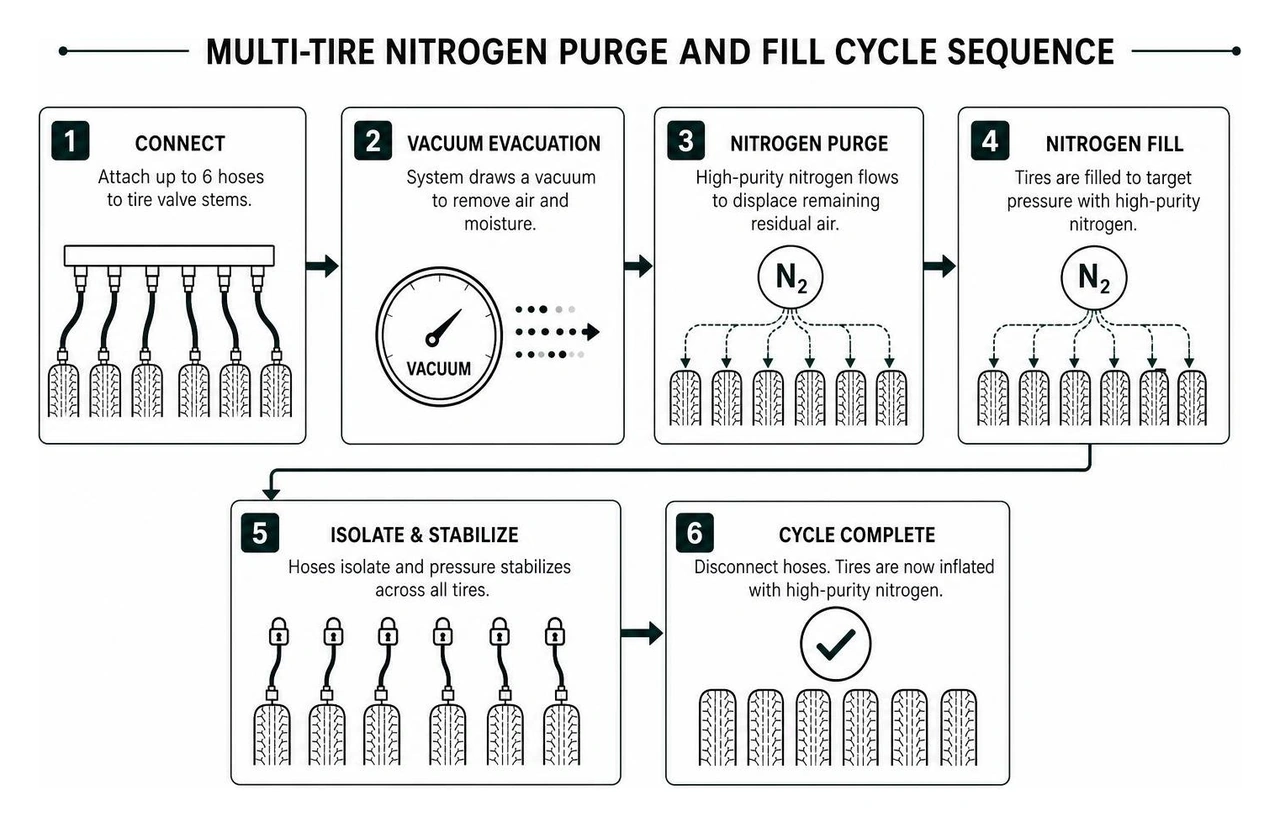
Advanced units utilize automated vacuum-evacuation cycles. The system draws a vacuum on the tire assembly to evacuate residual atmospheric air and moisture before initiating a high-purity nitrogen purge and fill. This automated sequence achieves 96% to 98%+ purity in a single unattended cycle, freeing technicians to conduct brake inspections, undercarriage diagnostics, or commercial car lift rack services. By reducing the number of manual fill steps, shops can process more vehicles per shift without adding headcount or extending service hours.
Compressed Air Integration and Maintenance
A nitrogen generator's performance is strictly governed by the quality of the air fed into it. Bulk moisture, compressor oil aerosols, and particulate matter will foul PSA sieves and contaminate separation membranes.
Every commercial installation demands a robust upstream filtration train featuring high-efficiency water separators, particulate pre-filters, and oil-coalescing filters. Shop managers should adhere strictly to an air compressor preventative maintenance guide to ensure desiccant dryers, oil-water separators, and auto-drains operate within manufacturer specifications. Maintaining proper inlet pressures (typically 100 to 217 PSI) ensures peak generation efficiency and protects internal pneumatic components. Consistent inlet pressure also prevents short-cycling of the generator and helps maintain stable nitrogen purity during simultaneous multi-tire service.
Commissioning Checklist for Reliable Nitrogen Service
Experienced shop planners treat a nitrogen generator as part of a compressed-air and service-process system, not as a standalone cart. Before installation, document the compressor's available capacity during peak demand, line pressure at the proposed generator connection, filtration and dryer condition, hose routing, and the number of bays expected to run simultaneous tire services. A simple baseline gives managers a way to verify whether the installed system is delivering the throughput and purity specified by the equipment manufacturer.
During commissioning, AutoTech Solutions can help align the generator, upstream filtration, storage, and service workflow with the facility layout. The practical goal is to avoid common implementation failures such as installing a high-output unit on an undersized air line, relying on overdue filters, or placing a mobile unit where technicians must repeatedly cross active service lanes. For a broader review of supply requirements and layout considerations, see this guide to air compressor installation for automotive shops.
A trustworthy rollout also includes a written operating standard. It should state the target pressure source, purge or evacuation sequence where applicable, gauge-verification interval, filter-maintenance responsibilities, and the circumstances in which technicians should use conventional shop air to restore safe operating pressure before the next scheduled nitrogen service. This is important because nitrogen does not eliminate the need for inspections, leak repairs, or routine pressure management. AAA's overview of nitrogen-inflation myths and facts similarly notes that nitrogen is not a substitute for maintenance.
Top Nitrogen Equipment Configurations for Commercial Shops
Facility layout, bay count, and fleet vehicle classes determine whether a centralized stationary generator or a mobile cart configuration is the most profitable choice. Commercial equipment layouts detailed in our automotive equipment solutions guide 2026 illustrate how strategically positioning high-volume pneumatic stations maximizes technician movement across busy bays.

High-Output Nitrogen Tire Inflation System Options for Commercial Fleets
For facilities handling high-volume commercial transports, municipal fleets, and heavy equipment, high-output stationary generators are essential. Units such as commercial-grade 26 CFM generators deliver the high-flow volume needed to fill large commercial casings—such as 12.00R x 22.5 tires—from 0 to 120 PSI in under 10 minutes.
Equipped with integrated 200- to 250-liter ASME nitrogen storage vessels, these systems handle continuous multi-tire inflation demands across multiple commercial service bays without starving downstream tools or compromising delivery purity. The storage capacity also allows the generator to build a nitrogen reserve during slower periods, so peak-demand cycles do not force technicians to wait for the system to catch up.
Mobile and Multi-Port Units for Fast Bay Turnaround
High-volume service centers, collision repair operations, and multi-bay commercial shops benefit extensively from mobile cart systems. Compact units mounted on heavy-duty casters can be wheeled directly to any lift rack or alignment bay.
Many portable systems operate purely on pneumatic shop air, eliminating the need for electrical cords while delivering 95% to 98% purity across up to five tire lines simultaneously. Programmable digital controls with automatic shut-off prevent over-pressurization errors and ensure precise PSI calibration across all serviced tires. Because the carts can move between bays, a single unit can support multiple work areas without requiring permanent plumbing changes or dedicated nitrogen drops.
Integrating Nitrogen Generation into Existing Shop Infrastructure
Installing a high-capacity nitrogen station requires auditing your facility's compressed air capacity, pipe sizing, and power distribution. Undersized air lines or insufficient compressor displacement lead to pressure drops that slow down nitrogen generation cycles.
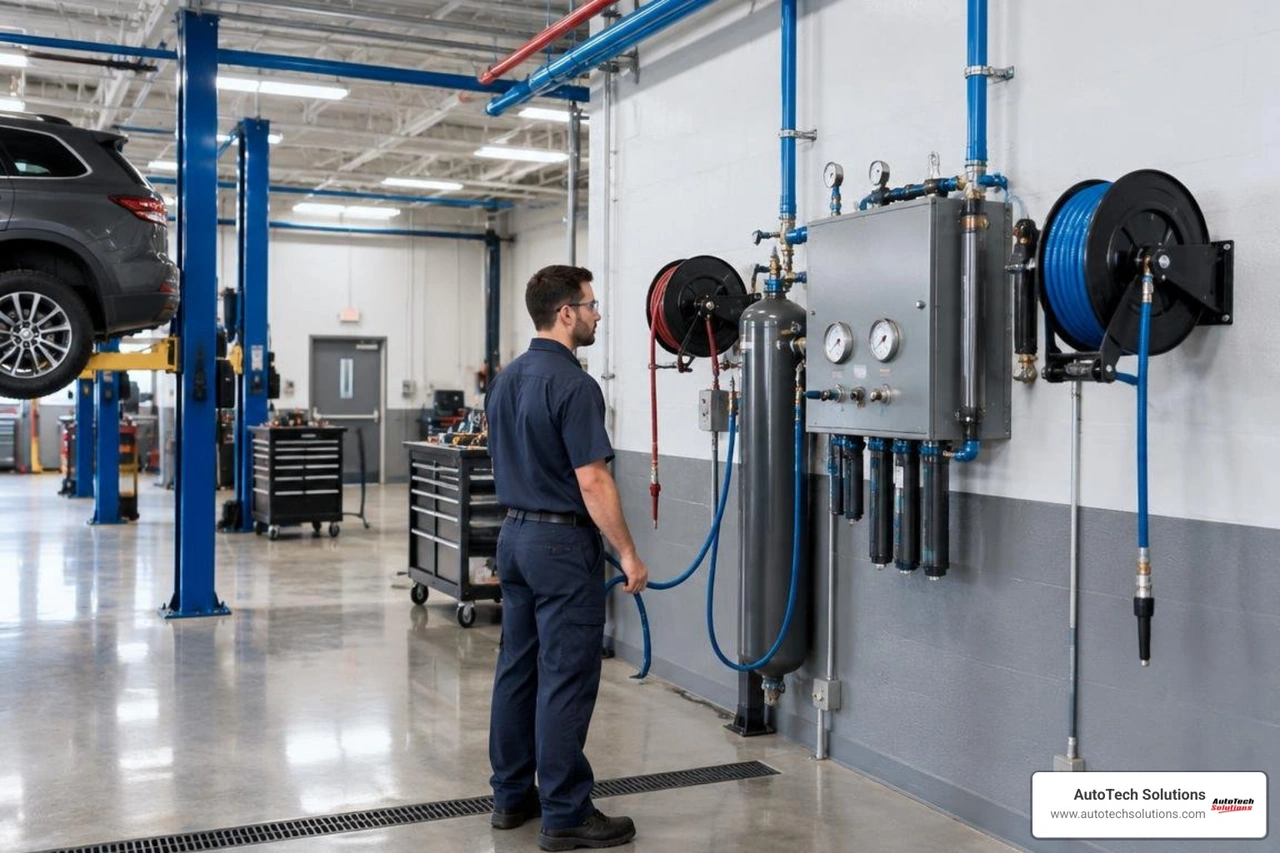
When designing a commercial pneumatic loop, review our complete compressed air systems guide for 2026 to ensure pipe diameters, header layouts, and receiver tank volumes match your total CFM demand. AutoTech Solutions engineers pneumatic infrastructure across Michigan to the Carolinas, sizing headers, zero-loss condensate drains, and dedicated nitrogen drops to guarantee steady airflow throughout heavy production shifts. A properly sized loop also prevents pressure fluctuations at the generator inlet, which helps maintain consistent nitrogen purity and reduces unnecessary wear on filtration components.
How Can a Commercial Shop Validate a Nitrogen System Before Purchase?
A commercial shop should validate a proposed nitrogen system against real operating conditions rather than relying on a purity percentage or a headline flow rating alone. Start with a one-week baseline of tire-service demand: record the number of simultaneous service events, typical pressure adjustments, technician time, compressor loading, and any delays caused by waiting for air recovery. That information helps determine whether a stationary generator, a mobile cart, or a staged deployment is the better fit.
Next, ask the supplier to define the conditions behind its performance claims. Useful questions include the required inlet pressure and air quality, expected output at the site's actual ambient conditions, supported number of connected service lines, storage capacity, maintenance intervals, and how purity is measured after a standard service cycle. Manufacturer specifications can vary materially by configuration; for example, one commercial inflator specification describes pressure-swing adsorption, integrated storage, and nitrogen purity above 95 percent, but the correct configuration still depends on the shop's demand profile and air system capacity.
Finally, establish an acceptance checklist for installation day. Verify that gauges are calibrated, drains and filters are accessible, service hoses reach the intended bays without creating a trip hazard, and technicians have a repeatable process for documenting the completed service. This approach gives the shop a defensible basis for measuring bay throughput and service consistency after deployment.
Frequently Asked Questions About Commercial Nitrogen Inflation
Can commercial fleets mix nitrogen and standard compressed air?
Yes. Mixing standard compressed air into a nitrogen-filled tire is completely safe and causes no adverse chemical reactions. However, introducing ambient air dilutes the nitrogen concentration below the optimal 95%+ purity threshold, reintroducing moisture and accelerating normal pressure loss. Commercial fleet operators should top off with ambient air during emergencies to preserve proper load-carrying inflation, then schedule a complete nitrogen purge and refill at the next scheduled maintenance interval. This approach keeps vehicles roadworthy in the short term while restoring the full benefits of nitrogen inflation during planned service.
What compressed air purity is required upstream of a nitrogen generator?
Commercial nitrogen generators require dry, oil-free compressed air. Inlet air must pass through sub-micron particulate filtration and high-efficiency coalescing oil-removal filters that limit residual oil aerosols to less than 0.01 mg/m³. Excess liquid water or oil mist will permanently contaminate the carbon molecular sieve in PSA units or clog the micropores of separation membranes, causing irreversible capacity degradation. Shops should also monitor dew point and drain intervals on upstream dryers, because moisture carryover can shorten the service life of both filtration media and the generator itself.
What is the typical ROI timeline for commercial nitrogen inflation equipment?
Commercial facilities typically realize a complete return on investment within 4 to 9 months. ROI is driven by billable fleet maintenance packages, increased bay turnaround speed, and high customer retention for ongoing fleet tire management contracts. Because modern systems automate the evacuation and inflation cycles, shops capture new billable services with virtually zero added technician labor hours. In addition, fleets that see measurable improvements in tire life and fuel efficiency are more likely to renew long-term maintenance agreements, creating recurring revenue beyond the initial equipment purchase.
Optimizing Commercial Bay Operations with AutoTech Solutions
Upgrading your commercial facility with advanced tire service equipment streamlines bay workflow, safeguards high-value fleet assets, and expands high-margin service capabilities. Whether your shop operates out of Charlotte, NC, Raleigh, NC, Wade, NC, or Novi, MI, AutoTech Solutions provides commercial equipment sales, professional car lift installation, certified maintenance, and layout planning required to maximize bay productivity.
Our field service technicians and system specialists ensure your shop air infrastructure, lifts, and tire service platforms work together seamlessly with zero unplanned downtime. Contact our team today for professional shop design and equipment consulting to configure the optimal nitrogen generation system for your commercial bays.