Why Paint Booth Airflow Validation Directly Affects Your Shop's Bottom Line
Paint booth airflow validation is the process of measuring, verifying, and documenting the air velocity and volume moving through your spray booth to confirm it meets safety standards, regulatory requirements, and manufacturer design specifications.
Quick answer — here's what you need to know:
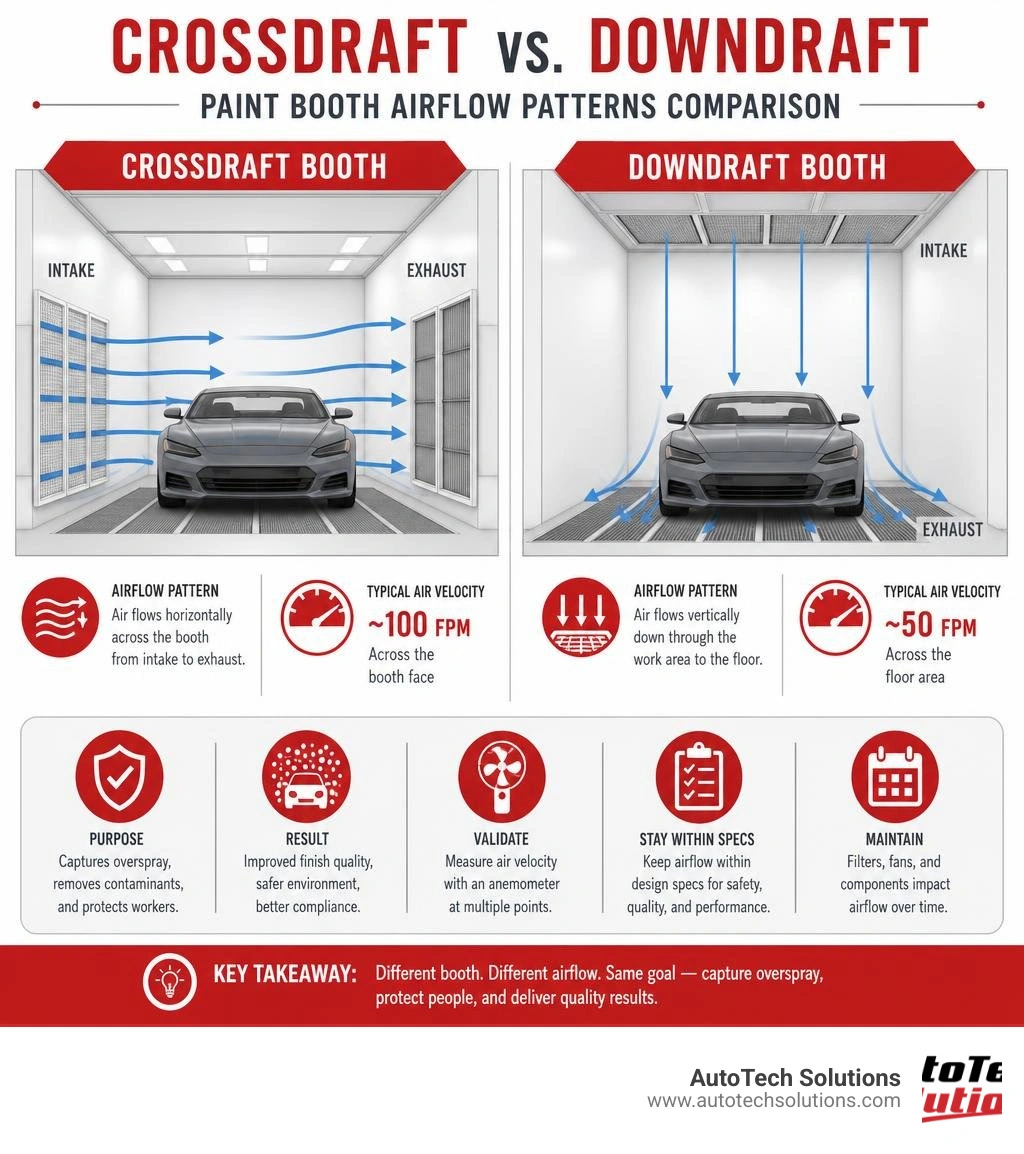
- Crossdraft booths should deliver approximately 100 FPM (feet per minute) across the booth face.
- Downdraft and side downdraft booths should deliver approximately 50 FPM across the floor area.
- Validation uses instruments like vaneometers or digital anemometers to take multiple readings across the booth and compare them to design specs.
- Key standards that govern this process include OSHA 29 CFR 1910.107 and NFPA 33.
- A booth that looks like it's working can still be operating outside acceptable airflow limits — which creates real safety and quality risk.
For collision and industrial facility managers, this is not a minor technical detail. When airflow is off — even slightly — the consequences stack up fast. Overspray doesn't capture properly. VOC concentrations climb. Finish quality drops. And in high-volume automotive production environments, contamination-driven defects can bring a line to a halt at operating costs that industry sources put at $500,000 to $1,000,000 per hour.
The challenge is that most shops treat airflow as a "set it and forget it" part of the booth installation. Filters load up. Fan belts wear. Blades accumulate buildup. Over time, the airflow you commissioned the booth with is not the airflow you're actually running — and nobody has checked.
This guide walks you through exactly how to validate your paint booth airflow, what tools to use, how to interpret the results, and how to build a program that keeps your booth performing the way it was designed to.
Understanding Airflow Standards and Booth Configurations
To validate your airflow, you first have to understand the specific engineering dynamics of your booth. Airflow isn't a one-size-fits-all metric. Different configurations move air in completely different directions, which fundamentally changes how you measure their performance.
There are four primary booth configurations commonly found in commercial shops:
- Crossdraft: Air enters through filters in the front doors and is drawn horizontally across the vehicle, exiting through exhaust filters at the back.
- Downdraft: Air enters through a fully filtered ceiling plenum and is drawn straight down around the vehicle, exiting through a grated floor exhaust pit.
- Side Downdraft: Air enters through a ceiling plenum and is drawn down over the vehicle, but exits through exhaust plenums built into the lower side walls of the booth.
- Semi-Downdraft: Air enters through a ceiling plenum at the front of the booth and is drawn diagonally down and back toward an exhaust chamber at the rear.
For a deeper dive into how these configurations operate mechanically, you can explore this guide on Paint Booth Ventilation | Different Airflow Styles Explained. If your shop is planning a structural upgrade, our team's overview of Downdraft Paint Booth Installation offers a detailed look at setting up high-performance extraction systems.
Airflow Metrics: FPM vs. CFM
When discussing airflow, we use two primary units of measurement: Feet Per Minute (FPM) and Cubic Feet Per Minute (CFM).
- FPM (Velocity): This is the speed at which the air is moving. It is the target metric you measure with hand-held instruments during validation.
- CFM (Volume): This is the total volume of air moving through the booth per minute. This is an engineered value calculated by multiplying the air velocity (FPM) by the cross-sectional area of the booth.
To understand how these numbers align across different styles, you can refer to the Paint Booths by Airflow product specifications. For design calculations, the Paint Booth CFM Calculator is an excellent resource to determine the volume requirements for your space.
Below is a standard comparison of the performance benchmarks required for each major booth type:
| Booth Type | Target Air Velocity (FPM) | Calculation Basis | Typical Air Exchange Rate |
|---|---|---|---|
| Crossdraft | ~100 FPM | Width × Height of the booth face | ~2.5 air changes per minute |
| Downdraft | ~50 FPM | Length × Width of the booth floor | ~3.5 air changes per minute |
| Side Downdraft | ~50 FPM | Length × Width of the booth floor | ~3.5 air changes per minute |
| Semi-Downdraft | 50 to 75 FPM | Ceiling plenum cross-section | ~3.0 air changes per minute |
Why Paint Booth Airflow Validation is Critical for Commercial Shops
Why do we care so much about these numbers? Because in a commercial environment, keeping your airflow within these ranges is the boundary line between a safe, highly profitable operation and a liability-ridden, low-yield shop.
Safety and Regulatory Compliance
The most immediate reason to validate your airflow is compliance. Under OSHA 29 CFR 1910.107, conventional spray booths must maintain an average air velocity of at least 100 linear FPM across the open face or cross-section. For electrostatic spraying, where paint wrap is assisted electronically, the minimum drops to 60 FPM.
Additionally, NFPA 33 mandates that mechanical ventilation must be maintained during all spraying operations to dilute flammable solvent vapors. The goal is to keep vapor concentrations safely below 25% of the Lower Explosive Limit (LEL). If your airflow drops, those solvents linger, creating an immediate fire and explosion hazard.
Defect Prevention and Quality Control
From a pure quality perspective, improper airflow is the leading cause of finish defects. If velocity is too low, paint overspray dwells in the air instead of being immediately evacuated. This overspray settles back down onto the wet clear coat, resulting in heavy dry spray, orange peel, and hours of color sanding and polishing.
Conversely, if the airflow is too high or highly turbulent, it can pull dust, lint, and paint-booth ceiling fibers directly into the wet paint film. To learn more about how proper air movement prevents these issues, read about the mechanics of Air Flow and Ventilation of Paint Booths or review the guidelines on How to Know If You Have the Right Airflow for Your Paint Booth.
Minimizing Production Downtime
In high-volume B2B environments, such as major collision centers or manufacturing plants, a quality-driven line stoppage is incredibly expensive. If contamination-driven defect rates escalate and force an automotive line to pause, the operating losses can quickly reach $500,000 to $1,000,000 USD per hour. Regular validation keeps you ahead of these catastrophic failures.
The Core Methodology of Paint Booth Airflow Validation
To perform a successful paint booth airflow validation, you must use the right tools and follow a standardized testing methodology. You can't just stand inside the booth, hold up a hand, and say, "Yep, feels like 100 feet per minute."
Measurement Tools and Instruments
Several tools are available for measuring air velocity, ranging from budget-friendly field tools to highly precise laboratory-grade instruments:
- Dwyer Vaneometer: A highly economical, mechanical swing-vane anemometer. It costs around $35 and is popular for quick field checks. While its precision is lower than digital tools, it is incredibly durable and perfect for checking basic compliance.
- Digital Vane Anemometer (e.g., Kanomax 6800 or Proster): These devices use a small rotating turbine to measure velocity. High-end units like the Kanomax (~$900) offer outstanding precision and digital data logging. Budget options like the Proster are useful but often struggle to read velocities below 35 FPM, making them less reliable for low-velocity downdraft booths.
- Ultrasonic Anemometer: These advanced, multi-axis sensors use sound waves to measure velocity in two or three dimensions. They are ideal for measuring low flows (0 to 20 FPM) and have no moving parts to get gummed up by paint overspray.

For a complete look at visualizing air patterns to identify dead zones or turbulence, consult the E3379 Standard Guide for Critical Airflow Visualization, which outlines the use of tracer smoke to map air streams.
Step-by-Step Guide to Executing Paint Booth Airflow Validation
To get an accurate, representative picture of how air moves through your booth, follow this step-by-step testing protocol:
1. Prepare the Booth
- Ensure all doors are completely closed.
- Ensure the booth is running in its standard "spray" mode (not bake or flash-off).
- Verify that clean filters are installed, or document the current pressure drop on your magnehelic gauge.
2. Establish a Measurement Grid
Airflow is never perfectly uniform. To get a true average, you must divide the booth into a grid and take multiple readings.
- For Crossdraft Booths: Imagine a vertical cross-section grid across the width and height of the booth. Divide it into at least 9 equal zones (top-left, top-middle, top-right, center-left, etc.).
- For Downdraft Booths: Divide the floor area into a grid of at least 9 to 12 zones, taking measurements roughly 36 inches above the floor grates.
3. Take the Measurements
- Hold your anemometer sensor perpendicular to the direction of the airflow. If using a vane anemometer, ensure the air flows straight through the housing.
- Stand out of the way of the air stream as much as possible to avoid blocking or disrupting the flow with your body.
- Hold the sensor in place for at least 10 to 15 seconds per grid point to allow the reading to stabilize, then record the value.
4. Calculate the Average Velocity
Add all your grid measurements together and divide by the total number of points. For example, if you took 9 measurements in a crossdraft booth:
$$\text{Average Velocity (FPM)} = \frac{\text{Sum of all 9 readings}}{9}$$
Compare this average to your target design standard (e.g., 100 FPM for crossdraft).
5. Verify Enclosure Integrity
If you are validating a booth designed as a Permanent Total Enclosure (PTE), you must ensure it complies with the EPA's capture standards. According to METHOD 204 - CRITERIA FOR AND VERIFICATION OF A PERMANENT OR TEMPORARY TOTAL ENCLOSURE, all Natural Draft Openings (NDOs) must exhibit an inward facial velocity of at least 200 FPM, and the total area of NDOs cannot exceed 5% of the enclosure's total surface area.
For a structured validation template, you can reference the framework provided in the HVAC Validation Protocol to build your internal documentation.
Advanced Modeling and Mass Balance Calculations
For large-scale industrial facilities, physical measurements are often paired with mathematical modeling to validate worker exposure limits and solvent dilution rates.
A classic approach is the box model, which uses mass balance material usage rates to predict solvent concentrations inside the booth. In a validated research study of a real-size industrial spray booth, the room volume was 161 m³ with an exhaust airflow rate of 13.4 m³/sec (28,500 acfm).
To determine how well the air mixes, researchers calculated the Reynolds number, which came out to 242,800. This incredibly high number indicates highly turbulent airflow, which is ideal for rapid vapor mixing.
The study calculated a mixing factor ($k$) of 0.87 (where a value of 1.0 represents perfect instantaneous mixing). A $k$-value of 0.87 indicates slight "tunneling" or short-circuiting of the air, but still shows excellent dilution performance.
Interestingly, correlation analysis showed that predicted concentrations had the strongest relationship with the exhaust stack concentrations ($r = 0.923$), proving that measuring exhaust air is one of the most reliable ways to validate booth performance.
For advanced multi-chamber automotive booths, facilities often use Paint booth airflow control systems that dynamically adjust downflow velocities using motorized dampers. These systems are designed using complex Computational Fluid Dynamics (CFD) modeling to prevent paint particulates from migrating between robotic spray zones and manual inspection areas.
Troubleshooting and Correcting Airflow Underperformance
If your validation reveals that your airflow is outside design specifications, you need to diagnose the root cause immediately.
Diagnosing Mechanical and Filtration Failures
When airflow drops below compliance levels, the issue is almost always mechanical or filter-related. You can use our Paint Booth Repair Tips Guide to start troubleshooting, or consider these common failure points:
- Clogged Intake or Exhaust Filters: As overspray and dust load up your filters, resistance (static pressure) increases. This forces your exhaust fan to work harder, reducing the volume of air it can pull. Always monitor your magnehelic pressure gauge; a high pressure drop indicates it is time for a filter change.
- Worn or Slipping Fan Belts: Over time, V-belts stretch and wear. A slipping belt prevents the fan blade from spinning at its rated RPM, drastically reducing CFM.
- Paint Buildup on Fan Blades: Overspray that bypasses your exhaust filters will settle on the fan blades. This extra weight and altered blade profile destroys aerodynamic efficiency.
- Exhaust Motor Wear: Worn bearings or electrical winding degradation will cause the motor to pull high amperage and run below its target speed.
- Improper Damper Settings: If your booth has a bake cycle, check that the recirculating dampers are closing and sealing properly during the spray cycle.
If you find that your existing booth is structurally compromised or beyond simple repair, it may be time to look at a new Auto Body Paint Booth. For shops looking for a cost-effective alternative, we also list high-quality Used Auto Body Paint Booth for Sale to help keep your capital expenditures in check.
Integrating Validation into a Governed Maintenance Program
Airflow validation should not be a reactive response to a bad paint finish. To maximize uptime and protect your technicians, you must manage it as a governed performance system.
This means establishing clear, scheduled maintenance programs rather than waiting for a failure. For a comprehensive look at setting up these schedules, read our guide on Automotive Paint Booth Maintenance. If your team is stretched thin, outsourcing this to a professional Paint Booth Service ensures your equipment is calibrated by factory-trained technicians.
When planning long-term operational budgets, understanding the Paint Booth Installation Cost Guide can help you factor in the lifecycle cost of high-efficiency air makeup units and variable frequency drives (VFDs).
Cleaning Cadences and Contamination Control
Airflow and cleanliness are deeply connected. If your booth walls and floors are coated in dry overspray dust, the incoming air velocity will constantly kick those particles up into your paint jobs.
- Overspray Capture: Ensure your dry separation filters or wet scrubber systems are cleaned weekly to prevent static pressure spikes.
- Transfer Points: Clean the conveyor rails, door seals, and adjacent areas to prevent dirt from migrating into the cabin.
- Adjacent Spaces: Airflow validation must extend to your Paint Mixing Room Equipment, where dedicated exhaust ventilation is required to keep chemical fumes from escaping into the main shop floor.
- Drying Systems: If you are using a modern Waterborne Paint Drying System, ensure the auxiliary air-amplifying nozzles are clean and free of paint buildup, as they rely on clean, high-velocity air streams to flash off water-based coatings quickly.
Frequently Asked Questions about Paint Booth Airflow
What is the difference between FPM and CFM in a paint booth?
FPM (Feet Per Minute) measures air velocity—how fast the air is moving at a specific point. CFM (Cubic Feet Per Minute) measures air volume—the total quantity of air moving through the entire booth. They are related by the formula:
$$\text{CFM} = \text{Area (sq. ft.)} \times \text{Velocity (FPM)}$$
Why do downdraft booths require lower FPM than crossdraft booths?
Downdraft booths are assisted by gravity. Because the air moves straight down, overspray is naturally pulled down toward the floor grates. Crossdraft booths must fight gravity to pull overspray horizontally across the entire length of the booth, which requires a higher velocity (100 FPM vs. 50 FPM) to prevent paint particles from settling prematurely.
How often should a commercial shop validate its paint booth airflow?
We recommend validating your airflow at least once every quarter, or immediately following any major filter replacement cycle. If your shop runs multiple shifts, monthly validation is highly recommended to catch belt wear and fan degradation before they impact production quality.
Conclusion
Validating your paint booth airflow doesn't have to be overwhelming. By understanding your booth's design, using the right digital or mechanical measurement tools, and establishing a regular testing grid, you can easily maintain compliance and protect your shop's bottom line.
At AutoTech Solutions, we are your one-stop-shop for automotive equipment sales, installation, service, and preventative maintenance. Our ultimate goal is minimizing your downtime with expert support and rapid repair response across Michigan and the Carolinas.
Whether you need a routine calibration, a complete system repair, or a brand-new setup, we are here to support your operations from Novi, MI down to Charlotte, Raleigh, and Wade, NC.
Ready to optimize your facility's performance? Contact us today to learn more about our professional AutoTech Solutions Facility Buildouts and custom preventative maintenance plans.