Why Paint Booth Rapid Repair Is the Bottleneck Costing Your Shop Money
Paint booth rapid repair is the process of restructuring your collision shop's spray and cure workflow — using smarter scheduling, parts-off painting, advanced curing technology, and integrated fast-repair bays — to push more vehicles through each day without sacrificing finish quality.
Quick answer: How do you set up a rapid repair workflow?
- Remove parts before painting — group panels from multiple vehicles into a single booth cycle
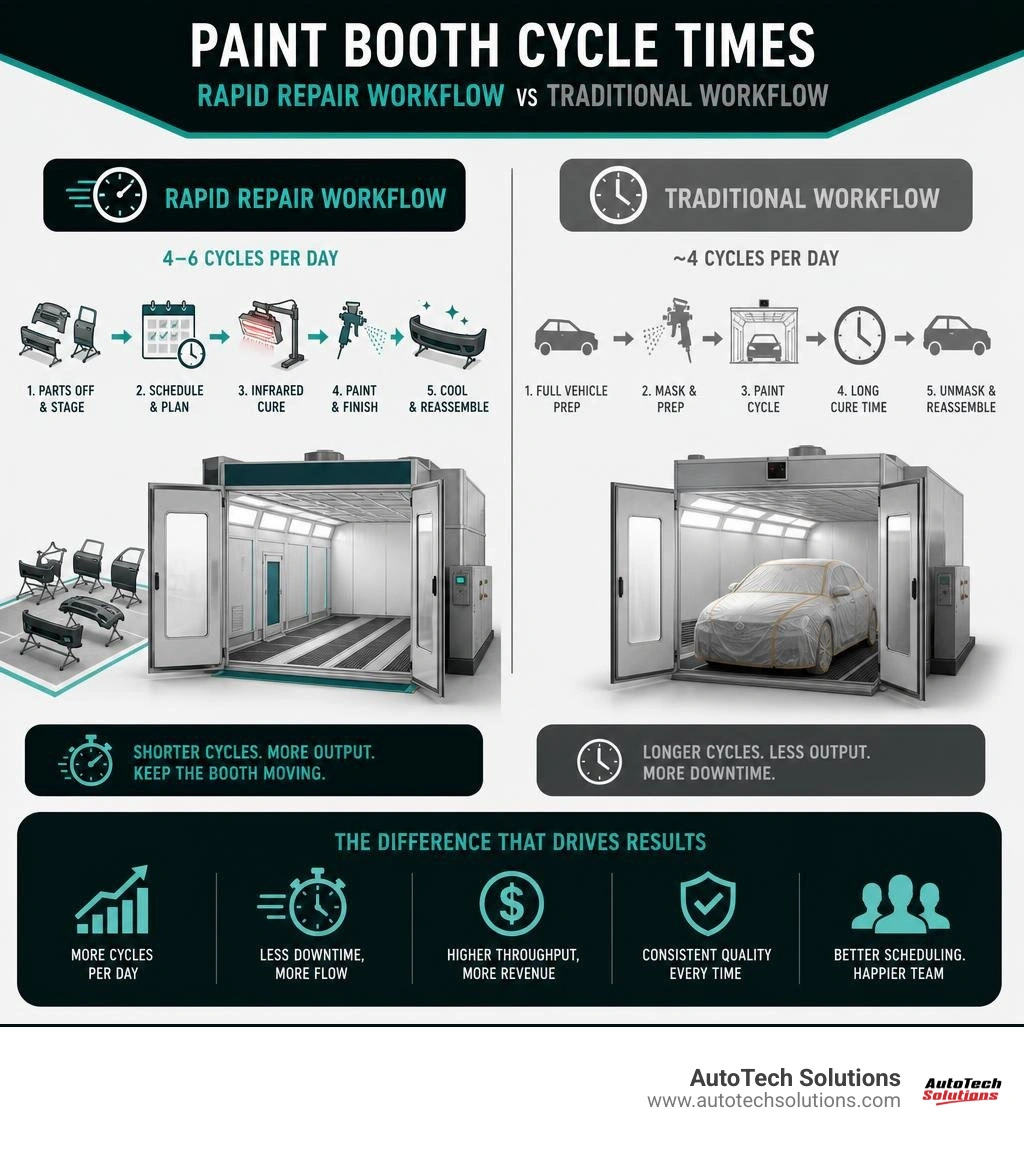
- Build a daily booth schedule — target 4 to 6 cycles per day with one buffer cycle built in
- Use infrared curing systems — cut cure times by 20+ minutes per cycle
- Apply floor staging — pre-organize parts outside the booth using a 3-foot spray zone boundary
- Upgrade prep bays — convert them to filtered rapid repair stations for small cosmetic jobs
In a busy collision shop, the paint booth is almost always the bottleneck. Most shops average just four booth cycles per day. That gap between four cycles and the six that high-performing shops achieve represents thousands of dollars in unrealized revenue every single month.
The good news? Many of the biggest gains come from process changes, not capital expenditure. Smarter staging, tighter scheduling, and the right curing equipment can transform what your existing booth produces — often without buying a second one.
At AutoTech Solutions, we work directly with collision and industrial facilities across Michigan and the Carolinas to design, install, and maintain professional shop equipment—from advanced paint booths to professional car lift installation—that makes rapid repair workflows actually work — and in this guide, we'll walk you through exactly how to build one.
Implementing a Paint Booth Booth Rapid Repair Workflow
To transform your production floor into a high-efficiency environment, you must move away from treating every vehicle as an isolated, single-unit job. A true paint booth booth rapid repair workflow treats the painting phase as a manufacturing assembly line. This relies on spatial discipline, process grouping, and keeping the booth running with minimal downtime.

Implementing this workflow requires an understanding of how parts move through your shop. If you are struggling with draft issues, burner failures, or uneven airflow, consult our paint booth repair tips guide to get your hardware running at peak performance first. Once your booth is mechanically sound, you can optimize your workflow by stocking up on the right auto body paint shop supplies and executing the core principles of rapid repair: parts-off painting and job grouping.
Maximizing Cycle Times with Parts-Off Painting
In traditional "parts-on" refinishing, a vehicle with a damaged fender and door is rolled directly into the booth. The entire vehicle takes up the cabin, requiring extensive masking to protect the rest of the car from overspray. This occupies the entire booth for a single, relatively small job.
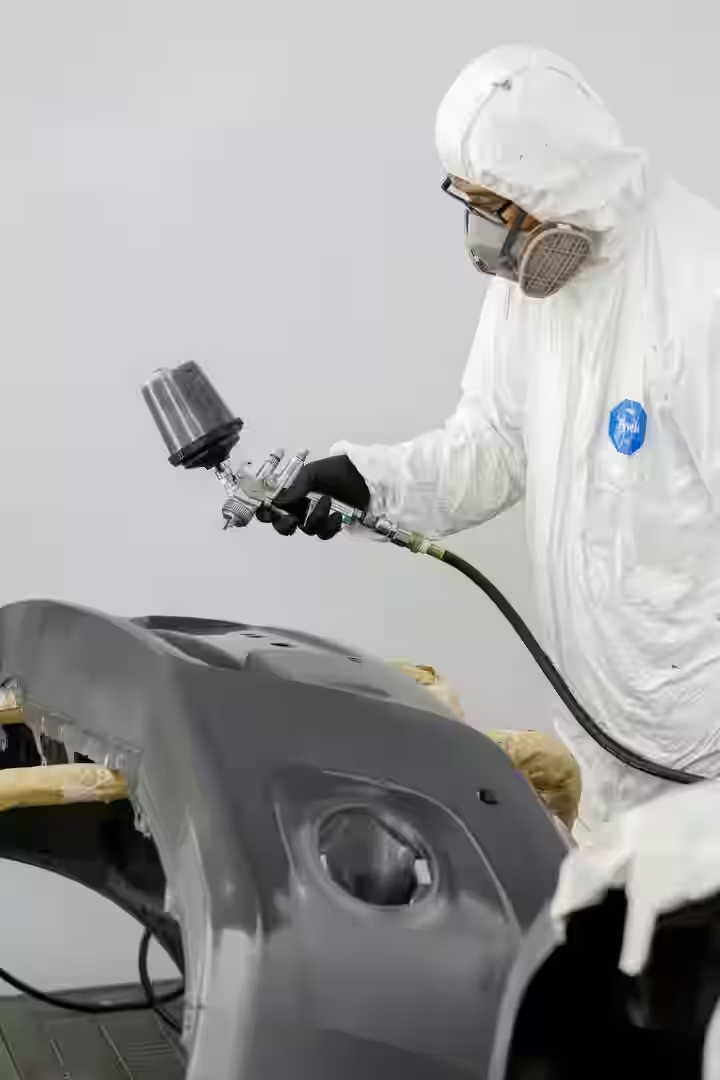
With parts-off painting, technicians remove the damaged panels from the vehicle before they ever reach the refinish stage. The vehicle remains in the assembly or prep area, while the individual parts are mounted on specialized stands and brought into the booth.
This approach offers significant advantages:
- Higher Part Density: You can place a bumper from one car, a door from a second, and a fender from a third into a single booth cycle.
- Minimized Masking Time: Spraying loose parts eliminates the hours spent masking off windshields, wheels, and trim.
- Superior Finish Quality: Painters can position loose parts at the perfect angle, minimizing runs and dry spray.
By adopting this strategy, highly efficient shops average around 12 refinish hours per cycle. Completing four to six cycles a day translates to an impressive 48 to 72 refinish hours per day, per booth. To achieve these numbers, you need a high-quality, commercial-grade auto body paint booth that can handle rapid, continuous cycles without losing temperature or air pressure.
Minimizing Material Waste and Overmixing
In a high-volume paint shop, material waste is a quiet profit killer. Because painters fear running out of sealer, basecoat, or clearcoat midway through a spray pass, they routinely overmix. On average, painters mix an extra 2 to 3 ounces of material per job as a safety margin. Over the course of a year, those wasted ounces add up to thousands of dollars in discarded paint.
To minimize this waste:
- Leverage Paint Mixing Software: Modern mixing systems calculate exact liquid volumes based on the specific panels being sprayed. Ensure your technicians are fully trained on your paint mixing room equipment to utilize these precise formulas.
- Group Similar Jobs: By scheduling jobs of the same color or those requiring the same undercoat sealer back-to-back, painters can share that 2-to-3-ounce safety margin across multiple jobs instead of throwing it away.
- Optimize Equipment Cleanup: Ensure your team uses an efficient spray gun cleaning machine to reduce solvent waste and keep spray patterns consistent, which improves transfer efficiency and further cuts paint consumption.
Advanced Curing and Ventilation Technologies for Fast Cycles
Even the most disciplined shop will hit a hard ceiling on productivity if they rely solely on traditional convection baking. Waiting for a standard booth burner to heat the air, which then slowly warms the vehicle panels, is a major bottleneck.
Short-Wave Infrared Curing Systems
Short-wave electric infrared (IR) technology is a game-changer for rapid repair. Unlike traditional convection systems that heat the surrounding air, short-wave IR energy penetrates directly through the paint layers to heat the metal or plastic substrate beneath.
This inside-out heating method offers several distinct operational benefits:
- Rapid Electric Infrared Curing: The curing time for both preparation fillers and topcoats can be reduced by hours, allowing technicians to complete repairs much faster.
- Instant On/Off Performance: IR lamps reach full curing temperature immediately and cool down just as fast, meaning they consume zero energy when not actively curing.
- Substrate-Specific Control: Advanced dual-cassette systems feature independent sensors and controls on each cassette. This allows you to safely cure different substrates—such as a plastic bumper and a steel door—simultaneously at their respective safe temperatures.
Using an advanced system like the REVO Rapid Accelerated Curing System cures primer more than 20 minutes faster than traditional heat lamps, enabling shops to easily process at least one additional car per day. Integrating these systems can lead to a 20% to 40% increase in overall shop productivity.
Because electric infrared energy costs are a fraction of the cost to run a conventional gas-fired heating system, the equipment can pay for itself within the first year of operation. However, because these systems involve intense heat and electrical loads, they must be installed and maintained in strict compliance with NFPA 33 (for spray application) and NFPA 86 (for curing and drying). For regular safety audits and lamp replacements, rely on certified curing lamp maintenance and repair services. Additionally, pairing IR technology with a dedicated waterborne paint drying system will maximize flash-off speeds for waterborne basecoats.
Closed-Top Open-Front (CTOF) and Integrated Fast-Repair Systems
For minor cosmetic repairs and spot painting, rolling a vehicle into a full-sized downdraft booth is highly inefficient. This is where Closed-Top Open-Front (CTOF) booths and integrated fast-repair systems, such as the REPIT vision Fast-Repair Systeme , come into play.
These systems consolidate prep, spraying, drying, and finishing into a single, dedicated workspace, completely eliminating the need to move the vehicle between different stages of the repair.
To support this continuous workflow without sacrificing air quality, these systems utilize advanced ventilation designs:
- Textile Air Distribution (TAD): Specialized flow ceilings use fabric ducts to distribute air evenly across the painting zone, directing overspray away from the technician and the painted surface. These fabric ducts can be easily removed for cleaning.
- Wall Extraction Systems: When floor excavation for a traditional pit is impossible or too costly, side-wall extraction systems can be engineered to pair with TAD ceilings, pulling air horizontally across the work area to capture overspray.
- Multi-Bay Efficiency: Some advanced setups allow a single ventilation machinery unit to power up to four adjacent working bays, significantly reducing the equipment's physical footprint and energy consumption.
If you are considering integrating one of these advanced systems into your shop, consulting with experts on downdraft paint booth installation will ensure your shop layout, air balance, and electrical hookups are designed for maximum efficiency.
Spatial Discipline: Floor Staging and Parts Organization
An efficient rapid repair workflow requires strict spatial discipline. If painters have to squeeze past loose parts or worry about overspray landing on adjacent components, cycle times will slow down.
| Staging Element | Traditional Staging | Rapid Repair Floor Staging |
|---|---|---|
| Part Placement | Placed haphazardly wherever space is open. | Pre-staged in a taped-off 3-foot "spray zone" outside the booth. |
| Color Grouping | Mixed colors sprayed in the same cycle without planning. | Different colors kept at least 3 feet apart or grouped by color family. |
| Wall Clearance | Parts placed directly against booth walls. | Strict 3-foot clearance from all walls to maintain airflow. |
| Scheduling | Reactive; cars painted as they are finished prepping. | Proactive; structured daily schedule with built-in buffer cycles. |
Keeping your booth clean is also vital to maintaining this spatial discipline and preventing airborne dust from ruining fresh finishes. Working with professional Paint Booth Cleaning & Maintenance Services ensures your walls, floors, and glass remain free of overspray buildup, keeping your working environment bright and safe. For ongoing upkeep, establish a strict routine using our guide on automotive paint booth maintenance.
The 3-Foot Rule and Color Contamination Prevention
To prevent cross-contamination and ensure the painter has adequate room to maneuver, we recommend implementing the 3-foot rule:
- Wall Clearance: All parts must be placed at least 3 feet away from any booth wall. This allows the painter to walk completely around the parts and spray from a consistent distance without having to lean over or squeeze against the wall.
- Color Separation: If you are spraying different colors within the same booth cycle (e.g., a black bumper and a white fender), they must be kept at least 3 feet apart. This spacing, combined with proper airflow management, prevents dry overspray from one part settling on and contaminating the other.
- Floor Staging: Tape off a simulated "spray zone" on your shop floor directly outside the booth entrance. Before loading the booth, pre-stage the parts within this taped zone. If they do not fit comfortably within the taped boundaries while maintaining the 3-foot rules, they will not fit in the booth.
Applying these rules in a high-capacity industrial paint booth will dramatically reduce the need for post-paint buffing and nibbing, saving your shop valuable time and labor.
Building a High-Throughput Booth Schedule
A successful rapid repair operation does not run on a first-come, first-served basis. It runs on a highly structured booth schedule.
To target 4 to 6 cycles a day, your schedule should be managed on a dry-erase board mounted directly next to the booth or mixing room. When building your daily schedule:
- Group by Undercoat/Sealer: Group jobs by their required sealer color (e.g., light gray, medium gray, dark gray) to minimize gun changes and cleaning times.
- Isolate Special Finishes: Schedule tri-coats and complex multi-stage finishes in their own dedicated slots, ideally at the start or end of the day when painters are most focused.
- Build in a Buffer Cycle: Always schedule one extra "filler" cycle in the middle of the day. This acts as a buffer. If the shop is running ahead of schedule, you can pull small parts or quick spot repairs into this slot. If a complex job runs behind, the buffer absorbs the delay without throwing off the rest of the day's schedule.
To keep your equipment reliable enough to support this demanding schedule, make sure to schedule routine paint booth service with a qualified technician who can catch minor wear-and-tear issues before they turn into unexpected downtime.
Frequently Asked Questions about Rapid Refinish Systems
What is a paint booth booth rapid repair bay?
A rapid repair bay is a specialized, multi-functional work zone designed to handle small, localized cosmetic repairs from start to finish. Unlike standard prep bays that are only meant for sanding and masking, a Rapid Repair Bay | Prep Bays is equipped with a fully filtered air ceiling and integrated extraction fans. At the push of a button, the bay transforms into a clean, filtered spraying environment, allowing technicians to prep, paint, and cure minor damage without ever moving the vehicle.
How does a paint booth booth rapid repair system reduce cycle times?
By consolidating the entire repair process into a single bay, these systems eliminate the need to repeatedly move the vehicle between the prep stall, the paint booth, and the detailing area. Consolidating these steps minimizes the risk of dust contamination during transit and frees up the primary downdraft booth for larger, multi-panel collision repairs. Combined with localized short-wave infrared drying, shops can achieve a substantial productivity increase, often processing 20% to 40% more vehicles per day.
Can existing prep bays be converted for rapid repair?
Yes, many traditional prep bays can be retrofitted and converted into rapid repair stations. This conversion typically involves installing high-efficiency intake fans, adding a fully enclosed, filtered ceiling plenum, and integrating localized extraction systems (either through the floor or via a specialized wall-extraction unit).
If you are considering upgrading your shop's footprint, reviewing our paint booth installation cost guide will help you evaluate the return on investment of converting an existing bay versus installing a completely new standalone system.
Conclusion
Transitioning your shop to a high-throughput rapid repair model is one of the most effective ways to unlock hidden capacity, reduce material waste, and boost your daily profitability. By embracing parts-off painting, implementing strict spatial discipline like the 3-foot rule, and utilizing advanced short-wave infrared curing, you can easily push past the industry average of four cycles a day.
However, even the most efficient workflow will ground to a halt if your equipment breaks down. At AutoTech Solutions, we specialize in minimizing your downtime with expert equipment sales, professional car lift installation, and fast-response preventative maintenance for all your shop infrastructure. Whether you are looking to upgrade your prep bays, install advanced curing lamps, or schedule routine maintenance, we serve shops across Michigan and the Carolinas with dedicated, local support.
Ready to optimize your shop's layout and maximize your daily throughput? Contact the team at AutoTech Solutions today to explore our comprehensive Collision Center Solutions and keep your paint line moving.