Why Waste Oil Heater Repair Keeps Your Shop Running and Your Costs Down
Waste oil heater repair is something every automotive shop manager will face at some point -- and knowing how to respond quickly can mean the difference between a warm, productive shop and costly downtime.
Quick answers for the most common waste oil heater problems:
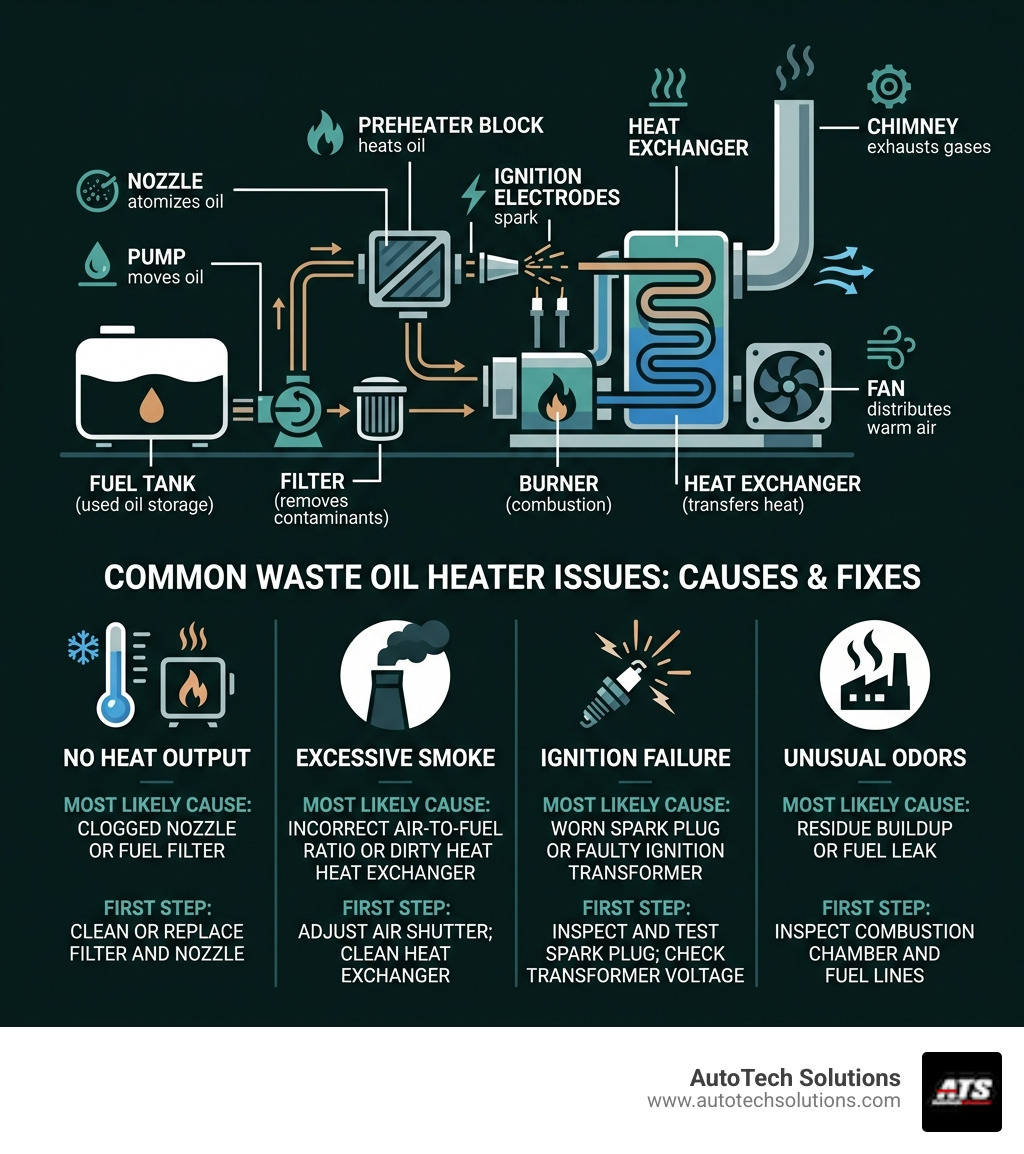
| Problem | Most Likely Cause | First Step |
|---|---|---|
| No heat output | Clogged nozzle or fuel filter | Clean or replace the filter and nozzle |
| Excessive smoke | Incorrect air-to-fuel ratio or dirty heat exchanger | Adjust air shutter; clean heat exchanger |
| Ignition failure | Worn spark plug or faulty ignition transformer | Inspect and test spark plug; check transformer voltage |
| Unusual odors | Residue buildup or fuel leak | Inspect combustion chamber and fuel lines |
| Power issues | Wiring fault or motor failure | Check circuit breaker and inspect wiring connections |
Waste oil furnaces are one of the most cost-effective heating solutions available to professional shops. They recycle used motor oil, transmission fluid, and other petroleum-based waste into free heat -- reducing both disposal costs and energy bills. According to the EPA's guidelines on used oil, recycling used oil benefits both the environment and the economy. In fact, one business saved over $32,000 per year simply by switching to waste oil heating.
But like any heavy-use equipment, these systems need consistent attention. Dirty fuel, neglected filters, and worn ignition components are the most common reasons a shop's furnace stops performing.
This guide walks you through exactly how to diagnose, fix, and maintain your waste oil heating system -- so your technicians stay warm and your operation stays profitable.
Simple guide to waste oil heater repair:
Troubleshooting Common Waste Oil Heater Repair Issues

When the temperature drops in Michigan or the Carolinas, a malfunctioning heater isn't just an inconvenience; it’s a threat to your shop's productivity. At AutoTech Solutions, we see a wide range of issues, but most fall into a few predictable categories. Understanding these symptoms is the first step toward a successful waste oil heater repair.
- No Heat: This is the most common "emergency" call. It often stems from a simple blockage in the fuel delivery system or a thermostat that has lost its calibration. Before panicking, check the basics: Is there fuel in the tank? Is the thermostat set at least 5 degrees above the room temperature?
- Excessive Smoke: Smoke is a billboard for incomplete combustion. If you see black or dark grey smoke billowing from the stack, your air-to-fuel ratio is likely off, or your heat exchanger is choked with ash.
- Unusual Odors: While waste oil heaters have a distinct "industrial" scent, a sharp, acrid smell or the scent of unburned fuel indicates a leak or a burner that isn't atomizing the oil correctly.
- Ignition Failure: If the burner cycles but never "catches," you're likely looking at a spark issue. This could be a fouled electrode or a failing transformer.
- Power Reliability: If the unit won't turn on at all or trips the breaker repeatedly, there is a fault in the electrical path.
For complex diagnostic needs, our Service Repair and Equipment Support team is always ready to get your infrastructure back online.
Diagnosing Fuel Flow and Ignition Problems
Fuel flow is the "circulatory system" of your furnace. If the oil doesn't reach the nozzle at the right pressure and temperature, the system fails. Clogged filters are the #1 culprit here. Because waste oil contains heavy particulates, filters can reach capacity quickly.
On the ignition side, the transformer is the heart of the spark. A typical ignition transformer should output between 10,000 and 20,000 volts. If your multimeter shows significantly less, the transformer needs replacement.
| Flame Color | Condition | Meaning |
|---|---|---|
| Bright Yellow/White | Optimal | Clean, efficient combustion; correct air/fuel mix. |
| Dark Orange/Red | Rich | Too much fuel or too little air; causes soot buildup. |
| Blue/Translucent | Lean | Too much air; can cause the flame to "lift" and go out. |
| Smoky/Flickering | Contaminated | Likely water or antifreeze in the fuel supply. |
Adjusting the Air-to-Fuel Ratio for Efficient Combustion
Achieving the perfect burn is a balancing act. Most modern units feature an air shutter and a fuel pressure regulator. To adjust for a clean flame, we recommend starting with the manufacturer's PSI settings—usually between 10 and 20 PSI depending on the model.
- Check the Air Shutter: If the flame is smoky, open the shutter slowly to introduce more oxygen.
- Monitor Fuel Pressure: Use a dedicated gauge to ensure the pump is delivering a steady stream.
- Flue Gas Analysis: For a truly professional setup, use a flue gas analyzer. You’re aiming for O2 levels between 2-4% and CO2 levels between 10-12%. This ensures you aren't literally "burning money" through inefficiency.
Component Cleaning and Maintenance Best Practices
In waste oil heater repair, cleanliness isn't just a virtue—it's a requirement for operation. Because waste oil produces more ash than standard #2 heating oil, the "cleanout" process is the most vital part of our Preventative Maintenance Programs.
Cleaning the Nozzle and Burner Assembly
The nozzle is a precision component with a very small orifice. Over time, heat causes oil to "coke" (turn into hard carbon deposits) inside the nozzle base.
- The Soak: Remove the nozzle and soak it in a high-quality parts solvent for several hours.
- Soft Touch: Never use a drill bit or wire to "poke" the nozzle hole, as this can distort the spray pattern. Use a soft brush or compressed air.
- The Nozzle Base: Don't forget the nozzle base passages. In some Shenandoah or Reznor models, coked oil can hide in the aluminum block, causing intermittent clogs that drive shop managers crazy.
Maintaining Fuel Quality to Prevent Waste Oil Heater Repair
The "free" fuel you're using is often the biggest threat to the machine. Motor oil is fine, but water contamination and high concentrations of synthetic oils can change the viscosity and burn characteristics.
- Settling Tanks: Always draw fuel from a point at least 6-12 inches above the bottom of your storage tank. This allows water and heavy sludge to settle where they won't be sucked into the pump.
- Centrifuge Cleaning: For shops processing massive amounts of oil (over 2,000 gallons annually), a centrifuge can be a wise investment to "polish" the fuel before it hits your filters.
- Testing: Periodically check your oil for antifreeze or water. If your fuel looks like a "chocolate milkshake," it's contaminated and will cause your heater to sputter and fail.
For more tips on keeping your equipment in top shape, check out our Automotive Shop Equipment Repair Guide.
Safety Protocols and Electrical System Diagnostics
Working on a waste oil heater involves high voltage, high heat, and flammable liquids. Safety is paramount. Always disconnect the power before opening the burner swing-door.
- PPE: Wear gloves and eye protection when handling waste oil or cleaning ash, which can contain heavy metals.
- Ventilation: Ensure your flue is clear. A blocked chimney can back-draft carbon monoxide into your service bays.
- High Voltage: The ignition transformer handles up to 20,000 volts. This isn't a "trial and error" component; use a multimeter and follow the manual.
Identifying and Fixing Electrical Faults
Electrical issues often manifest as "ghost" problems—the heater works fine one day and refuses to start the next.
- Thermostat Calibration: If the shop feels like an oven or a freezer regardless of the setting, the thermostat may need recalibration. Use a secondary thermometer to check the accuracy.
- Control Module: The "brain" of the unit manages the timing of the spark and fuel. If the module is scorched or smells like burnt electronics, it’s time for a replacement.
- Wiring Shorts: In a shop environment, vibrations and heat can cause wire insulation to crack, leading to shorts or intermittent power loss.
Our Preventative Maintenance Service Guide covers these electrical checks in greater detail to help you avoid unexpected shutdowns.
Professional Service vs. DIY Repair Decisions
We love a proactive shop manager who can handle a nozzle change or a filter swap. However, there are times when DIY becomes dangerous or voids your warranty.
- OEM Parts: We always recommend using Original Equipment Manufacturer (OEM) parts. Third-party parts might be cheaper upfront, but they often lack the precise tolerances required for high-temperature waste oil combustion. Using non-OEM parts can even void industry-leading warranties, like the 10-year/15,000-hour replacement warranty offered by top brands like Clean Burn.
- Heat Exchanger Cracks: If you suspect a crack in the combustion chamber, stop using the unit immediately. This is a major safety hazard and requires professional inspection and often a full refurbishing.
When to Call for Professional Waste Oil Heater Repair
If you've cleaned the nozzle, replaced the filters, and verified power, but the unit still won't fire, it's time to call in the experts. At AutoTech Solutions, we provide on-site service across Michigan and the Carolinas, bringing fully stocked trucks to handle everything from burner rebuilding to full system refurbishing.
Don't let a heater issue snowball into a week of lost labor. Much like the Common Causes of Automotive Lift Downtime, heater failure is usually preventable with the right professional partner. For more complex repairs, visit our Automotive Equipment Repair page.
Frequently Asked Questions
How often should I perform routine maintenance on a waste oil heater?
You should perform a full "seasonal" service at least once a year, ideally in the late summer before the cold hits. During peak winter usage, we recommend checking your fuel filters every 50-100 hours of operation and cleaning the ash out of the combustion chamber every 1,000 hours. A quick 30-minute monthly inspection of the burner head can prevent 90% of mid-winter breakdowns.
What causes my heater to produce excessive smoke or odors?
Excessive smoke is almost always caused by an improper air-to-fuel ratio (too "rich") or a dirty heat exchanger that is preventing proper airflow. Odors can also be caused by unburned fuel pooling in the bottom of the chamber due to repeated failed ignition attempts (known as "wetting" the chamber).
Can I burn synthetic oil in my waste oil furnace?
Yes, most modern waste oil heaters from reputable brands can handle synthetic oils. However, synthetic oil has different burn characteristics than conventional oil. If your shop uses a high percentage of synthetics, you may need to adjust your air shutter or fuel pressure to ensure a clean, hot flame.
Conclusion
At AutoTech Solutions, we understand that your waste oil heater is a critical piece of shop infrastructure. Whether you are in Novi, MI, or Raleigh, NC, our mission is to minimize your downtime with expert support and fast repair response. From simple waste oil heater repair tips to full-scale preventative maintenance programs, we are your one-stop-shop for keeping your bays warm and your business profitable.
Ready to ensure your shop stays warm this winter? More info about shop equipment services is just a click away. Let us handle the infrastructure so you can focus on the vehicles.