Car Dent Puller Machine Price: Commercial Shop Budget Snapshot
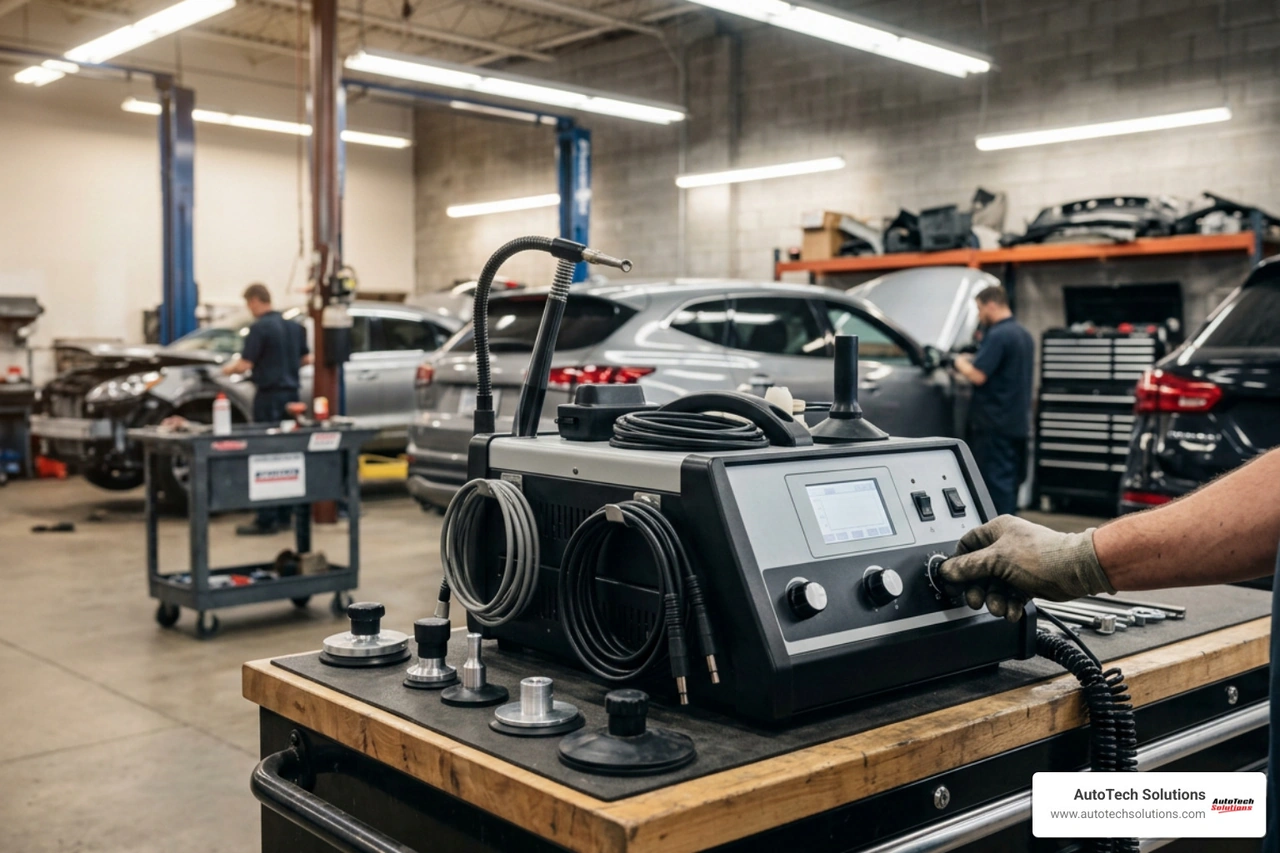
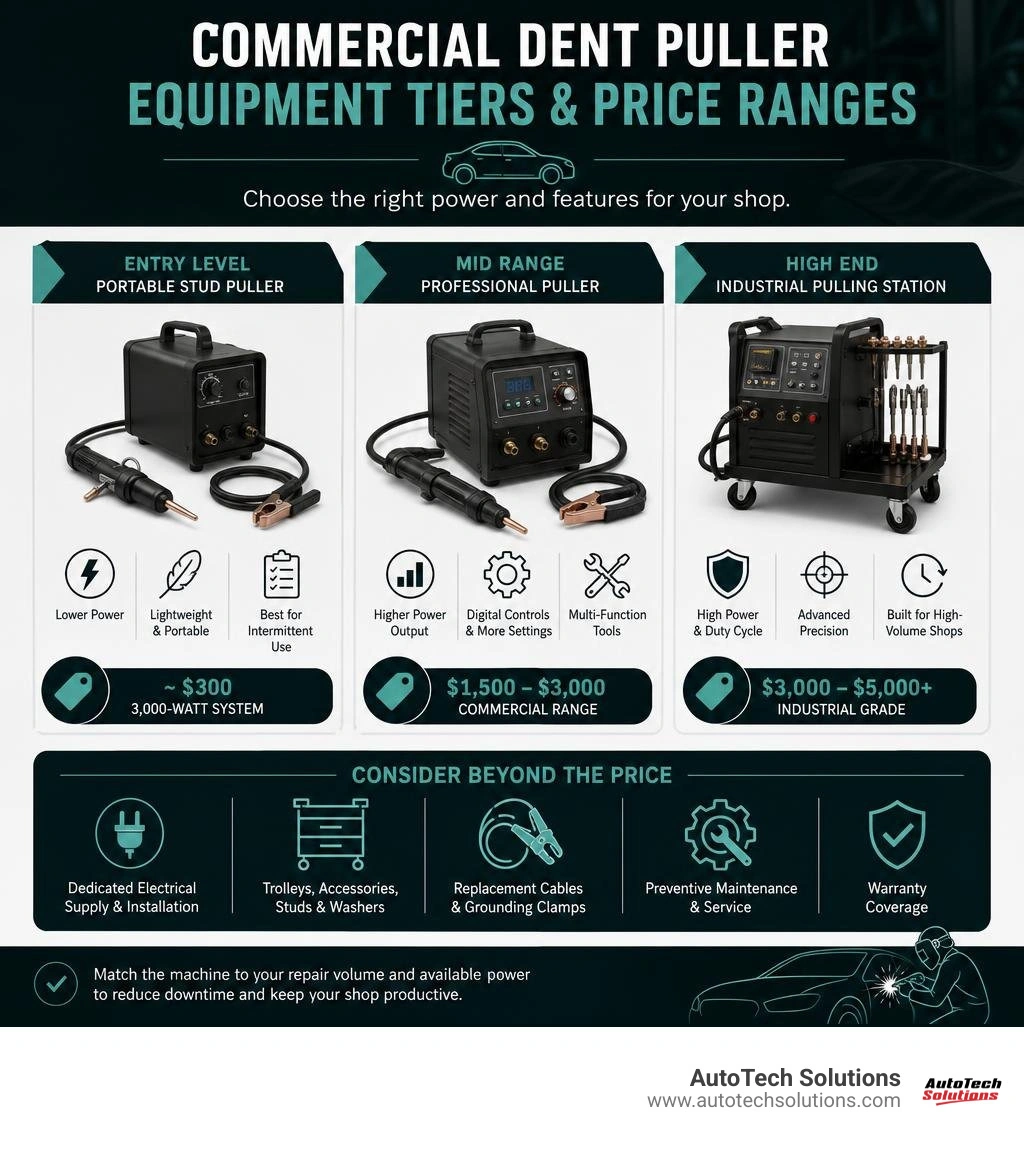
For commercial collision facilities, a car dent puller machine price can range from roughly $300 for a portable 3,000-watt stud-puller system to $1,500-$5,000+ for high-output, industrial-grade stations. Lower-priced professional units suit intermittent repair work. Higher-capacity systems add stronger current output, longer duty cycles, digital controls, multi-function pulling tools, and better support for busy shop workflows.
As a market reference, a 3,000-watt portable stud welder system is listed around $303 in the U.S. In India, commercial 9-10 KVA units commonly appear near Rs. 42,000 to Rs. 45,000, before freight, installation, and local service considerations.
The purchase price is only part of the investment. Shop managers should also budget for:
- Dedicated electrical supply and safe installation
- Mobile trolleys, pulling accessories, studs, and washers
- Replacement cables and grounding clamps
- Preventive maintenance and warranty coverage
The best value is not always the lowest-priced unit. A reliable machine matched to repair volume and available power can reduce technician delays and limit costly downtime.
AutoTech Solutions Staff helps collision and automotive facilities evaluate, install, and maintain professional repair equipment for dependable daily operation.
Explore more about car dent puller machine price:
Commercial Car Dent Puller Machine Price Factors and Benchmarks
Equipping a modern collision center requires balancing initial capital expense with long-term shop floor productivity. When evaluating the overall car dent puller machine price, commercial facility operators must look beyond the initial sticker price. Key variables such as transformer design, instantaneous power delivery, thermal management, duty cycles, and microprocessor controls dictate what a machine costs upfront and how reliably it performs during demanding multi-bay production schedules.
In a busy production environment, cheap equipment quickly becomes an expensive bottleneck. Selecting robust auto collision repair tools ensures your technicians can pull high-strength body panels without tripping breakers or overheating transformers mid-cycle.
| Equipment Tier | Input Power / Voltage | Peak Current Output | Primary Applications | Typical Commercial Price Range (USD) |
|---|---|---|---|---|
| Entry Commercial Portable | 110V / 230V Single-Phase (2.2 kW – 3.0 kW) | 1,500A – 2,500A | Light spot pulling, secondary bay repairs, low-gauge steel | $300 – $600 |
| Mid-Tier Industrial Mobile | 220V Single-Phase (5.0 kW – 9.0 kVA) | 3,000A – 3,800A | General collision repair, steel panel straightening, metal shrinking | $600 – $1,800 |
| High-Volume Production Station | 220V / 400V Multi-Phase (10 kVA – 21 kVA) | 3,800A – 5,600A+ | Heavy continuous panel reshaping, high-strength steels, multi-gun setups | $1,800 – $5,000+ |
Key Technical Specifications Driving Investment Costs
The internal engineering of a dent puller directly dictates both machine pricing and shop floor capabilities. A primary cost driver is the transformer construction. Commercial-grade systems, like the Spot welder Dent Puller Machine series, employ heavy-duty varnished pure copper transformers paired with PCB conformal coating. This protective layer shields delicate internal logic boards from ambient airborne metallic dust, grinding debris, and shop humidity.
Output current represents another substantial engineering benchmark. While basic benchtop welders operate under 2,500A, heavy collision environments demand industrial output. High-output units deliver instantaneous currents between 3,800A and 5,600A. A top-tier machine like the STL-DP100 Dent Puller Machine draws up to 21 kVA input power to generate 3,800A of output force, allowing instantaneous bonding without overheating the host panel. Higher instantaneous current shortens the weld duration (often to fractions of a second), which dramatically reduces heat-affected zones on vehicle panels and preserves structural integrity.
Input voltage configurations also affect capital investment. While 110V units offer localized convenience for secondary touch-ups, commercial facilities rely on dedicated 220V single-phase or three-phase connections to maintain continuous duty cycles without power fluctuation.
Assessing Entry-Level vs Professional Car Dent Puller Machine Price Tiers
Entry-level commercial systems ($300 to $600) typically provide manual output settings, air-cooled or passive thermal dissipation, and basic slide-hammer accessories. While capable of managing intermittent minor panel repairs, their lower duty cycles limit efficiency during back-to-back jobs.
In contrast, professional industrial workstations ($1,500 to $5,000+) integrate microprocessor-controlled synergy modes, dual-gun connections, pneumatic auto-extraction mechanisms, and heavy-gauge mobile carts with locking casters.
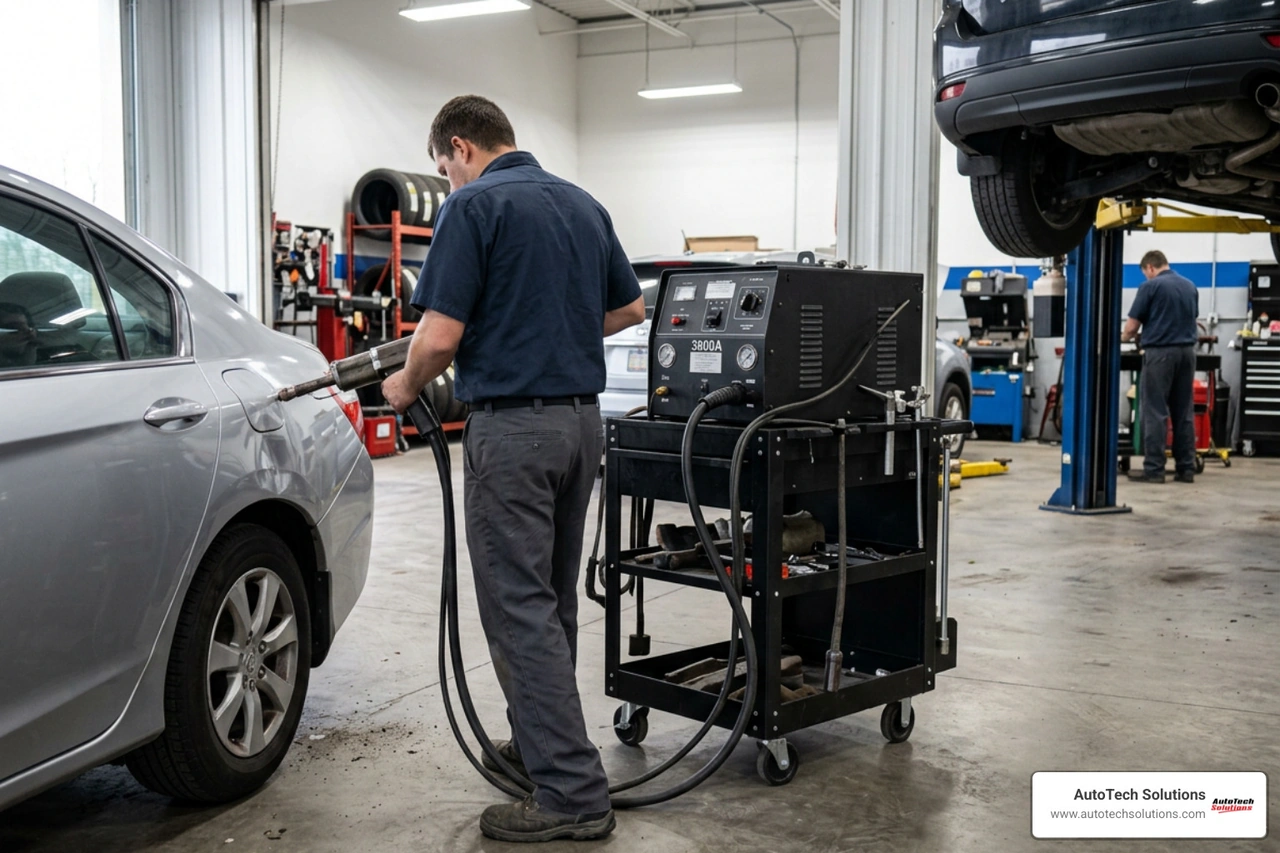
These high-tier units allow technicians to toggle instantly between spot welding, triangle washer bonding, wavy wire application, and carbon rod metal shrinking without changing tools. When integrated alongside heavy capital equipment such as an auto body shop frame machine, an industrial dent extraction station significantly accelerates workflow and cycle times across collision repair bays.
Comparing Commercial Dent Extraction Technologies
Collision facilities leverage several extraction technologies, each with unique price points, power footprints, and operational parameters. Matching the correct technology to your shop's repair mix is vital for optimizing return on investment.
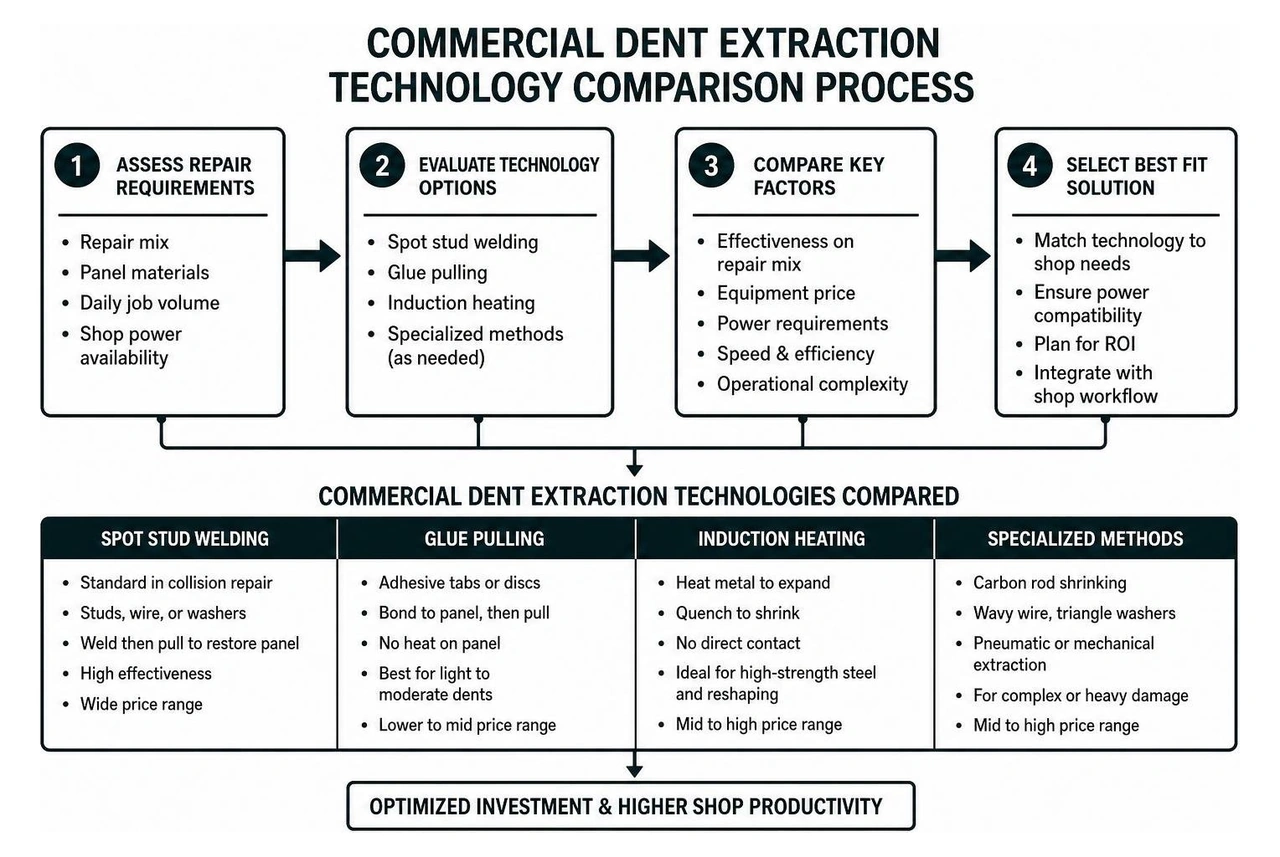
To keep complex electronic equipment performing at peak manufacturer specifications, regular collision center equipment maintenance is required across all bay infrastructure.
Stud Welder and Spot Dent Pulling Systems
Spot welding systems remain the standard equipment across commercial collision repair centers. These units operate by momentarily tacking consumable copper-coated steel studs, corrugated wire, or slotted washers onto damaged external surfaces. Technicians then apply calibrated mechanical or pneumatic leverage to draw the panel back to its factory contour.
High-power spot pullers often incorporate dual functionality:
- Automatic Pulse Timing: Electronic sensors trigger current delivery the moment the tool electrode contacts the panel, ensuring uniform weld depth and preventing burn-through on thin-gauge metals (0.4mm to 1.2mm).
- Thermal Metal Shrinking: Utilizing specialized copper or carbon electrodes, the machine delivers controlled localized resistance heating to release tension in stretched sheet metal, tightening expanded areas without requiring panel replacement.
Electromagnetic Induction and Paintless Dent Systems
Electromagnetic induction machines represent a specialized investment for high-end collision facilities and express repair centers. Rather than creating a mechanical weld, these systems project high-frequency magnetic fields into the steel panel.
The resulting eddy currents produce instantaneous localized heating beneath the paint layer. This thermal expansion causes the micro-structure of the dented metal to contract, popping out soft dings, hail damage, and minor outer panel deformations without damaging factory paint finishes. While induction systems carry higher initial acquisition costs relative to their raw pulling force, they eliminate panel repainting steps and cycle time on qualifying structural repairs.
Total Cost of Ownership: Accessories, Tooling, and Facility Integration
Procuring the base power supply is only one component of calculating the total car dent puller machine price. Commercial facilities must account for supporting shop tooling, workflow integration, and facility infrastructure to ensure efficient, safe operation.

Critical elements that influence the total capital outlay include:
- Integrated Mobile Tooling Carts: Professional stations mount power supplies onto heavy-gauge steel trolleys equipped with 360-degree locking casters, cable boom supports, and organized accessory shelving.
- Pulling Towers and Leveling Bars: Multi-hook pulling levers, quick-pull slide hammers, and pneumatic floor-anchored pulling bars allow technicians to apply precise directional tension across large creases.
- Consumable Inventories: Ongoing expenditures include replacement ground clamps, heavy-gauge copper leads, triangle washers, stud pins, and carbon shrinking rods.
- Shop Infrastructure: Installing high-draw 220V/230V drops requires professional installation to verify shop electrical panels can handle repeated high-amperage current spikes without voltage drops.
Partnering with certified experts for professional automotive equipment installation and service guarantees your facility's power drops and physical layouts comply with industrial safety standards.
Global Market Variations and Car Dent Puller Machine Price Discrepancies
Commercial equipment pricing exhibits regional variance driven by manufacturing supply chains, transformer ratings, and local certification standards.
In the domestic United States market, complete commercial pulling workstations with safety certifications, heavy-duty mobile carts, and full accessory arrays typically retail between $1,200 and $4,500 through established industrial suppliers.
Conversely, looking at international benchmarks:
- The Lion Dent Puller XMD-001i, a single-phase 10 kVA commercial system with German-designed thyristor drive control, lists in the Indian market for approximately Rs. 42,000 (roughly $500 USD).
- A 9 kVA mobile digital unit from Weldnex Equipments sells for approximately ₹43,000 ($515 USD).
- Base manual pullers, such as those from NEUTECH Equipments, retail near Rs. 45,000 ($540 USD).
While direct overseas purchases might initially appear cost-effective, commercial facility managers must account for international ocean freight, import tariffs, customs clearance, localized voltage differences, and the absence of domestic warranty dispatch. Working through established domestic distributors for auto equipment sales provides reliable local service, rapid access to OEM replacement parts, and complete regulatory compliance.
Maintaining Uptime and Maximizing Equipment ROI
Unplanned equipment breakdowns halt body technicians, create production bottlenecks, and directly inflate the total cost of ownership. Maximizing the lifespan and return on investment of your dent repair machinery requires disciplined operational oversight and scheduled preventive care.
Key maintenance practices for commercial dent pulling equipment include:
- Transformer and Enclosure Cleaning: Routinely blow dry, filtered compressed air through machine ventilation louvers to clear out conductive metal dust that accumulates around transformers and internal circuitry.
- Cable and Connector Inspections: Inspect high-current welding cables for signs of fraying, insulation cracking, or heat discoloration near the terminal ends. High electrical resistance at loose cable joints reduces output amperage and causes premature thermal tripping.
- Grounding Clamp Maintenance: Keep heavy-duty grounding clamps free of surface corrosion, paint overspray, and spatter to ensure consistent, low-resistance electrical return paths during pulling operations.
- Cooling Cycle Adherence: Train technicians to respect machine duty cycles during heavy shrinking or continuous pulling jobs to prevent thermal degradation of transformer windings.
Establishing structured preventative maintenance programs across your commercial facility safeguards your capital equipment, protects technician productivity, and ensures reliable performance across every bay.
Frequently Asked Questions About Dent Puller Costs
What is the average commercial car dent puller machine price for high-volume shops?
For high-volume commercial collision centers, professional-grade dent puller stations typically range between $1,500 and $5,000+. These commercial units provide high power ratings (9 kVA to 21 kVA), output current capacities between 3,800A and 5,600A, heavy-duty mobile carts, dual-gun configurations, and digital microprocessor controls engineered for continuous operation across busy shop bays.
How does power rating impact equipment cost and performance?
A machine's power rating (measured in kVA or peak output amperage) directly dictates its pricing and panel-reshaping efficiency. Higher-rated machines (3,800A+ and 10+ kVA) generate instant, concentrated heat over a fraction of a second. This allows strong welds on high-strength automotive steel without warping adjacent panels or damaging surrounding paint finishes. Lower-rated units require longer cycle times, increasing the risk of panel distortion and slowing technician throughput.
What hidden costs should commercial auto body shops anticipate?
Beyond the initial equipment purchase, commercial facilities should budget for:
- Dedicated 220V/230V electrical drops and circuit breaker upfits
- Structural pulling bars, multi-hook claws, and leveling levers
- Recurring consumable inventories (studs, slotted washers, wavy wire, and carbon electrodes)
- Preventive maintenance contracts, electrical testing, and replacement high-current cables
Conclusion
Selecting the right dent extraction machinery is a critical capital decision that directly impacts shop cycle times, repair quality, and bottom-line profitability. While entry-level commercial units can handle supplemental tasks, high-volume collision centers benefit most from high-output, industrial workstations that combine rugged transformer engineering, intuitive digital controls, and rapid multi-function versatility.
AutoTech Solutions is a trusted one-stop-shop for commercial automotive equipment sales, professional car lift installation, shop-level exhaust extraction systems, facility installations, expert service, and comprehensive preventative maintenance programs. We specialize in serving light mechanical, heavy-duty fleet, and high-volume collision repair facilities across Michigan and the Carolinas—including our local service hubs in Novi, MI, Charlotte, NC, Raleigh, NC, and Wade, NC. Our mission is to eliminate costly shop downtime through rapid on-site repair dispatch, certified equipment installation, and dedicated technical support.
To upgrade your facility's body repair capabilities, request routine maintenance, or explore commercial equipment financing, contact our team today for expert service repair and equipment support.