Why the Right Car Lift 2-Post for Sale Can Make or Break Your Shop's Productivity
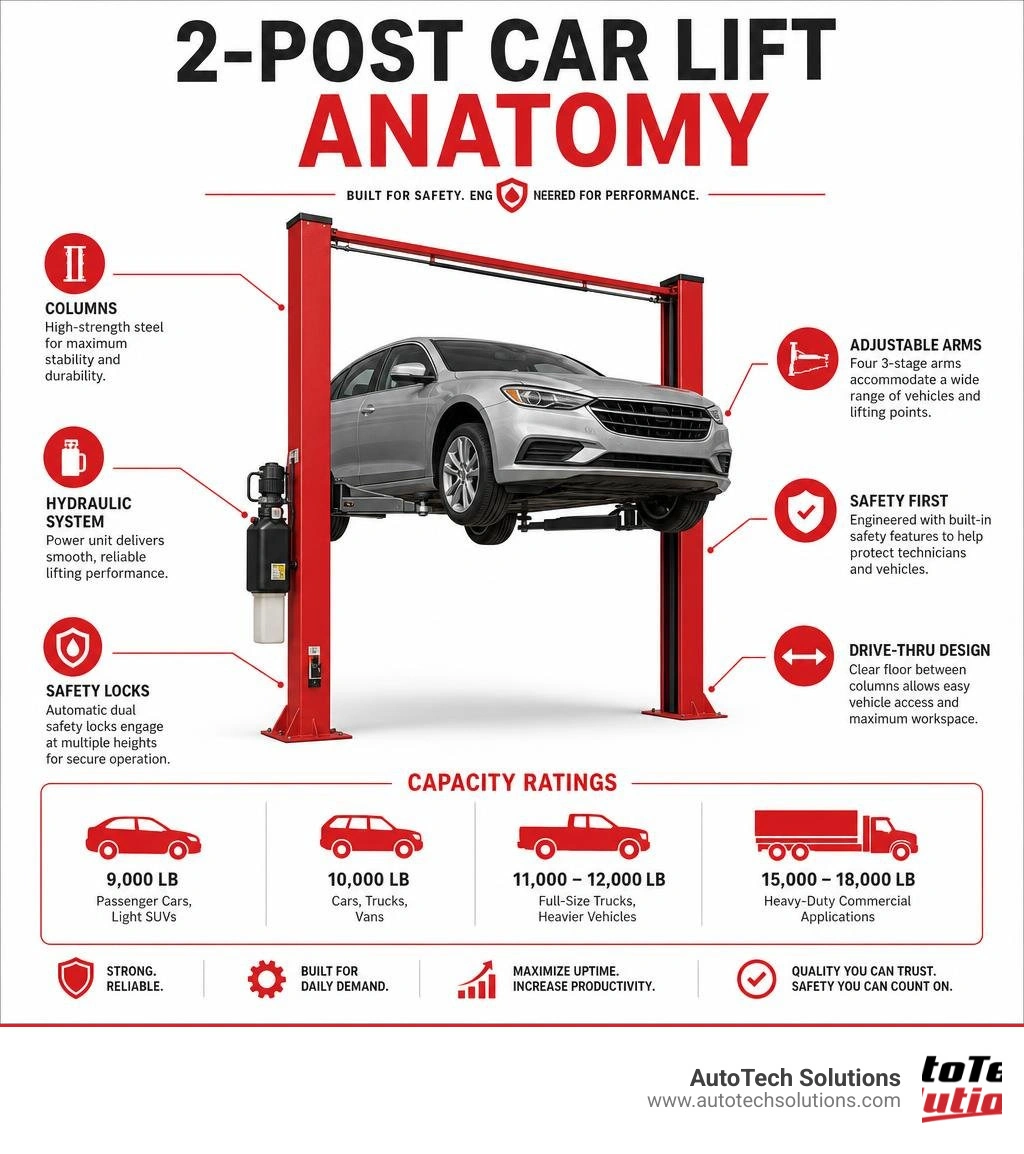
If you're evaluating a car lift 2 post for sale for your commercial automotive facility, here's a fast answer before we dive deeper:
Quick Comparison: 2-Post Lift Options by Capacity and Price
| Capacity | Typical Price Range | Best For |
|---|---|---|
| 9,000 lb | $1,900 – $2,920 | Fleet cars, light commercial SUVs |
| 10,000 lb | $2,000 – $7,600 | Standard fleet vehicles, work trucks, vans |
| 11,000 – 12,000 lb | $2,099 – $4,950 | Full-size commercial trucks, heavier fleet vehicles |
| 15,000 – 18,000 lb | $6,100 – $7,695 | Heavy-duty commercial applications |
Two-post lifts are the backbone of high-throughput automotive service operations. They support a vehicle on two columns, leaving the entire undercarriage exposed — which means faster service, better technician access, and more vehicles moved through the bay each day.
Unlike four-post lifts, a two-post design maximizes floor space and gives technicians unobstructed reach to suspension, exhaust, brakes, and drivetrain components. That matters when your shop's profitability depends on cycle time.
But not all two-post lifts are equal. Capacity, arm configuration, ALI certification status, concrete requirements, and column design all vary significantly across brands and price points. Choosing the wrong unit can mean compliance issues, technician safety risks, or costly downtime.
This roundup covers the key specs, brands, and decisions that commercial shop managers need to get right the first time.
Professional shop equipment resources:
Understanding 2-Post vs. 4-Post Lifts for Commercial Shops
When setting up a professional service bay, choosing between a 2-post and a 4-post lift is one of the most critical decisions we make. For commercial shops focusing on high vehicle throughput, wheel service, and rapid diagnostics, the 2-post lift is almost always the gold standard.
The primary advantage of a 2-post lift is unmatched undercarriage access. Because the vehicle is suspended by its frame lifting points, the wheels hang free. This makes brake jobs, suspension overhauls, tire rotations, and wheel bearing replacements exceptionally efficient. Technicians do not have to set up secondary rolling jacks just to get the tires off the ground, which is a common bottleneck when using 4-post lifts.
Additionally, 2-post lifts are highly space-efficient. They require a much smaller physical footprint in your service bay, allowing you to fit more revenue-generating work bays into the same square footage. For a comprehensive breakdown of how these systems compare across various commercial shop setups, consult our Ultimate Automotive Lifts Guide 2026.
| Feature | 2-Post Lifts | 4-Post Lifts |
|---|---|---|
| Undercarriage Access | Unobstructed; ideal for exhaust, transmission, and drivetrain work. | Partially obstructed by runways; best for quick oil changes. |
| Wheel Service | Wheels hang free automatically; ready for brake and suspension work. | Requires auxiliary rolling jacks to lift wheels off the runways. |
| Space Efficiency | Compact footprint; maximizes available bay space. | Large footprint; occupies significant floor space. |
| Loading Speed | Requires manual arm positioning at vehicle lifting points. | Fast drive-on loading; ideal for alignment and quick-lube bays. |
While 4-post lifts excel in alignment bays and quick-lube lanes where technicians drive straight onto runways, the versatile 2-post lift remains the undisputed champion for general mechanical repairs and heavy-duty component swaps.
Symmetrical vs. Asymmetrical Arm Designs
When searching for a car lift 2 post for sale, you will quickly encounter two primary arm configurations: symmetrical and asymmetrical. Understanding the physics of these designs is vital for protecting your technicians and the vehicles they service.
Symmetrical lifts feature columns that face each other directly. The lifting arms are of equal length, meaning the vehicle is positioned with its center of gravity directly in the middle of the columns. This design is highly reliable and is typically preferred for heavier, longer vehicles like commercial vans and dual-rear-wheel trucks. Symmetrical setups provide excellent drive-through clearance but can make opening vehicle doors difficult, as the columns sit right next to the front doors.
Asymmetrical lifts feature columns that are angled slightly backward (usually around 30 degrees), and the front lifting arms are shorter than the rear arms. This configuration shifts the vehicle’s center of gravity slightly rearward, placing about 60% of the weight behind the columns and 40% in front.
The main advantage here is door protection; because the columns are positioned further back relative to the vehicle, technicians can open car doors wider without hitting the steel columns, allowing easy access to the vehicle's interior.
To see how arm configurations impact overall workflow, check out our Automotive Shop Equipment Complete Guide. Choosing the right arm configuration depends entirely on the mix of light fleet vehicles versus heavy commercial trucks your facility services daily.
Key Factors to Consider When Browsing a Car Lift 2 Post for Sale
Investing in a commercial vehicle lift requires careful planning. You cannot simply purchase the first unit you find online and bolt it down. To ensure long-term reliability and compliance with local safety regulations, several structural factors must be evaluated.
First, lifting capacity must match your heaviest anticipated fleet vehicles. Second, the physical height of your shop’s ceiling must accommodate both the overall height of the lift columns and the maximum rise height of the vehicles you plan to service.
Finally, automatic safety locks are non-negotiable. Look for multi-position, gravity-engaged mechanical locks with single-point releases to ensure your technicians are safe while working beneath heavy loads. For an in-depth checklist on preparing your facility for a new hoist, see our Automotive Lift Installation Guide.
Selecting the Right Capacity for a Car Lift 2 Post for Sale
Selecting the correct capacity is not just about matching the total weight of a vehicle to the rating on the lift’s placard. Commercial shop managers must account for weight distribution, axle loads, and strict safety margins.
- The 75% Rule: Many industry experts and manufacturers recommend not exceeding 75% of a lift's rated capacity for daily operations. This built-in safety margin prevents premature wear on hydraulic seals, motors, and structural columns.
- Axle Weight Calculations: A vehicle might weigh 9,000 lbs overall, but if it has a heavy service body or is loaded with tools, one axle may carry 6,000 lbs while the other carries 3,000 lbs. Because each individual lift arm has its own weight limit (typically 25% of the total capacity), an unevenly distributed load can easily overload a single arm or column even if the total vehicle weight is within limits.
- Heavy-Duty Fleet Vehicles: If your facility regularly services Class 1 through Class 5 commercial vehicles, upgrading to an 11,000 lb, 12,000 lb, or even 15,000 lb symmetric hoist is essential.
For shops handling heavy fleet vehicles, utilizing auxiliary support tools such as professional-grade Heavy Duty Jacks (specifically high-capacity underhoist support stands, rather than retail bottle jacks) during heavy component removal (like transmissions or differentials) helps maintain vehicle balance on the lift.
Installation and Concrete Requirements for a Car Lift 2 Post for Sale
The foundation under your lift is quite literally the most critical safety feature of the entire system. A two-post lift exerts immense pulling and pushing forces on the concrete floor.
- Concrete Depth & Strength: Standard light-duty lifts (9,000 to 10,000 lbs) typically require a minimum concrete slab thickness of 4 to 6 inches, rated at 3,000 PSI or higher. However, heavier-duty commercial hoists (12,000 to 18,000 lbs) often require concrete depths exceeding 6 to 8 inches, with some industrial models requiring specialized foundations deeper than 12 inches (or 500 mm) to handle structural anchoring loads.
- Anchor Bolts: Anchor bolts must be driven to precise depths specified by the manufacturer. Using sub-standard anchors or installing them in cracked, uneven, or green concrete can lead to catastrophic anchor failure.
- Ceiling Clearance: You must ensure that your ceiling height allows for the full extension of the lift columns plus the height of the tallest vehicle you intend to lift. Clearfloor models require overhead clearance for the equalizer bar, while floor plate models run cables along the ground to accommodate lower ceilings.
Because of the high stakes involved in anchor placement and concrete testing, we highly recommend reading our Car Lift Installers Complete Guide to understand why certified professional installation is a necessity for commercial shops in the Carolinas and Michigan.
Top Professional-Grade 2-Post Lift Brands and Models
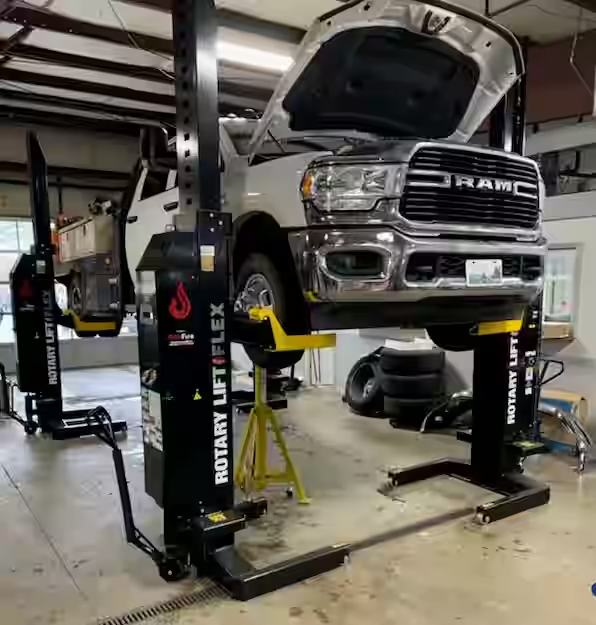
When it comes to selecting a reliable car lift 2 post for sale, choosing a brand with a proven track record for structural integrity and parts availability is paramount. In the commercial repair sector, several brands stand out for their engineering excellence and adherence to Automotive Lift Institute (ALI) standards.
- Rotary Lift: Known worldwide for inventing the hydraulic auto lift, Rotary’s SPOA10 is a legendary asymmetric model in the 10,000 lb class. Their Shockwave-equipped models feature rapid rise and descent times, significantly improving bay cycle times. Learn more about their professional line via Two-Post Car Lifts | Rotary Solutions.
- Challenger Lifts: Challenger's CL12 series offers 12,000 lbs of capacity with their patented Versymmetric technology, allowing technicians to service both symmetric and asymmetric vehicle configurations in the exact same bay.
- Forward Lift: A trusted brand since 1968, Forward Lift's I12PRO is a gold-certified, 12,000 lb capacity powerhouse featuring concealed hydraulic cylinders and spring-operated arm restraints that automatically disengage at floor level.
- Amgo Hydraulic & Triumph: These brands offer excellent value-driven options for shops looking for rugged, dependable performance. From the Amgo OH-9 (9,000 lb clearfloor) to the heavy-duty Amgo OH-18 (18,000 lb capacity), they provide robust, no-nonsense options for commercial fleets.
To explore our curated inventory of these top-tier brands, visit our dedicated 2 Post Car Lifts for Sale | AutoTech Solutions catalog.
Clearfloor vs. Floor Plate Configurations
As you shop for professional hoists, you will need to choose between clearfloor and floor plate configurations.
- Clearfloor Lifts: On a clearfloor lift, the hydraulic lines and steel equalizing cables run through an overhead bar connecting the two columns. This leaves the shop floor completely clear between the columns, allowing technicians to easily roll toolboxes, oil drains, transmission jacks, and utility carts underneath the vehicle. This is the preferred setup for modern commercial shops with ceilings of 11.5 feet or higher.
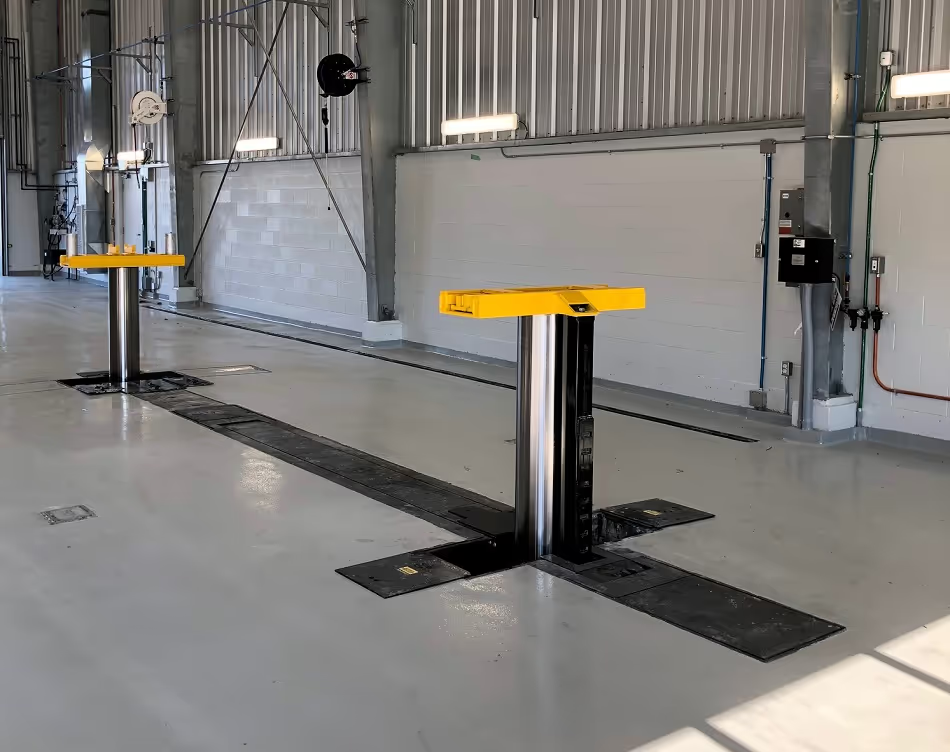
- Floor Plate Lifts: If your shop has low ceilings (typically under 11 feet), a floor plate lift is your best option. These models run the hydraulic hoses and cables along the floor beneath a low-profile steel cover plate. While this design accommodates lower overhead clearances, the floor plate creates a small speed bump that can make rolling heavy equipment like transmission jacks back and forth slightly more difficult.
For a deeper dive into low-ceiling solutions, read our guide on the 2 Post Floor Plate Car Lift.
Maintenance, Safety, and Warranty Protocols
A commercial car lift is a long-term capital investment. To protect your investment and ensure technician safety, your shop must implement strict preventative maintenance schedules.
- Daily Inspections: Technicians should perform quick daily checks to ensure arm restraints engage properly, hydraulic hoses show no signs of cracking or leaks, and safety locks click audibly into place as the lift rises.
- Cable Equalization: Steel cables ensure that both carriages rise at the exact same rate. Over time, these cables stretch and must be adjusted to prevent uneven lifting, which can destabilize the vehicle.
- Warranty Support: Major commercial manufacturers typically offer 1- to 3-year warranties on functional parts and 3- to 5-year structural warranties. When buying equipment, ensure you have access to local service representatives who can quickly provide OEM replacement parts to minimize downtime.
For detailed maintenance checklists and professional repair services, refer to our guides on Car Lift Maintenance and Two Post Lift Repair.
Frequently Asked Questions about 2-Post Lifts
What is the minimum concrete thickness required for a commercial 2-post lift?
For standard commercial 9,000 lb to 10,000 lb lifts, a minimum of 4 to 6 inches of reinforced, 3,000 PSI concrete is required. For heavier heavy-duty lifts (12,000 lbs to 18,000 lbs), manufacturers often specify a minimum depth of 6 to 8 inches, or even up to 20 inches (500 mm) of specialized pre-cast concrete foundations, along with heavy-duty M16 anchor bolts.
How often should a commercial 2-post lift be inspected?
According to ALI (Automotive Lift Institute) standards, professional vehicle lifts must undergo a comprehensive safety inspection by a certified lift inspector at least once a year. Additionally, shop owners should mandate daily visual inspections by technicians before operating the equipment.
What is the typical price range for a professional 2-post lift?
Commercial-grade 2-post lifts generally range from $2,000 for standard light-duty models to upwards of $7,500+ for heavy-duty, high-capacity, or rapid-cycle models. This price typically excludes professional installation, freight shipping, and concrete testing fees.
Conclusion
Investing in a high-quality car lift 2 post for sale is one of the most effective ways to boost your shop’s productivity, improve technician ergonomics, and increase your daily vehicle throughput. However, selecting the right equipment is only half the battle. To ensure safety, compliance, and zero operational downtime, you need a partner who can manage the entire lifecycle of your shop equipment.
At AutoTech Solutions, we are a true one-stop-shop for automotive equipment sales, professional installation, certified safety inspections, and rapid preventative maintenance. Serving commercial facilities from Michigan to the Carolinas — including our key locations in Novi, MI, Charlotte, NC, Raleigh, NC, and Wade, NC — we focus on minimizing your shop's downtime with expert support and fast repair response.
Don't leave your shop's safety and productivity to chance. Contact our team today to find the perfect professional lift for your facility.
- Find local sales and service: Car Lift Sales Near Me
- Optimize your entire service floor: Automotive Shop Equipment Complete Guide
- Browse our full commercial catalog: AutoTech Solutions Equipment Catalog