What Equipment Lifecycle Management Means for Automotive Facilities
Equipment lifecycle management for automotive facilities is the structured process of overseeing every piece of shop equipment — from the day it's purchased to the day it's retired — to maximize uptime, control costs, and keep technicians productive.
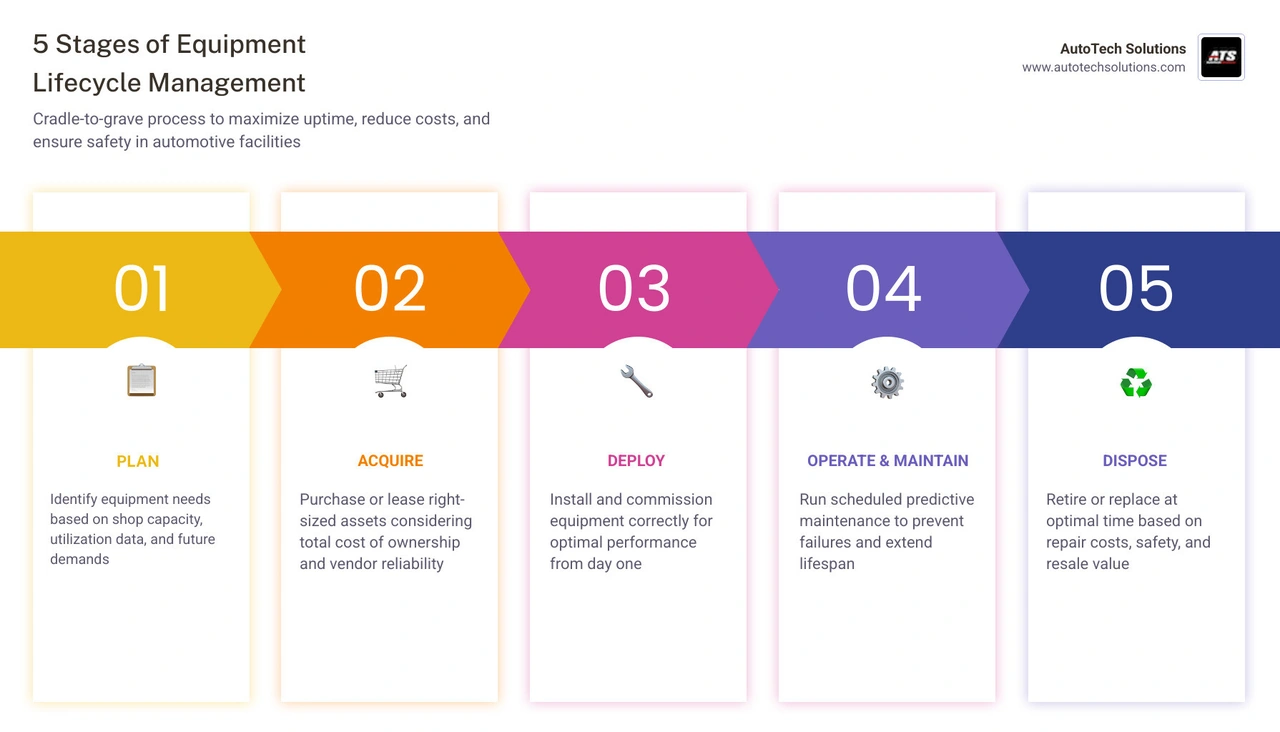
Here's a quick summary of what it covers:
- Plan - Identify what equipment you need and why, based on shop capacity and utilization data
- Acquire - Purchase or lease the right assets at the right time, with total cost of ownership in mind
- Deploy - Install and commission equipment correctly so it performs from day one
- Operate and Maintain - Run scheduled and predictive maintenance to prevent costly failures
- Dispose - Retire or replace assets at the optimal time to recover value and avoid safety risks
This approach is sometimes called "cradle to grave" asset management. The goal is simple: get the most value out of every piece of equipment while keeping your shop safe, compliant, and running at full capacity.
For automotive service, collision, and industrial facilities, this matters more than most industries realize. Equipment downtime doesn't just slow one technician — it can bring a bay, a department, or an entire operation to a halt. Research shows that organizations with structured equipment lifecycle management programs see up to a 30% reduction in maintenance costs and a 25% increase in equipment uptime. And running equipment to failure? That can cost 3 to 10 times more than a consistent maintenance program.
The stakes are high. But the path forward is clear.
The Strategic Importance of Equipment Lifecycle Management for Automotive Facilities
In the world of automotive service—whether you’re running a dealership in Novi, MI, or a collision center in Charlotte, NC—your equipment is your lifeline. We’ve seen how a broken lift or a malfunctioning compressor can throw a whole week’s schedule into chaos. That’s why equipment lifecycle management for automotive facilities isn't just a "nice-to-have" administrative task; it’s a strategic pillar for your business.
When we talk about ELM, we’re talking about moving away from the "if it ain't broke, don't fix it" mentality. That old-school approach is actually one of the most expensive ways to run a shop. Implementing a structured ELM practice can lead to a 30% reduction in maintenance costs, a 25% increase in equipment uptime, and a 20% extension in the actual lifespan of your machines.
At AutoTech Solutions, our goal is to help you hit those numbers. By following a Preventative Maintenance Service Guide, you aren't just checking boxes—you’re ensuring that your shop remains a high-output environment. Proper management ensures that Automotive Equipment Repair happens on your terms, not during your busiest rush.
Maximizing ROI through Proactive Asset Oversight
To truly maximize your Return on Investment (ROI), you have to look at the Total Cost of Ownership (TCO). The purchase price of a heavy-duty lift or an advanced alignment rack is just the tip of the iceberg. The real costs lie in energy consumption, technician productivity, and, most importantly, unplanned downtime.
Did you know that vehicle downtime alone can cost a facility up to $760 per day? When a critical piece of shop infrastructure goes down, the bill grows even faster. By using Asset Lifecycle Management (ALM) Software and Solutions | IBM or similar data-driven approaches, facilities have achieved a 47% reduction in unplanned downtime and a 17% increase in average asset lifespan.
We help you plan your capital expenditures so you aren't hit with a massive bill for three new compressors all at once. By tracking the age and health of your assets, we can help you stagger replacements and keep your budget stable.
Enhancing Shop Safety and Regulatory Compliance
Safety isn't just about avoiding accidents; it’s about liability and culture. In the automotive world, we live and die by ALI (Automotive Lift Institute) standards and OSHA requirements. A lift that hasn't been inspected isn't just a breakdown risk—it’s a legal one.
Understanding the Common Causes of Automotive Lift Downtime allows us to mitigate risks before they become injuries. For specialized environments like body shops, Collision Center Equipment Maintenance ensures that frame machines and paint booths remain compliant with environmental and safety regulations. Regular ELM audits prove that you are striving for the safest possible work environment, which improves employee morale and can even lower your insurance premiums.
The Five Critical Stages of the Equipment Lifecycle

Managing the lifecycle of your shop equipment is like taking care of a high-performance engine. You can't just floor it and hope for the best; you need a plan. According to the Asset Lifecycle Management for Fleet Operations: Practical Guide, breaking the process down into distinct stages is the only way to maintain control.
1. Planning: The Blueprint for Success
Before you spend a single dollar, you need to know why you’re buying. Are you expanding your service capacity in Raleigh, NC? Or are you replacing an aging unit that’s costing too much in repairs? Planning involves auditing your current inventory and identifying gaps.
2. Acquisition: Buying Smarter
This stage is where you weigh the TCO against the initial price. It’s also a great time to consider Vendor Consolidation for Dealership Equipment Service. By working with a single partner like AutoTech Solutions for your sales and service, you streamline your communication and often secure better long-term support.
3. Deployment: Starting on the Right Foot
Installation is more than just bolting a lift to the floor. It involves calibration, technician training, and integrating the asset into your maintenance tracking system. If it’s not deployed correctly, you’re setting yourself up for premature failure.
4. Operation and Maintenance: The Long Haul
This is the longest stage of the lifecycle. Here, the focus shifts to maximizing uptime. We advocate for a mix of preventative and predictive maintenance to ensure your shop stays profitable.
5. Disposal: Knowing When to Let Go
Every piece of equipment has an "economic cliff"—the point where it costs more to keep than it would to replace. ELM gives you the data to see that cliff coming so you can retire the asset while it still has some resale value.
Data-Driven Acquisition and Planning
"Right-sizing" your inventory is a term we use a lot. It means having exactly the equipment you need—no more, no less. If you have five alignment racks but two of them sit idle 40% of the time, you’re wasting floor space and capital.
By performing utilization audits, we can help you decide if you should reallocate resources or consolidate your fleet of equipment. Using data to drive procurement means you aren't guessing; you’re investing.
Optimizing Operation and Maintenance in Equipment Lifecycle Management for Automotive Facilities
The heart of ELM is moving from reactive to proactive. Reactive maintenance is the "fire drill"—everything stops because a hose blew. Proactive maintenance is the "scheduled pit stop."
| Maintenance Type | Cost Factor | Impact on Productivity | Lifespan Impact |
|---|---|---|---|
| Reactive | 3x to 10x higher | High (Unplanned stops) | Shortens equipment life |
| Proactive | Predictable/Lower | Low (Scheduled downtime) | Extends life by 20%+ |
By following Preventative Maintenance Programs, you can catch small issues before they become catastrophes. Our Automotive Shop Equipment Repair Guide highlights how simple tasks like lubrication and bolt tightening can prevent the most common shop failures.
Advanced Strategies for Extending Equipment Lifespan
If you want to stay ahead of the curve in Michigan or the Carolinas, you have to look at technology. The "Internet of Things" (IoT) isn't just for smart fridges; it’s revolutionizing the automotive shop. IoT sensors can now monitor the vibration of a compressor motor or the cycle counts of a lift, alerting you to potential failures before they happen.
Leveraging Technology for Equipment Lifecycle Management for Automotive Facilities
Modern Maintenance Tracking and Asset Management systems allow us to see the health of your shop in real-time. For dealer groups with locations across multiple cities, Managing Shop Equipment Maintenance Across Multiple Locations becomes much easier with a centralized digital platform.
We can provide Centralized Equipment Service Coordination for Dealer Groups, giving management a "bird’s eye view" of every asset in every shop. This level of transparency means you can spot trends—like a specific brand of equipment failing prematurely in one region—and adjust your future buying strategy accordingly.
Another high-tech area is fluid management. Systems like Graco Matrix or Pulse Pro provide automated tracking of every drop of oil, coolant, and windshield wash. This prevents waste, ensures accurate billing, and monitors tank levels so you never run out of critical supplies during a busy shift.
Implementing a Breakdown Response Plan
Even with the best ELM, parts eventually wear out. The difference between a minor inconvenience and a total shutdown is your response plan.
A solid Breakdown Response Plan for Critical Shop Equipment includes:
- Redundancy: Having backup equipment or "swing" bays available.
- Priority Service: Knowing exactly who to call for a 24-hour response.
- Training: Ensuring your technicians know how to safely shut down and tag out failed equipment.
At AutoTech Solutions, we pride ourselves on being that "emergency contact" for shops from Novi to Wade. Our fast repair response is designed to get your lifecycle back on track as quickly as possible.
Measuring Success: KPIs for Equipment Lifecycle Management for Automotive Facilities
You can't manage what you don't measure. To see if your equipment lifecycle management for automotive facilities is actually working, you need to track Key Performance Indicators (KPIs).
- Mean Time Between Failures (MTBF): How long does your equipment typically run before needing a repair? If this number is shrinking, your maintenance program needs an upgrade.
- Asset Uptime Percentage: The goal is 95% or higher. If a lift is down two weeks out of the year, that’s a significant hit to your bottom line.
- Maintenance Cost per Operating Hour: This helps you see when an asset is becoming a "money pit."
- Depreciation Tracking: Understanding the book value versus the actual utility of the asset.
Using an Equipment Industry Management Software Solution | Annata can help automate these metrics, giving you a dashboard that shows exactly how your shop is performing.
Frequently Asked Questions about Automotive ELM
How does ELM differ for shop equipment versus vehicle fleets?
While both involve maintenance and disposal, shop equipment is "fixed infrastructure." This means installation is more complex (involving concrete, electrical, and air lines), and the equipment often has a much longer lifespan than a vehicle. Calibration is also more critical for shop tools like alignment racks or tire balancers, as they directly impact the quality of the service provided.
What are the most common pitfalls in equipment management?
The "run-to-fail" mentality is the biggest one. Others include poor documentation (losing track of warranties), ignoring the Total Cost of Ownership by only looking at the sticker price, and having a fragmented vendor list where no one takes full responsibility for the shop's health.
When is the optimal time to dispose of or replace shop equipment?
The "sweet spot" is usually right before the cost of an upcoming major repair exceeds 50% of the asset's remaining value, or when the downtime frequency begins to frustrate your technicians and drive away customers. Safety obsolescence is also a major factor—if a lift no longer meets modern ALI standards, it’s time for it to go, regardless of if it still "works."
Conclusion
Strategic asset management is the secret weapon of the most successful automotive facilities. By treating your equipment as a lifecycle rather than a series of one-off purchases and repairs, you unlock a level of operational excellence that your competitors simply can't match.
From the initial planning stages to the final disposal, every step you take to improve your equipment lifecycle management for automotive facilities puts money back in your pocket and keeps your team safe. At AutoTech Solutions, we’re here to be your partner in that journey. Whether you need a new installation in Charlotte or a preventative maintenance plan in Novi, we have the expertise to keep your shop moving.
Ready to take control of your equipment's future? Explore our Service, Repair, and Equipment Support today and let’s build a more productive shop together.